...


By John Feng and Nick Mordowanec
0
Share
Newsweek is a Trust Project member
See more of our trusted coverage when you search.Prefer Newsweek on Googleto see more of our trusted coverage when you search.
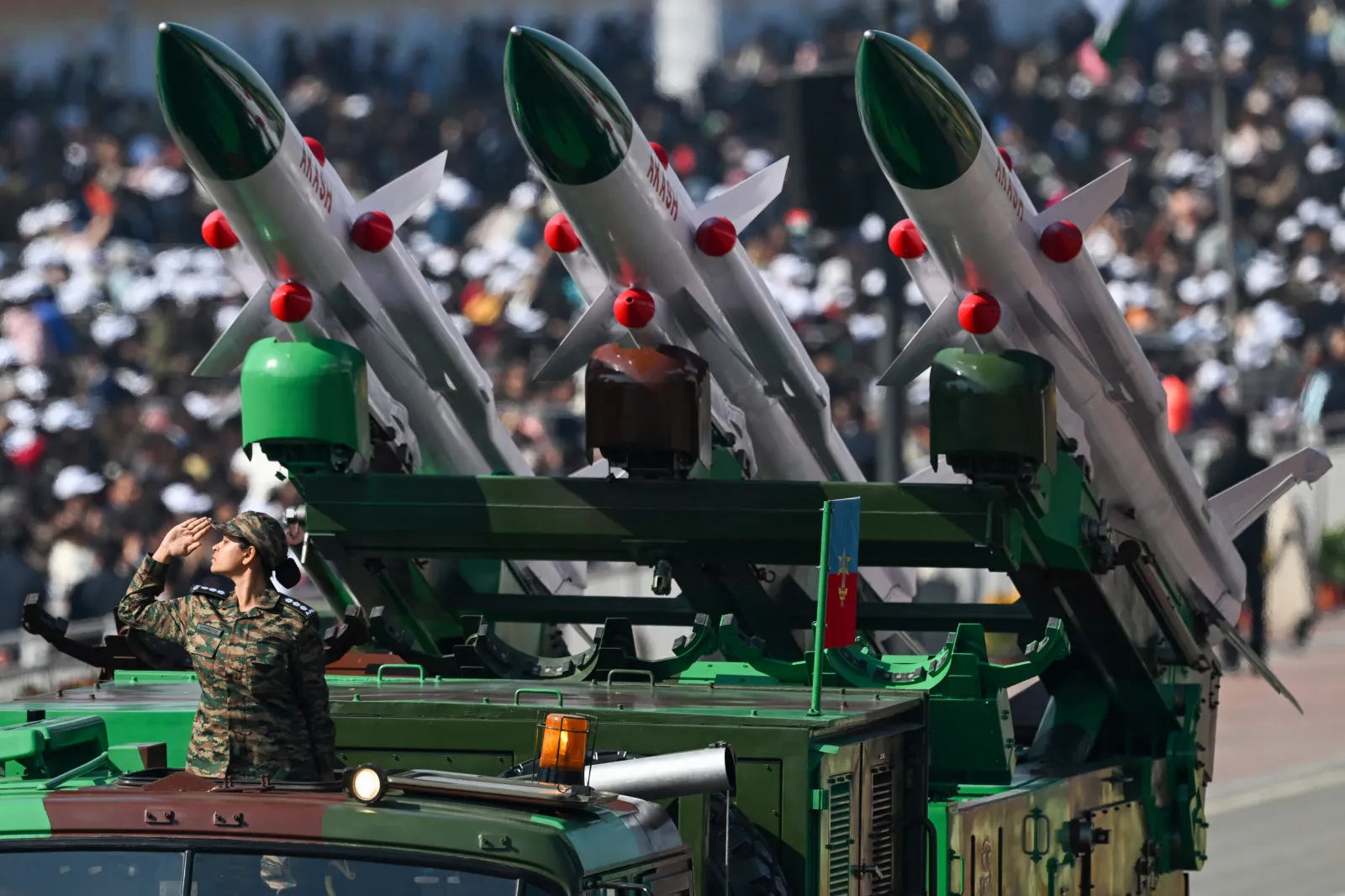
India has been a nuclear power for over 50 years, possessing an arsenal that is publicly clandestine but capable in warfare—notably against its neighboring country, Pakistan, amid their decades-long clash over Kashmir.
Why It Matters
Last week, animosities reignited after Islamist militants shot and killed 26 people in Pahalgam, in the India-administered stretch of the disputed Jammu and Kashmir region.
Read More on World
Harsh rhetoric erupted out of Hindu-majority India and Muslim-majority Pakistan, two nations that have been aggressive toward one another—largely due to laying claim over the Kashmir region—since both achieved independence from Great Britain in 1947.
On Wednesday, Pakistan said it had "credible intelligence" that India intends to carry out military action against it in the "next 24-36 hours on the pretext of baseless and concocted allegations of involvement in the Pahalgam incident," Reuters reported.
What To Know
India first tested its nuclear weapons in 1974, becoming the sixth country to detonate a nuclear weapon. The arsenal ranges from 10 to 40 kilotons, though exact numbers remain unknown, according to The Center for Arms Control and Non-Proliferation.
While the exact number of nuclear weapons has never been made fully public by India, the nation's stockpile was estimated to be 160 nuclear warheads in 2022, according to the Nuclear Information Project with the Federation of American Scientists.
...
They said that India at that time produced enough military plutonium, approximately 700 kilograms, for 140 to 210 nuclear warheads—data which has been supported by the International Panel on Fissile Materials.
India can deliver approximately 48 nuclear warheads via the aging Mirage 2000H/I, Jaguar IS/IB and potentially the French-made Rafale aircraft, according to the Nuclear Information Project—the first two of which were deployed in the early 1980s and have ranges of 1,850 and 1,600 kilometers, respectively. The Rafale has a range of about 2,000 kilometers.
There were 64 land-based missiles as of 2022.
"In a nuclear exchange, which we certainly hope does not happen, India has a huge advantage because Pakistan's population centers are within reach of Indian aircraft and ballistic missiles—and many Indian population centers are difficult to hit from Pakistan," John Erath, senior policy director at the nonprofit Center for Arms Control and Non-Proliferation, told Newsweek.
He added: "The real—I hate to use the phrase center of gravity—but the focal point of the Pakistani state is in Punjab, and that's very close to the Indian border. So Indian aircraft...could reach those centers of Pakistani identity relatively easily."
Erath said that Indian nuclear policy has been relatively consistent in that they don't want to use such weapons as a deterrent, either against Pakistan or China—the latter of which has been involved in border disputes with India every few years, where some shots have been fired but no major warfare has occurred.
"China has an extensive and growing number of nuclear weapons, and this makes the Indians very nervous that one of these border states could spiral out of control and lead to a nuclear response," he said. "China has a 'no first use' policy on its nuclear weapons, but that's increasingly difficult to believe."
What People Are Saying
U.S. State Department Spokesperson Tammy Bruce stated: "The United States stands with India, strongly condemns all acts of terrorism. We pray for the lives of those lost and for the recovery of the injured and call for the perpetrators of this heinous act to be brought to justice."
U.S. Vice President JD Vance said: "Growing relations between our countries over the last decade are part of what led America to designate India a Major Defense Partner — the first of that class."
Chinese Foreign Ministry spokesperson Guo Jiakun: "We strongly condemn the attack. China firmly opposes all forms of terrorism. We mourn for the lives lost and express sincere sympathies to the bereaved families and the injured."
What Happens Next
Nuclear provocations will be the major goal for diplomacy from the perspective of the United States, whose leaders have offered full-throated support to India due to decades of allyship. The situation's outcome will not just impact South Asia but could also reshape global security, particularly with China's growing influence in the region.
View 0 Comments
Submit Correction
View Editorial & AI Guidelines