...
0
Share
Newsweek is a Trust Project member
See more of our trusted coverage when you search.Prefer Newsweek on Googleto see more of our trusted coverage when you search.
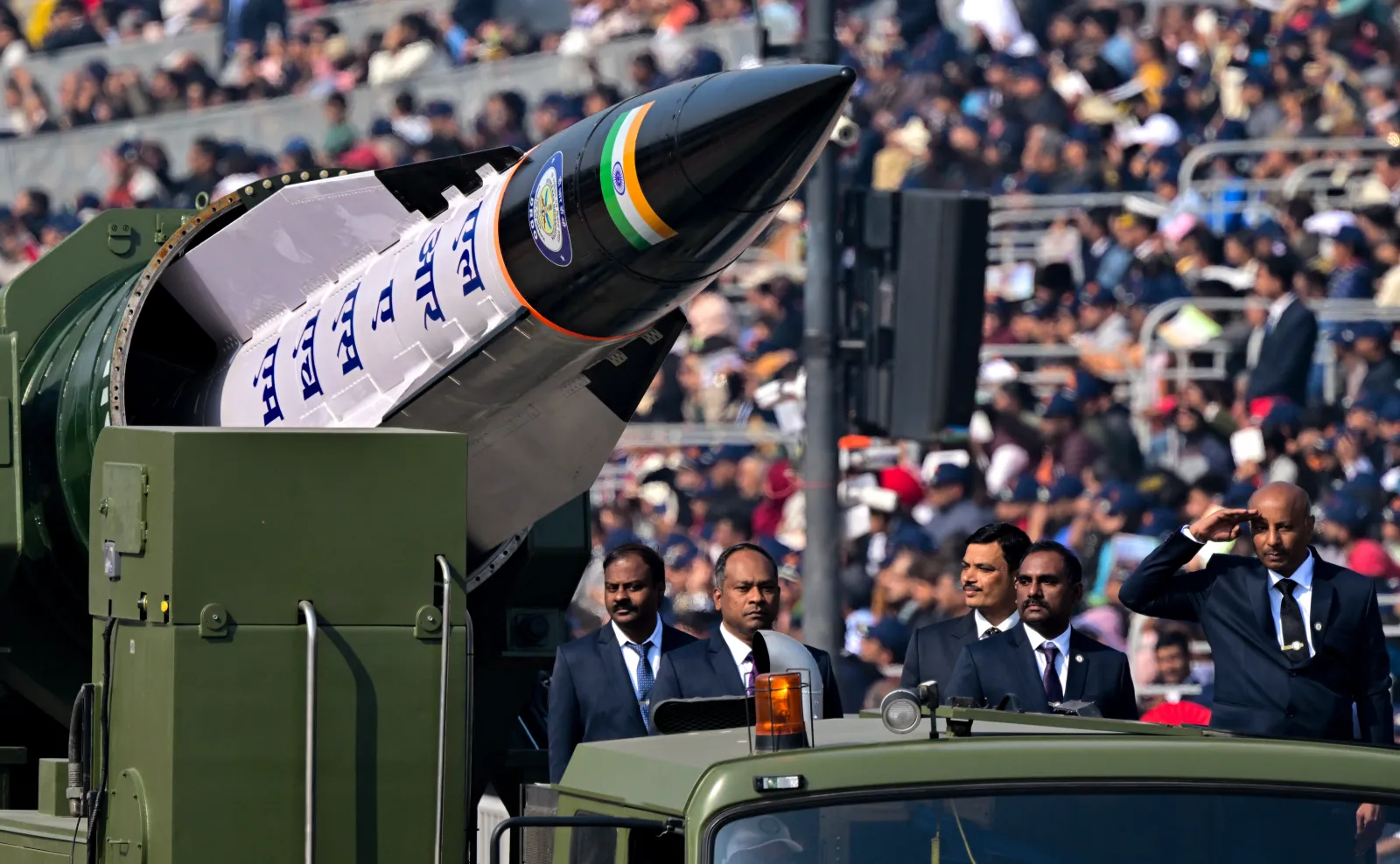
India debuted its first hypersonic missile on Monday, cementing its position in an elite club of states that possess the capability.
Newsweek has contacted India's Defense Ministry for comment by email.
Why It Matters
The unveiling of the Long-Range Anti-Ship Missile (LR-AShM) also marks another milestone for India's largely indigenous missile force after the introduction of the short-range hypersonic BM-04 last year.
Read More on World
The South Asian country is mulling an integrated missile arsenal to counter the People's Liberation Army Rocket Force amid a territorial dispute with strategic rival China and long-running tensions with archfoe Pakistan. That branch, along with a fast-growing navy, has significantly expanded Beijing's strategic reach in the Asia-Pacific.
Hypersonic missiles travel at least Mach 5, or five times the speed of sound, and can execute sharp maneuvers in their terminal phase, making them extremely difficult for existing defense systems to detect, track or intercept.
What To Know
Developed by the government-run Defense Research and Development Organization, the LR-AShM is "designed to meet the coastal battery requirements of the Indian Navy." It is "capable of engaging static and moving targets and is designed to carry various payloads," India's Defence Ministry said in a statement.
...
It made its first public appearance on its mobile launcher along with a wide array of other military hardware at New Delhi's Kartavya Path during the Republic Day parade marking the 77th anniversary of the country's constitution.
The missile is said to have a range of 1,500 kilometers (932 miles) and maximum speed of Mach 10, maintaining an average speed of Mach 5 through "skips" throughout the flight, state media outlet DD News reported.
It uses a two-stage boost-glide system in which rocket boosters accelerate the missile to speed. After the boosters burn out and separate, a hypersonic glide vehicle carries out maneuvers as needed to reach its target.
The LR-AShM's speed, maneuverability and low-altitude flight profile make it difficult for ship- or ground-based radar to detect until it's too late.
What People Are Saying
India's Ministry of Defense wrote on social media: "The system, designed to meet the coastal battery requirements of the Indian Navy, is a Hypersonic Glide Missile capable of engaging static and moving targets and is designed to carry various payloads."
Debak Das, a professor of peace and security at the University of Denver, told Defense News: "India is still a ways away from being at parity with China along some of these vectors of conventional strength. So until we see ideas like the IRF [Integrated Rocket Force] mature, it is difficult to say if they will be effective in keeping peace."
What Happens Next
The race for these lethal weapons is well underway. China already boasts by far the largest arsenal of hypersonic weapons, including Dongfeng-17 medium-range missiles and the YJ-20 anti-ship missiles introduced during Beijing's "Victory Day" parade in September.
Russia continues to deploy and develop hypersonic systems, and North Korea and Iran also claim to have tested missiles that can be fitted with glide vehicles. Meanwhile, the United States and Japan are pushing ahead with their own hypersonic programs.
In a polarized era, the center is dismissed as bland. At Newsweek, ours is different: The Courageous Center—it's not "both sides," it's sharp, challenging and alive with ideas. We follow facts, not factions. If that sounds like the kind of journalism you want to see thrive, we need you.
When you become a Newsweek Member, you support a mission to keep the center strong and vibrant. Members enjoy: Ad-free browsing, exclusive content and editor conversations. Help keep the center courageous. Join today.


View 0 Comments
Submit Correction
View Editorial & AI Guidelines