...

By Anna Skinner
Associate News Editor
0
Share
Newsweek is a Trust Project member
See more of our trusted coverage when you search.Prefer Newsweek on Googleto see more of our trusted coverage when you search.
Millions of Americans and Canadians will have a chance to see the International Space Station (ISS) on Thursday night as it cuts a path across North America.
Why It Matters
The ISS orbits Earth and houses astronauts and a research laboratory for experiments in microgravity. The ISS is maintained by NASA, Roscosmos, the European Space Agency, the Japan Aerospace Exploration Agency and the Canadian Space Agency. It travels at about 17,500 mph and completes an orbit around Earth every 90 minutes.
Read More on News
What To Know
At times, the ISS is visible from the U.S. as it orbits Earth. The next chance Americans will have at sighting the space station will be Thursday night as it cuts from Northwest Canada through parts of the Northeastern U.S. in a span of a few minutes.
"The International Space Station is visible because it reflects sunlight—the same reason we can see the Moon," a NASA webpage about the ISS says. "However, unlike the Moon, the space station is not bright enough to see during the day. Viewing opportunities can range from one a month to several a week as the light from the Sun reflects off station as it passes overhead at dawn and dusk at the user's preferred location."
No equipment will be needed to view the ISS as it passes over the U.S., as it is visible to the naked eye. Millions of Americans outside the ISS' direct path also will have a chance to see it.
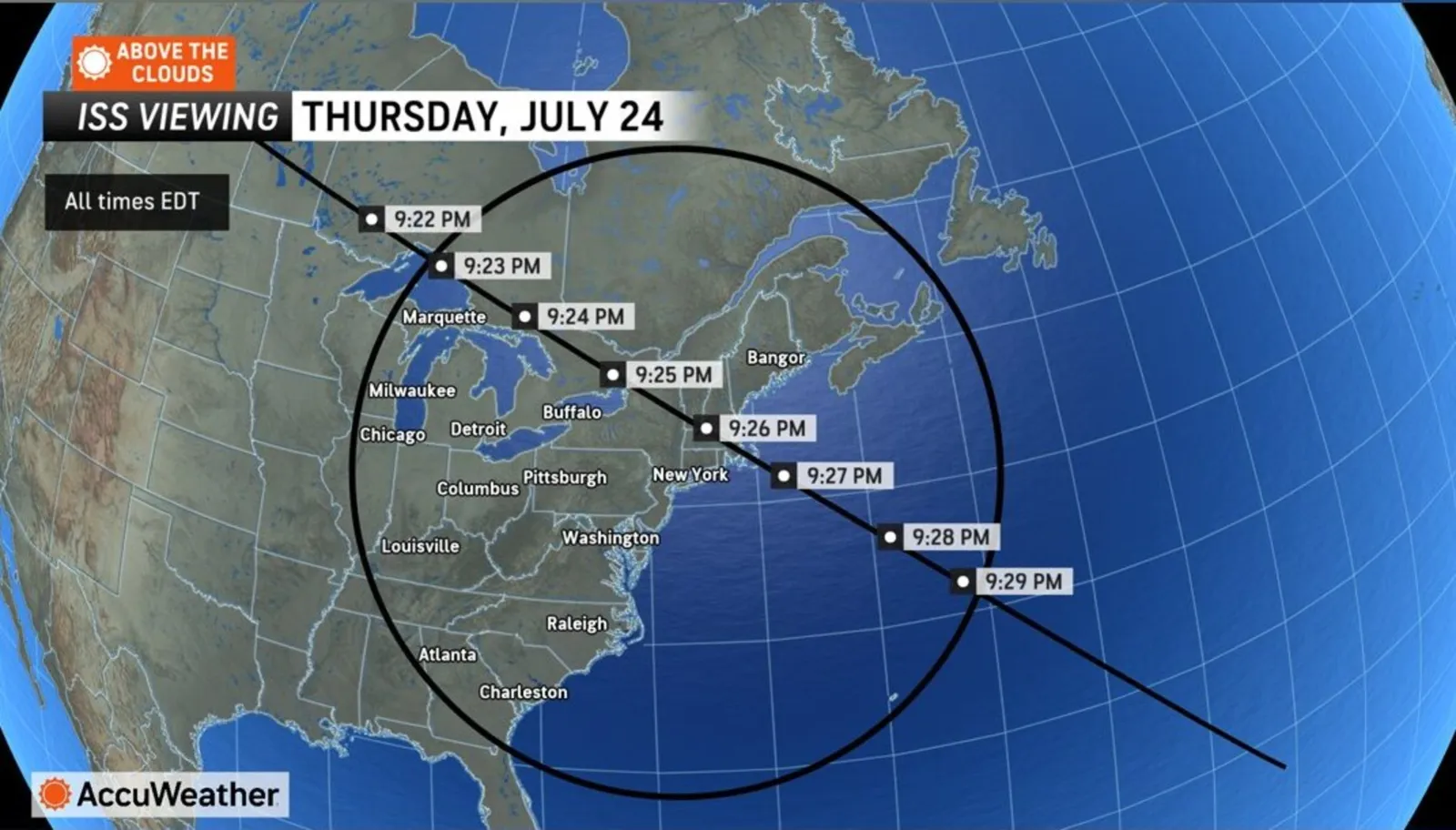
A map from AccuWeather shows the planned path of the ISS. Shortly after 9:25 p.m. ET, the ISS will travel from Canada into New York, where it will continue its southeastern path for hardly more than a minute before it exits over the Atlantic Ocean.
...
The timeline is as follows:
- 9:22-9:25 p.m. ET: The ISS will be traveling southeast over Ontario, Canada.
- 9:25-9:26 p.m. ET: The ISS will travel over Northern New York, Southern Vermont, far Southwestern New Hampshire and through Massachusetts to exit over the Atlantic Ocean.
- 9:27-9:29 p.m. ET: The ISS will continue its path over the Atlantic Ocean.
Anyone within the viewing circle will be able to see the space station if weather conditions are right, meaning millions as far south as Georgia up through Maine and Michigan will have a chance at spotting the ISS.
The ISS is bright enough that people can spot it even in large cities with light pollution. However, cloudy conditions could disrupt the viewing in some areas.
"It looks like there could be some clouds on the western side of that near the Great Lakes, so Wisconsin, Michigan...and the Toronto area," AccuWeather meteorologist Alex DaSilva told Newsweek. "Those areas I'm a little worried there could be some clouds in the way."
People further east in Southeastern Ohio, Pennsylvania and Western New York will have the best chance to view the ISS.
All ISS viewings occur a few hours before or after sunrise or sunset.
The ISS includes six sleeping areas, two bathrooms, a gym and a 360-degree-view bay window, NASA says in a webpage. It orbits earth 16 times in 24 hours, "traveling through 16 sunrises and sunsets."
What People Are Saying
AccuWeather posted on X on Thursday morning: "The International Space Station [ISS] will fly over the eastern United States and parts of Canada just after sunset on Thursday evening, an easy-to-see event for millions of residents across the region."
NASA in a webpage about the ISS: "The acre of solar panels that power the station means sometimes you can look up in the sky at dawn or dusk and see the spaceship flying over your home, even if you live in a big city."
What Happens Next
NASA suggests people who want a chance to view the ISS when it passes over the U.S. to download Spot the Station, a mobile app that notifies users about potential ISS viewings.
View 0 Comments
Submit Correction
View Editorial & AI Guidelines