
...

By Ellie Cook
Senior Defense Reporter
0
Share
Newsweek is a Trust Project member
See more of our trusted coverage when you search.Prefer Newsweek on Googleto see more of our trusted coverage when you search.
Talks between Iran and Oman over control of the Strait of Hormuz are ongoing, according to Tehran, after President Donald Trump threatened to "blow up" the United States ally if traffic cannot pass freely through the vital waterway.
Tehran and Muscat have met repeatedly, and discussions are "well underway" on control of the Strait of Hormuz, Iran's IRNA state news agency reported on Monday, citing Iranian Foreign Ministry spokesperson Esmaeil Baqaei.
The U.S. says the strait, which has been effectively blockaded by Tehran for three months, must be open to all international shipping and not subject to Iranian control.
Read More on World
Washington has rejected the idea of a toll system that would benefit Iran, slapping sanctions on Iran's newly created Persian Gulf Strait Authority, which Tehran said would control shipping in the strait. It has also threatened sanctions on those paying Iran for safe travel through the waterway.
...
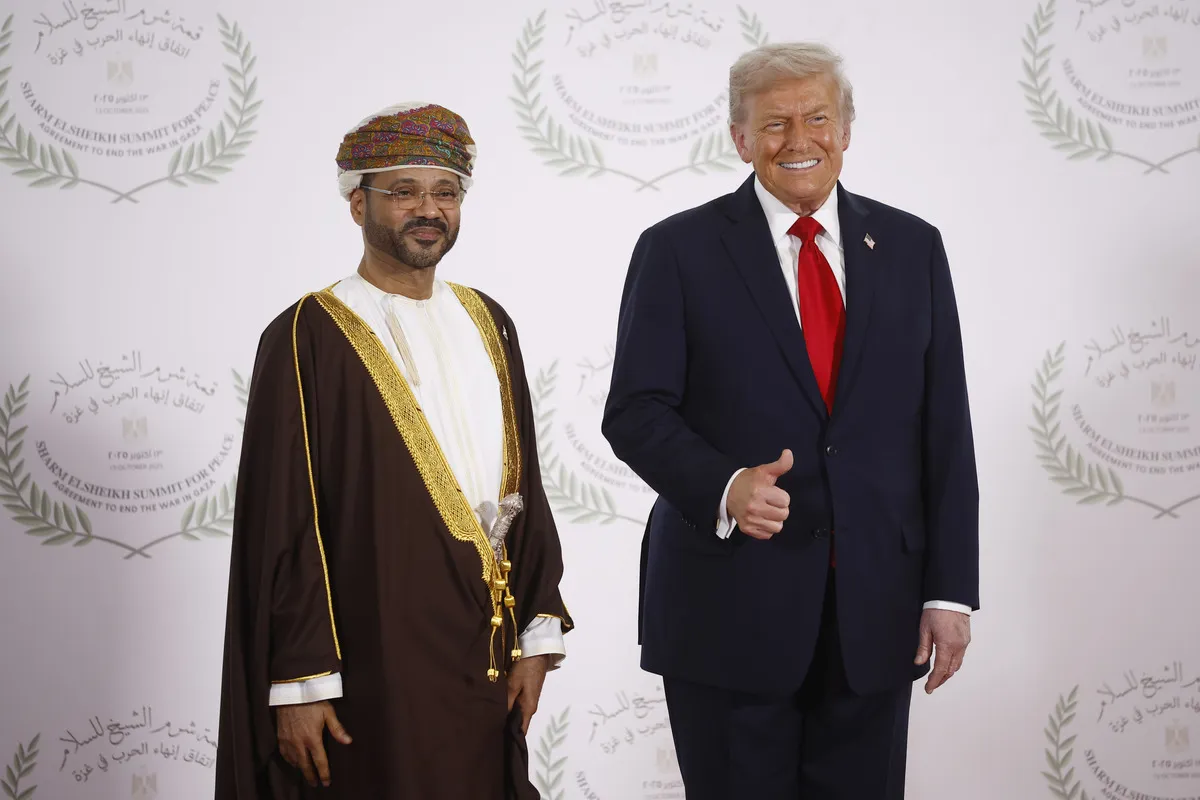
Trump on Wednesday said Oman "will behave like everybody else or we’ll have to blow them up," while U.S. Treasury Secretary Scott Bessent said over the weekend he had been assured by an Omani official that Muscat would not collect fees from ships in the waterway.
Oman, which says it is committed to safe passage and freedom for vessels to travel through the strait, is a longstanding U.S. ally that allows American troops to use its military bases. Iran targeted the Gulf state in the early stages of the war between Iran, the U.S. and Israel from February 28.
But the U.S. is under increasing pressure to reopen the strait and get maritime traffic moving after months of yo-yoing fuel prices, supply chain pressures and concerns about food access for millions of people.
A fifth of the world's oil and gas usually travels through the strait, along with a third of global seaborne fertilizer supplies, which are key to ensuring enough crops can be grown to feed famine-vulnerable areas, including the Horn of Africa and the Sahel.
The long weeks of blockages left more than 1,500 ships stranded and sent fuel prices soaring. Traffic is still far below prewar levels, and Iran has resisted loosening its grip on the strait, despite the U.S.'s own competing blockade on Iranian ports.
Iran Halts US Talks Over Israel's Lebanon Strikes: State Media
Iran’s negotiating team has paused indirect talks with the United States, citing Israel’s continued military campaign against Hezbollah in Lebanon and what Tehran describes as broader breaches of the U.S.-Iran ceasefire, according to the Tasnim news agency.
Tasnim, which maintains close ties to Iran’s Islamic Revolutionary Guard Corps (IRGC), reported that Tehran would stop negotiations and message exchanges through intermediaries over what it called the “continuation of the Zionist regime’s crimes in Lebanon.”
Iranian officials have previously said the ceasefire framework covers developments in Lebanon and that the agreement is under strain “on all fronts” due to Israel’s actions.
Iran Tells Oman Not To 'Give In' to US
Iranian Deputy Foreign Minister Kazem Gharibabadi said on Monday that only Iran and Oman had the right to "exercise sovereignty" in the strait, adding that Muscat should "not give in" to U.S. threats.
Omani Foreign Minister Badr Albusaidi hosted Iran's top diplomat, Abbas Araghchi, in the Omani capital last week. Muscat said the delegations discussed restoring ship traffic in the strait in "a safe and sustainable manner" and considered "a set of principles."
But progress toward a deal to resume normal traffic levels in the Strait of Hormuz is still slow, and Iran's military said on Monday that 15 ships had passed through the strait with Iranian permission in the previous 24 hours. This falls far short of the more than 130 vessels that would travel through the waterway each day before the war.
"Commercial vessels and tankers in the Persian Gulf and the Strait of Hormuz are warned that any cooperation with hostile forces beyond the region will be recognized as an imminent security threat and will be dealt with accordingly," Iran's Islamic Revolutionary Guard Corps (IRGC), a powerful branch of the Iranian military, said in a statement carried by the country's semiofficial Fars news agency.
Trump said in the early hours of Monday, Iran "really wants to make a deal, and it will be a good one for the U.S.A. and those that are with us."
He slammed what he termed negative "chirping," and hit back at critics, saying negotiations were moving slowly.
"Just sit back and relax, it will all work out well in the end," he said in a post to his Truth Social platform. Baqaei said hours later that Iran was receiving "contradictory" messages from U.S. officials.
Baqaei separately said there had "been no negotiations at this stage on the details of the nuclear issue," contradicting a Sunday remark from Trump that insisted "most of the agreement" on the table focused on Iran's nuclear program.
The U.S. has long said Iran is not allowed to have a nuclear weapon, while Tehran insists its nuclear program is peaceful and designed to support its civilian power generation.
The United Nations' nuclear watchdog, the International Atomic Energy Agency (IAEA), said that by mid-2025, Iran had enriched roughly 440 kilograms of uranium to 60 percent, which is close to weapons-grade 90 percent. From there, it's a short scientific jump to making a nuclear bomb.
It's generally accepted that uranium enriched to 3.67 percent works for civilian reactors.

...
Fresh Strikes Amid Ceasefire
The U.S. military confirmed on Monday that Iran had shot down an MQ-1 drone over the weekend and said the U.S. had responded by targeting Iranian air defenses, a ground control station and two drones in "self-defense" strikes on mainland Iran and the strategic island of Qeshm in the Strait of Hormuz.
The U.S. Central Command (CENTCOM), which oversees American forces in the Middle East, then said that U.S. troops intercepted two ballistic missiles launched by Iran at U.S. bases in Kuwait overnight. Kuwait's military said it was intercepting drone and missile attacks.
The IRGC had said it had targeted a U.S. airbase responsible for coordinating an attack on an Iranian island southwest of Qeshm.
Despite a ceasefire that has been in place since April 8, the U.S. and Iran have traded occasional strikes. The U.S. last week launched attacks on southern Iran, and Tehran attacked a U.S. facility in Kuwait.
View 0 Comments
Submit Correction
View Editorial & AI Guidelines