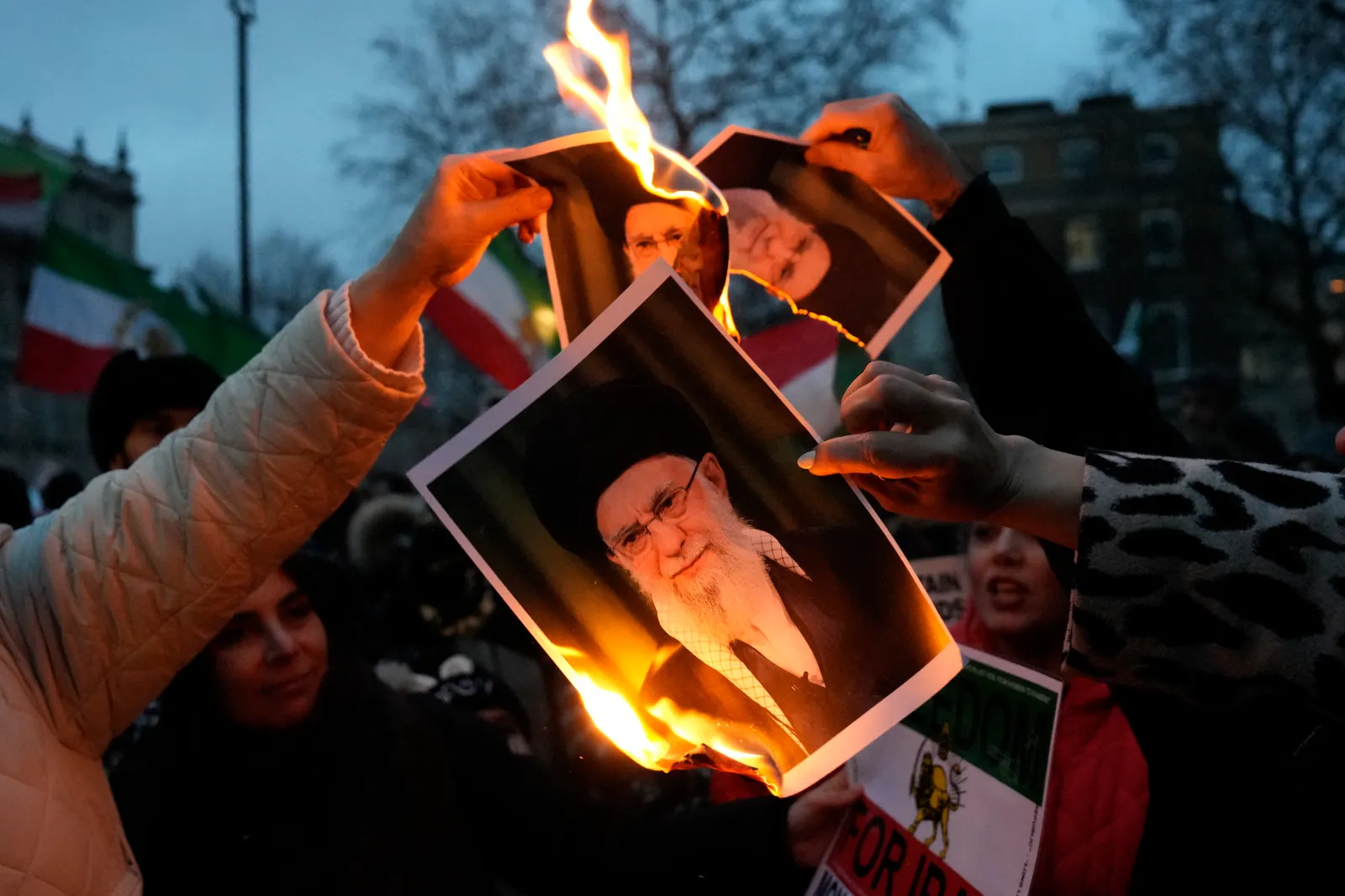
...

By Sonal Nain
Newsletter Reporter/Producer
0
Share
Newsweek is a Trust Project member
See more of our trusted coverage when you search.Prefer Newsweek on Googleto see more of our trusted coverage when you search.
“The combination of distance, responsibility, and powerlessness can be overwhelming and debilitating,” says Heather Barahmand, 40, a first-generation Iranian-American, watching Iran's protests unfold from Chicago.
“Intergenerational trauma and survivor’s guilt are very real and very raw in these moments,” she adds.
With Iran’s protests now stretching into a fourth week, those watching from abroad told Newsweek they feel a mix of grief, anger and profound helplessness.
Read More on World
The protesters who swamped city streets across Iran have posed the biggest challenge to the Islamic Republic since the 1979 revolution and the authorities have responded with a bloody crackdown. At least 3,941 people have died, according to U.S.-based activists quoted by the Associated Press, but that toll is expected to rise as information is leaking slowly due to a government-imposed internet shutdown.
...
Newsweek contacted Iran’s Ministry of Foreign Affairs via email for comment. Supreme Leader Ali Khamenei has said Iran must break the back of what he has called "seditionists" and that "criminals" will be punished. Authorities have acknowledged the economic difficulties that sparked the protests, but have accused some of those on the streets of being "terrorists" and said U.S. President Donald Trump has fanned the flames of disorder.
“Today, I look at Iran, and I don't just see a political crisis, I see a humanitarian catastrophe created by this regime,” says Shahrzad Rafati, Tehran-raised CEO, who moved to Vancouver when she was 17. **“**Moving to the West clarified a devastating truth for me: the difference between living and merely surviving.”
Rafati, founder of RHEI, a global technology company based in Canada, grew up in Tehran under tightly controlled media. Decades after, “the regime is still silencing the internet to hide the fact that they are hunting down their own citizens, shooting at eyes, firing into crowds and using ambulances to abduct protesters.”
Rafati describes the economic collapse of the country, stating that factories are shutting down for 14 hours a day due to power shortages, families are freezing in winter and nearly 60 percent of the population is below the poverty line. Official data from the Statistical Center of Iran indicate that annual inflation exceeded 40 percent in 2025 and that the rial has lost a substantial portion of its value, trading at over 1.4 million rials per US dollar, severely reducing purchasing power.
‘Nothing Left To Lose’
“You have a generation with literally nothing left to lose,” Rafati says. “They aren’t just fighting for democracy in the abstract; they are fighting because they cannot afford bread, they cannot find jobs, and they cannot see a future. When a regime forces people to choose between starvation and a bullet, the fear of the bullet eventually disappears. That is what we are seeing now.”
Barahmand says uprisings in Iran, which have occurred with increasing frequency in recent years, have been about more than specific issues such as economic grievances or women being forced to wear hijabs.
“These uprisings have always been about the Iranian people pushing back against an oppressive, illegitimate regime that has maintained power through violent and coercive means, she says. “The only expectation Iranians hold toward the current regime is that it should be abolished.”
Many Iranians in and outside the country support practical U.S. measures such as expanding direct to cell connectivity, reactivating Voice of America’s Persian service and funding human rights documentation—initiatives already backed by some U.S. lawmakers, she says.
However, Barahmand says that while some diaspora members call for full U.S. military intervention, many are wary of the potential civilian cost and long-term regional instability. In her view, limited strikes might force the regime to negotiate but would likely leave the existing power structure largely intact without benefiting ordinary Iranians in a meaningful way.
On January 13, President Trump urged Iranian anti-government protesters to "keep protesting", saying "help is on its way,” while also canceling planned meetings with Iranian officials until the killings stop.
Rafati says that "Trump’s move is exactly the kind of pressure that shakes the mullahs. It sends a message that the world sees them as illegitimate."
Barahmand says that historically, statements by foreign actors—particularly Western leaders—have only led to increased bloodshed, harsher repression, and greater consolidation of power by the government.
Salam Darya, 33, born in Iran and now living in Los Angeles, California, maintains close ties with family and friends still living there. For Darya, the crisis is deeply personal, saying: “Honestly, it’s emotionally exhausting and heartbreaking. There’s a constant feeling of grief mixed with helplessness. Even though I’m far away, Iran is always with me—in my family, my memories, and my identity.”
Daily life inside Iran, she says, has become a struggle for survival. Inflation has made necessities unaffordable, savings have lost value and families are forced to make impossible choices between food, medicine, and rent. “Hope itself has become a luxury, and that is one of the most devastating consequences,” Darya says.
Constant Fear
The constant fear for loved ones amplifies the emotional toll. “Many live in constant anxiety—financially, emotionally, and physically. They avoid speaking openly, limit their movements, and live with the fear that something small could turn into a life-altering consequence,” she says.
She expresses frustration at international media reporting. “While some coverage exists, it often fades quickly or lacks depth. The scale of suffering, fear, and long-term impact on ordinary people is rarely captured accurately. Stories come and go, but for people inside Iran, this is not a moment—it’s their permanent reality.”
The conversation inside Iran, Rafati says, has moved past grievances to seeing a future without the regime. “People want basic economic normalcy, jobs, to end the drug addiction epidemic that has destroyed so many families and for the immense wealth of the nation to be spread among its 90 million people rather than stolen by a corrupt elite regime to fund foreign wars and terrorist activities,” she says.
Barahmand says the diaspora’s current role should be amplifying voices from inside Iran, bearing witness and advocating globally. “The regime relies on cutting communications to restrict organization and control the narrative. The diaspora decided our main function was to make it impossible for the international community to look away—and that remains our task.”
On the question of the international response, Barahmand says, “Iranians inside Iran are not asking for direct military intervention. What they want is sustained international pressure to protect protesters and restrict the regime’s ability to commit mass murders. Surgical strikes may bring limited concessions, but they will not meaningfully benefit ordinary Iranians. The world’s focus should be on advocacy, communication, and holding the regime accountable.”
Rafati says, “We need more than condemnation. We need action that paralyzes the regime’s assets, cuts off their diplomatic lifelines, and supports the Iranian people’s right to self-defense.”
“This is the end of the line for the Iranian people,” Rafati adds. “They are done. They are asking the world not to look away.”
View 0 Comments
Submit Correction
View Editorial & AI Guidelines