...

By Ellie Cook
Senior Defense Reporter
0
Share
Newsweek is a Trust Project member
See more of our trusted coverage when you search.Prefer Newsweek on Googleto see more of our trusted coverage when you search.
A senior Iranian official has warned Tehran will set U.S. troops "on fire" and attack American allies in the Middle East if the White House puts ground troops onto Iranian soil.
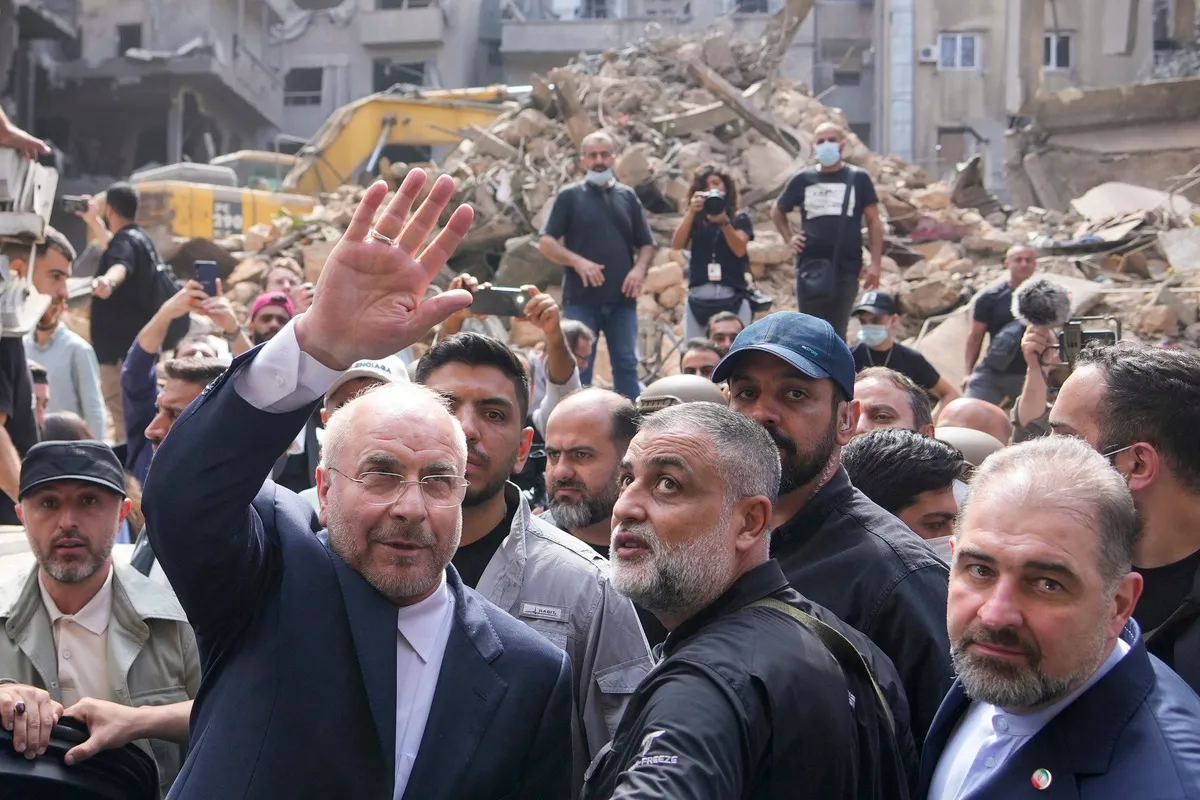
Iran's military is "waiting for the arrival of American troops on the ground to set them on fire and punish their regional partners forever," Mohammad Bagher Ghalibaf, Iran's powerful parliamentary speaker, said on Sunday.
Ghalibaf spoke shortly after roughly 3,500 U.S. Marines arrived in the Middle East, along with three ships, vehicles, fighter jets and equipment that would enable U.S. forces to land on Iranian shores. Another, similar-size Marine unit is en route, backed up by paratroopers from the U.S. Army's 82nd Airborne Division.
Read More on World
While the White House doesn't appear to have made any decision on whether to carry out ground operations, analysts say the build-up, on top of the roughly 50,000 soldiers that were already deployed in the Middle East, could be used to capture Iranian islands in the Persian Gulf and Strait of Hormuz, or to launch daring raids on mainland Iran.
...
The prospect of a quick peace settlement is a remote possibility, with Ghalibaf playing down talks with the U.S. and Yemen-based Houthi rebels—backed by Tehran—firing on Israel on Saturday for the first time since the start of the war and pledging to continue attacks.
Representatives from Egypt, Turkey, Saudi Arabia and Pakistan met in Islamabad on Sunday to attempt to find diplomatic off-ramps to the conflict, now in its fifth week. Iranian and American delegations were not present.
Meanwhile, Iranian drones and missiles targeted Israel, Bahrain, Saudi Arabia, Kuwait, and the United Arab Emirates (UAE) after Tehran hit major industrial sites across the Gulf over the weekend.
Israel's military said on Sunday it had struck "dozens" of Iranian weapons sites overnight, including a facility developing ballistic missile components, as well as carrying out fresh strikes on southern Lebanon and the country's capital, Beirut, against Iran-backed Hezbollah.
Although no final decision has been made, the Pentagon is preparing for weeks of operations on the ground in Iran, The Washington Post reported late Saturday.
U.S. Special Forces would likely lead raids alongside infantry troops rather than carry out a full-scale invasion, anonymous U.S. officials said.
White House press secretary Karoline Leavitt said the Pentagon's job was "to make preparations in order to give the commander in chief maximum optionality."
"It does not mean the president has made a decision," Leavitt told the Post.
U.S. President Donald Trump himself has said he is "not putting troops anywhere," but quickly caveated his remarks by insisting he would not publicly disclose ground operations, should he authorize this significant escalation to more than a month of war with Iran.
Secretary of State Marco Rubio said on Friday the U.S. could achieve its goals in Iran without deploying ground troops, despite the relocation of service personnel to the Middle East.
But the White House does have options. U.S. troops could storm ashore on Kharg Island, a rocky Iranian territory in the Persian Gulf that accounts for 90 percent of Tehran's all-important oil exports and props up its ailing economy.
This could allow the U.S. a stronger negotiating position in its attempts to break Iran's grip on the Strait of Hormuz, the narrow waterway typically responsible for about a fifth of the world's oil and gas flows.
Since the start of U.S.-Israeli strikes on Iran on February 28, Iran has blocked tankers and cargo ships linked to the U.S., Israel or its allies from safely passing through the strait. Maritime traffic has tumbled by 90 percent as global fuel prices soared and share markets wobbled, pressure on the U.S. to break the deadlock growing.
The Houthis, too, could exert further pressure on global trade, strained by the more than four weeks of fighting, if they fire on vessels in the Red Sea.
Military experts also say U.S. troops could seize Qeshm Island, south of Kharg and one of a handful in the Strait of Hormuz. Qeshm is thought to host anti-ship missile, mine and drone stockpiles in a vast underground network.
But U.S. boots on the ground would likely further split Trump's voter base, unenthusiastic about the prospect of further U.S. involvement in the Middle East and unavoidable casualties.
Iranian state-linked media reported on Sunday that five people had been killed in a U.S.-Israeli strike on a port city in southern Iran, close to the Strait of Hormuz.
In a polarized era, the center is dismissed as bland. At Newsweek, ours is different: The Courageous Center—it's not "both sides," it's sharp, challenging and alive with ideas. We follow facts, not factions. If that sounds like the kind of journalism you want to see thrive, we need you.
When you become a Newsweek Member, you support a mission to keep the center strong and vibrant. Members enjoy: Ad-free browsing, exclusive content and editor conversations. Help keep the center courageous. Join today.


View 0 Comments
Submit Correction
View Editorial & AI Guidelines