
10
Loading video...


By Gabe Whisnant and Dan Gooding
0
Share
Newsweek is a Trust Project member
See more of our trusted coverage when you search.Prefer Newsweek on Googleto see more of our trusted coverage when you search.
President Donald Trump said Wednesday he believes the war with Iran will end after the U.S. midterm elections, predicting Tehran will eventually be forced to back down once the vote is over.
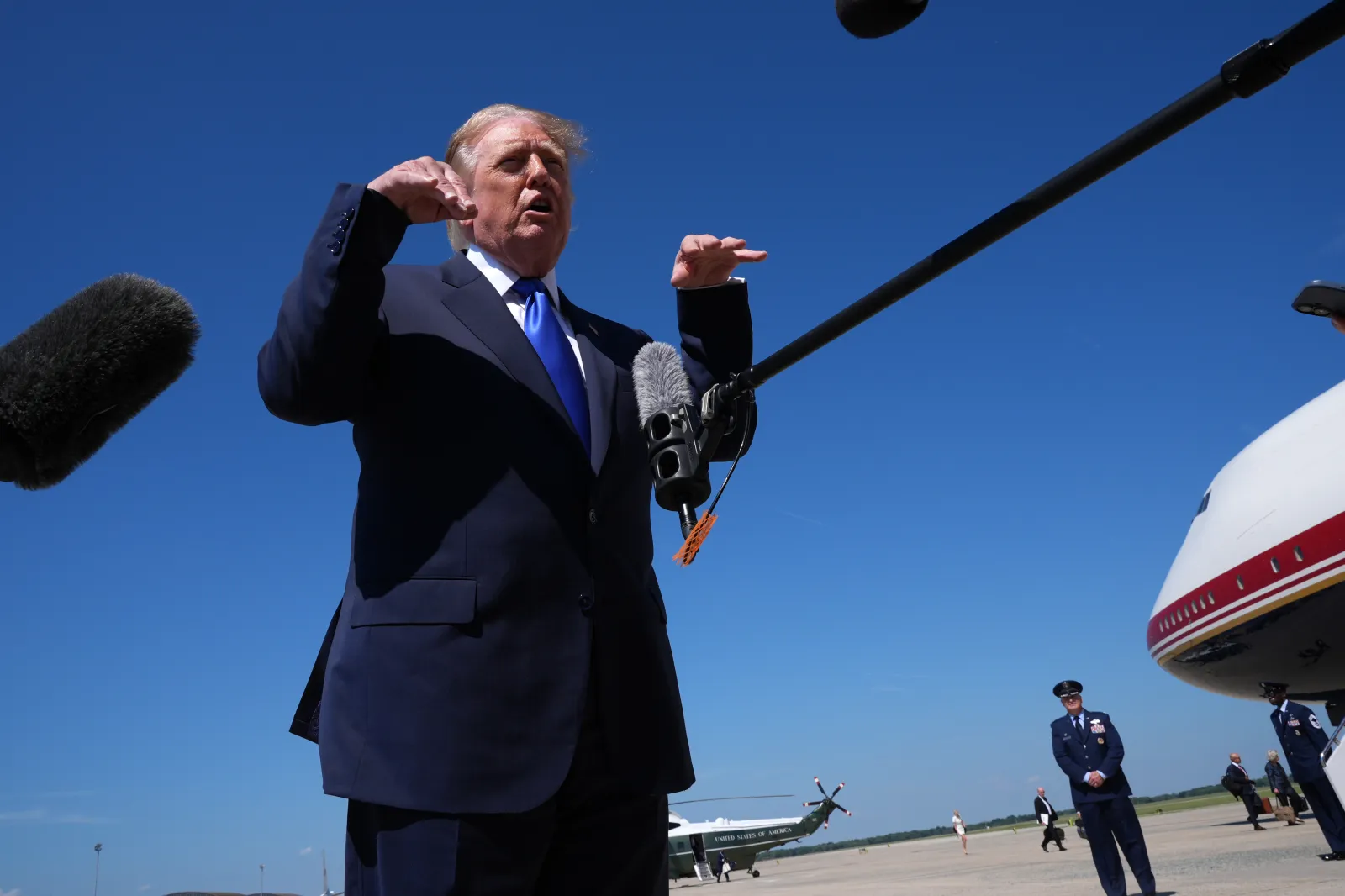
Speaking to reporters before traveling to Dallas for the Republican National Convention, Trump said elevated oil prices driven by the conflict are unlikely to ease before November. His comments came as Brent crude rose above $100 a barrel for the first time since July after a fresh escalation in hostilities between the United States and Iran.
Trump's comments appeared to rest on the assumption that Iranian leaders are waiting to see the outcome of the U.S. midterm elections before changing course. He suggested Tehran wants weaker American political leadership after the vote, though he did not specify whether he meant control of Congress, the White House's political influence, or the broader U.S. political landscape.
Read More on Politics
"I think the war's going to end immediately after the election because they can't hold out any longer," Trump said. "They’re desperate to affect the election, so that we can get a nice, weak group of people in there and leave them alone and let them have their nuclear weapon. All they want is their nuclear weapon, and if they have a nuclear weapon, the whole world is in deep trouble."
He added, "Originally I wanted to make a deal [with Iran]. We're so far down the line. They have very little country left right now. So we're not looking for, yes, a negotiation could possibly happen, but it's not something we're looking at. This war will end immediately after our election."
New Air Force One Slide Deployed
Trump arrived at Joint Base Andrews on Marine One, with reporters on the ground stating that he had to wait on board the helicopter for a short time. An emergency slide was spotted deployed from the new Qatari-gifted Air Force One, with photos showing staff moving around underneath the plane.
A short time later, the old Air Force One was maneuvered out of its hangar into position a short distance away.
The White House declined to comment further when reached by Newsweek.

...

...
1 of 2
Trump's Claims About the End of the War
Trump's remarks marked one of his clearest predictions yet about the duration of the conflict. At the outset of the war, the president said the fighting would last only weeks. The conflict is now in its seventh month.
Trump has offered an imminent or relatively near-term end to the conflict at least two dozen times, after initially estimating four to five weeks. Wednesday's forecast is materially different because it effectively extends the timeline until after November 3, almost eight months after the fighting began.
Over the course of the war, since it began at the end of February, there have been at least 23 separate dates on which Trump said the conflict was short, nearly finished, would end soon or within a specified period, or had effectively been won.
Speaking to Newsweek later in the afternoon, Florida GOP Chair Evan Power reflected on the president's remarks, saying, "The Iranian regime has been on 47 years, they've been in power, they've killed countless American lives through their terrorism network.
"The president took both decisive action by in an election year to go after and change that regime," Power said. "And I think when you look at it, it pays long term benefits, because that's going to provide real peace in that region, and that will end up in lower gas prices long term."
Gas Prices Since the War Began
When the conflict began on February 28, the national average for regular gasoline was approximately $2.982 per gallon, according to Brown University’s Iran War Energy Cost Tracker, which uses AAA daily averages. As of Wednesday afternoon, the tracker showed $4.147, up $1.165 per gallon, or 39.1 percent.
The latest Associated Press report, citing AAA, puts the current national average slightly higher, at $4.22 per gallon, up 7 cents overnight. Against the $2.982 war-start figure, that represents an increase of approximately $1.24 per gallon, or 41.5 percent. The AP also reports that gasoline is now more than $1 a gallon higher than at the same point last year.
Diesel has risen even more sharply. Brown’s tracker shows the national average rising from $3.670 on February 28 to $5.882, a 60.3 percent increase. The AP’s latest figure is $5.94, described as a record high. That matters beyond motorists because diesel prices feed into trucking, delivery and production expenses.
Oil itself has been volatile. On Wednesday, international Brent crude moved back above $100 a barrel, while U.S. West Texas Intermediate reached around $95 to $96, following renewed U.S.-Iran attacks. Trump said oil prices would come “tumbling downward” after the election, linking the expected decline to an end to the war.
Florida Senator Rick Scott, speaking to CBS News Wednesday, challenged the concerns over gas prices, saying, "Nobody likes war, nobody likes higher gas prices, but nobody wants to be killed by a nuclear weapon. That's what's at stake here. Do we want to be destroyed by a nuclear weapon?"
...
Inflation Since February
The inflation rate was 2.4 percent in February, just before the war’s economic effects began showing up in economic data. It accelerated to 3.3 percent in March, reached 4.2 percent in May, and then eased to 3.5 percent in June and 3.4 percent in July.
The Consumer Price Index (CPI) rose from 326.785 in February to 333.918 in July, meaning average consumer prices were about 2.2 percent higher by July.
The latest official inflation report is for July, because the August CPI will not be released until September 11.
Contact Newsweek editors on this story: Samantha Beech and Sam Wilson.
View 0 Comments
Submit Correction
View Editorial & AI Guidelines