Media Office of Iraqi Ports


By Ellie Cook and John Feng
0
Share
Newsweek is a Trust Project member
See more of our trusted coverage when you search.Prefer Newsweek on Googleto see more of our trusted coverage when you search.
Three more shipping vessels were struck near the Strait of Hormuz overnight, increasing already sustained pressure on the vital waterway after Iran's military vowed to block all oil heading out from the region.
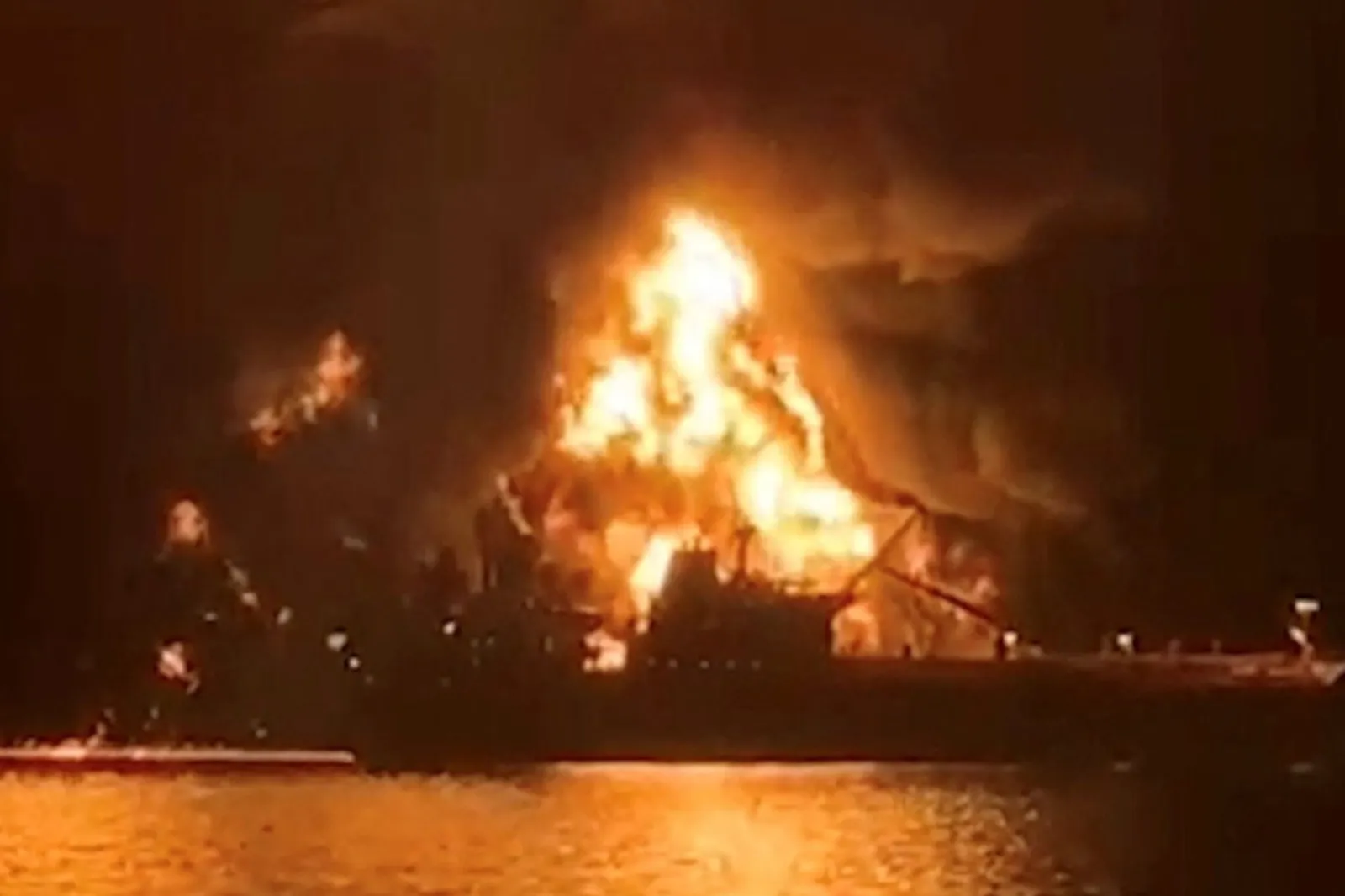
Two tankers were hit by an "unknown projectile" near the Iraqi coast, according to the United Kingdom Maritime Trade Operations (UKMTO), backed by the British military. One person was killed, according to the Iraqi News Agency, with fires breaking out on both vessels.
Iraqi officials identified the ships as the Marshall Islands-flagged tanker, the Safesea Vishnu, and the Zefyros, which sails with a Maltese flag. Ship tracking data showed both ships in the northern Persian Gulf near Iraq at the time of the attacks.
Read More on World
Iran's semi-official Tasnim news agency reported Iran was responsible for attacking the Safesea. Several U.S. media reports indicated Iranian boats filled with explosives were used.
...
Separately, a container ship north of the major Jebel Ali port in the United Arab Emirates (UAE) came under attack, sparking a "small fire onboard," the UKMTO said.
Shortly after the U.S. and Israel started striking Iran nearly two weeks ago, Tehran vowed to attack any ship traveling near the Strait of Hormuz, an essential waterway that sees roughly 20 percent of the world's crude oil supplies. More than a dozen vessels have been targeted in under a fortnight.
A series of assaults on merchant vessels and major insurers pulling war risk cover effectively shut down the waterway and caused maritime traffic to plummet.
Iraq's oil ports have completely halted their operations, although commercial ports are still working, Iraqi media reported on Thursday.
Iran has also retaliated against continuing U.S.-Israeli strikes by attacking a dozen countries in the region, many hosting U.S. bases, and homing in on oil infrastructure used by the Gulf's major petroleum exporters.
Brent crude prices drifted back down below $100 a barrel after spiking to their highest point in years on Monday, although they surged again on Thursday after an Iranian military spokesperson warned the U.S. should be prepared for a spike toward $200 a barrel.
President Donald Trump threatened to hit Iran "twenty times harder" if the country did not allow more oil tankers to pass safely through the Strait of Hormuz. By contrast, Iran's Islamic Revolutionary Guard Corps said not "one liter of oil" would make it out of the region.
Reports in recent days have suggested Iran may have started to mine the Strait, possibly posing a new threat to international shipping. Trump warned Iran it would face consequences "at a level never seen before" if it placed explosives in the Strait of Hormuz, although he said there was no indication the country had done so.
The U.S. military is currently weighing up how best to escort tankers in the Strait.
A Thai cargo ship was hit in the Strait of Hormuz on Wednesday and a Japanese-flagged container ship was damaged in the Persian Gulf on Wednesday.
Update 3/12/2026 at 5:50 a.m. ET: This article was updated with additional information.
View 0 Comments
Submit Correction
View Editorial & AI Guidelines