10
Loading video...

By Muhanad Seloom
0
Share
Newsweek is a Trust Project member
See more of our trusted coverage when you search.Prefer Newsweek on Googleto see more of our trusted coverage when you search.
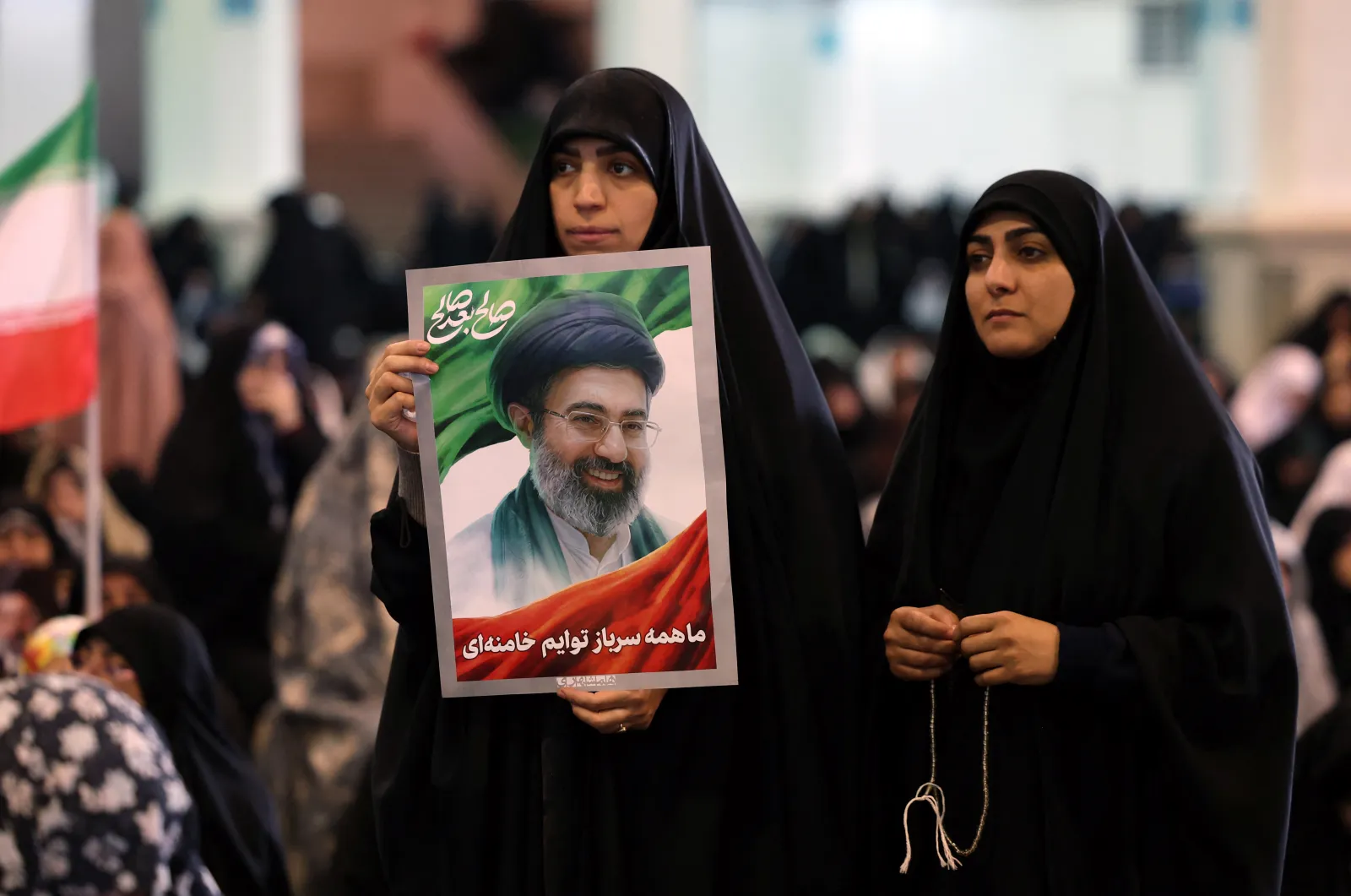
Mojtaba Khamenei’s elevation to iran’s supreme leader is already being read as proof that the Islamic Republic’s command structure remains intact, that the regime has absorbed another shock and moved on. That reading is wrong. What happened is not continuity. It is the moment a revolutionary republic founded against monarchy made supreme authority a matter of bloodline. That contradiction may damage Iran more durably than the bombs falling on it.
Iran’s system was designed, in theory at least, to rest on something other than heredity. The 1979 revolution overthrew a dynasty. The constitution says the leader is to be chosen by the Assembly of Experts and measured against standards of scholarship, piety, political judgment and administrative capacity. The late Ali Khamenei—selected by the Assembly of Experts following the death of the first supreme leader, Ayatollah Ruhollah Khomeini, in 1989—reportedly opposed his son’s candidacy because he did not want a slide toward hereditary rule in a state born from overthrowing the Shah. A revolutionary republic can survive war. It cannot so easily survive becoming what it said it replaced.
...
Read More on Opinion
What happened was not a normal constitutional transfer. By multiple accounts, the Islamic Revolutionary Guard Corps was decisive in Mojtaba Khamenei’s elevation, underscoring how far succession has shifted from clerical selection toward security management. That is the crucial point. Once the men with guns become the effective arbiters of juristic authority, the Assembly of Experts no longer looks like a body of selection. It looks like a ceremonial stamp on a decision made elsewhere.
Mojtaba Khamenei’s profile deepens the problem. He had never held a formal government position. He operated as gatekeeper to his father, built close ties with the Guards over two decades and was widely regarded as a hard-liner hostile to reformist engagement with the West. As the Middle East Institute’s Alex Vatanka has noted, “Mojtaba owes his position to the Revolutionary Guards and as such he is not going to be as supreme as his father was.” That gives him leverage. It does not give him recognized clerical standing, the very thing the office is supposed to confer. His rise translates revolutionary legitimacy into network power and security patronage. He can command obedience. He does not automatically command belief. He can inherit his father’s machinery. He cannot inherit his father’s myth.
And he enters office under the worst possible conditions. Reportedly injured in the strike that killed his father, Mojtaba Khamenei has still not made a confirmed public appearance, and his Persian New Year (Nowruz) message was issued in writing via Telegram rather than delivered before the nation. The war around him has meanwhile removed senior figures across Iran’s military, intelligence and security apparatus, leaving succession to unfold under extreme institutional stress. What remains is a shrinking war cabinet wrapped around an absent leader.
What This Means Beyond Tehran
The regional consequences are where the real strategic damage lies. Iran’s network of allied militias and proxy forces has never run on missiles and money alone. It has depended on the Islamic Republic presenting itself as the center of a transnational cause, one grounded in resistance, sacrifice and religious legitimacy. When supreme authority is visibly reduced to bloodline and enforced loyalty, that ideological claim erodes.
Consider the variation across the network. Hezbollah, already organizationally devastated following Israeli attacks in 2024, remains the actor most tightly bound to the juristic legitimacy of wilayat al-faqih (the doctrine, institutionalized in Iran’s 1979 constitution, that supreme political authority in the absence of the Twelfth Imam belongs to a qualified Shiite jurist who governs on his behalf). Under its current secretary general, Naim Kassem, the movement still treats obedience to the guardian-jurist as a matter of religious authority, not simple political convenience. A dynastic succession corrodes exactly the theological claim that made Tehran’s authority over the movement more than transactional. The Houthis, by contrast, emerge from a distinct Zaydi tradition (a branch of Shiite Islam, historically present in both Yemen and parts of northern Iran, that recognizes leadership by a qualified descendant of Ali and Fatimah through merit and activism rather than the fixed hereditary line central to Twelver Shiism). They are less directly bound to Tehran’s clerical doctrine, even if Iranian influence has shaped their ideology and military development. For them, the succession changes less operationally, but removes one more reason to treat Tehran as ideologically authoritative. Iraqi militias fall somewhere in between, with some factions already drifting toward nationalist or patronage-driven logics that a weakened supreme leader accelerates rather than creates.
The likely result is not that every allied militia suddenly defects. It is that the ideological premium on alignment with Tehran falls. Over time, the network becomes less a movement than a set of clients, franchises and security dependencies. That is a poorer form of power, and a more expensive one to sustain, especially for a state already under military and
economic siege.
How Dynastic Succession Weakens Iran’s Regime
The Islamic Republic has never ruled by coercion alone. The Guards, Basij militia, seminaries and regional networks were all nourished by an idea: that they served not merely a state but an Islamic order under the guardianship of a qualified jurist. Strip away that claim at the apex and every institution below changes character. The Guards become less guardians than kingmakers. The clerical establishment becomes less a source of authority than a chorus enlisted to ratify power after the fact.
Analysts who track Guard politics have warned for years that unchecked IRGC dominance could turn the Islamic Republic into a military state with only a slim layer of religious legitimacy. Mojtaba Khamenei’s elevation is the moment that warning stopped being hypothetical. This does not mean immediate collapse. Coercive states can last a long time after their ideological foundations crack. The regime retains a disciplined core of loyalists, and hard-liners remain organized enough to suppress dissent. But its support base is far narrower than what the Islamic Republic once enjoyed.
In the March 2024 elections for parliament and the Assembly of Experts, only about 25 million of 61 million eligible Iranians cast ballots after the Guardian Council barred prominent centrists and reformists, including former President Hassan Rouhani, from the race for the very body charged with selecting the supreme leader. The regime can still mobilize defenders. It is far less able to claim a broad social mandate. A regime that cannot renew legitimacy has to substitute surveillance for persuasion, patronage for charisma and militarization for institutional balance. It becomes harsher but also more brittle. Its leaders speak more in the name of national security because they can speak less convincingly in the name of revolutionary virtue. Its errors become harder to correct because admitting error threatens the thin basis of authority that remains. Dynastic succession does not weaken such a system by making it soft. It weakens it by making it rigid, suspicious and ever more dependent on the coercive apparatus that created the problem in the first place.
Airstrikes may damage Iran’s runways, ports, command centers and oil infrastructure more quickly than any internal contradiction ever could. But physical destruction is often reversible. Political mythology is not. The Islamic Republic emerged by denouncing hereditary rule, enthroning juristic authority and promising that its legitimacy came from Islamic virtue rather than blood. By elevating Mojtaba Khamenei, it has signaled something else: that in the decisive hour, the revolution became a family business. Mojtaba Khamenei may secure obedience. He may even prolong the system. But a revolutionary republic that turns itself into a dynasty is not demonstrating resilience. It is beginning a slower collapse.
Muhanad Seloom is assistant professor of international politics and security at the Doha Institute for Graduate Studies and an honorary research fellow at the University of Exeter.
The views expressed in this article are the writer's own.
View 0 Comments
Submit Correction
View Editorial & AI Guidelines