
10
Loading video...

By Sam Stevenson
Associate News Editor
0
Share
Newsweek is a Trust Project member
See more of our trusted coverage when you search.Prefer Newsweek on Googleto see more of our trusted coverage when you search.
Republican Attorney General for Texas Ken Paxton released an AI-generated attack ad targeting Democratic State Representative James Talarico’s religious statements as their Texas Senate contest entered its closing stretch.
Polling narrowly favors Talarico, but prediction markets remain split over whether a Democrat can overcome Texas’ Republican lean.
Texas voters must assess genuine remarks repackaged into a synthetic performance containing words and actions that did not occur together.
Read More on Politics
"Ken Paxton and his billionaire backers in D.C. know they can’t rely on facts to win this race—so their only answer is to literally put words in James’ mouth with AI deepfake videos to try and fool Texans," Talarico campaign spokesperson JT Ennis told Newsweek in an emailed statement.
"Dark money groups are lying about James Talarico because they’re scared of the people-powered movement we’re building to fix this broken, corrupt political system."
Newsweek emailed Paxton's campaign for comment on Wednesday morning.
Key Points
- The RealClearPolling average places Talarico at 47.3 percent and Paxton at 44.9 percent, a Democratic advantage of 2.4 points.
- Five of the six individual surveys listed in that average show either a Talarico lead or a tie.
- U.S.-regulated prediction market Kalshi gives Paxton a 53 percent chance of victory against 47 percent for Talarico, based on $310,000 in trading volume.
- Polymarket displays both candidates at 51 percent, with more than $1 million traded.
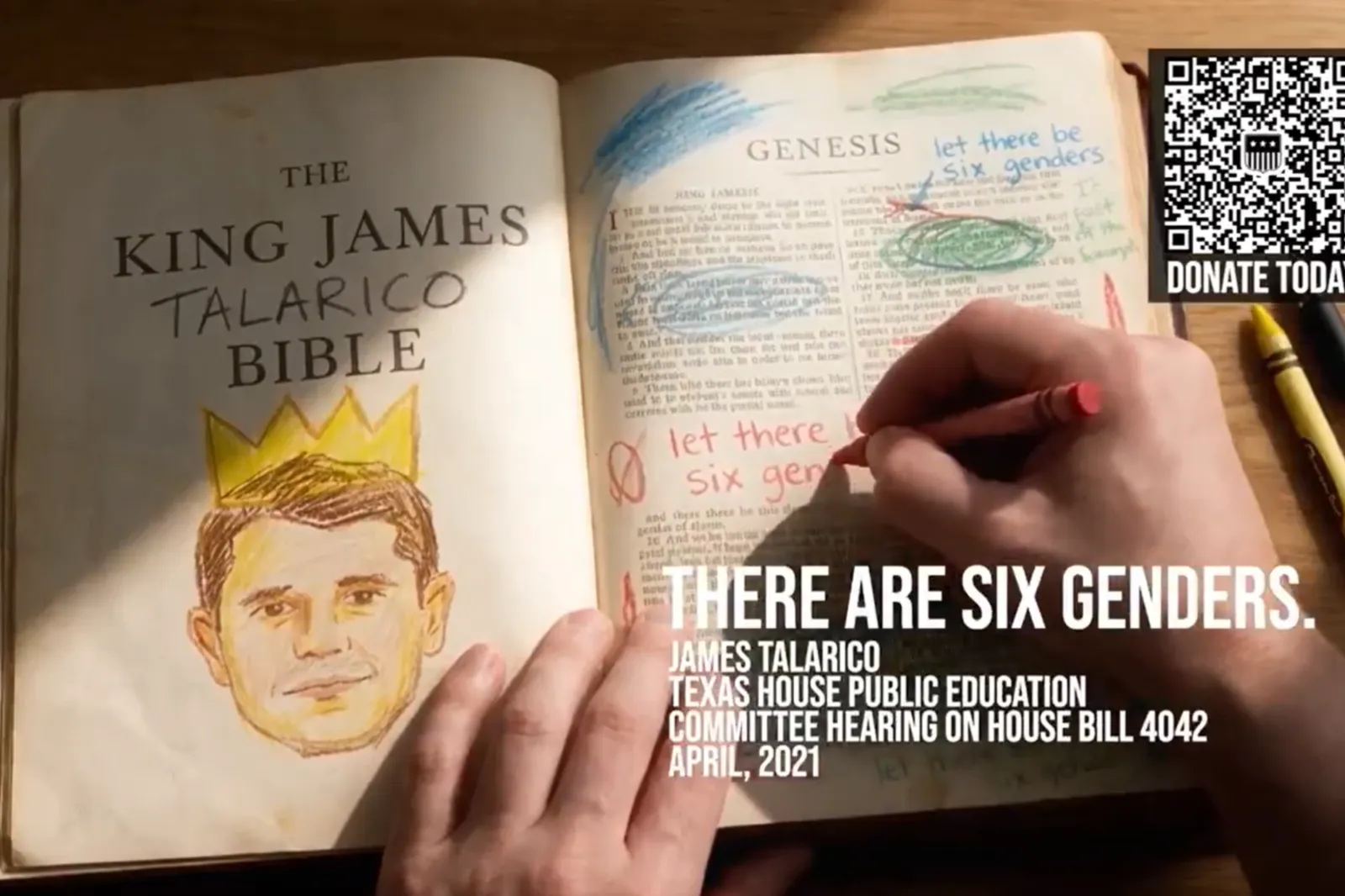
- Paxton’s latest spot uses an AI-generated likeness of Talarico to combine separate religious remarks into a fictional Bible reading.
- Journalist Mehdi Hasan shared the ad on X and wrote: "AI ads like this should be illegal."
Related Story

RNC Dallas Puts the GOP’s Trump Paradox on Full Display
Why It Matters
Texas has not sent a Democrat to the Senate since Lloyd Bentsen won reelection in 1988.
That history makes Talarico’s polling notable, but a narrow survey lead is not the same as a secure advantage in a state where Republican candidates have repeatedly survived competitive races.
...
The Latest AI Attack
Posted by Paxton’s official X account on September 8, the 30-second ad depicts an AI-generated look-alike of Talarico writing in a book called "The King James Talarico Bible."
The synthetic character recites a passage assembled from remarks Talarico previously made about Christianity, gender and Jesus.
"James Talarico is weaponizing faith to sell a radical agenda, and he even brags about hating Christianity," Paxton’s account captioned the video.
Several of the statements referenced in the ad came from different speeches or interviews.
Generative AI turns them into a continuous scene, creating the appearance of a single performance that never happened.
Political commentator Mehdi Hasan responded by reposting the video with his call for such advertising to be outlawed.
Meanwhile, X user Frank Luntz wrote: "Is this the first nationwide TV ad with an AI depiction of a political opponent? I can only imagine what 2028 ads will be like."
These reactions capture the wider argument surrounding synthetic campaign media: political satire is protected speech, but realistic impersonation can make it harder for viewers to separate quotation from invention.
Polling Points to a Close Race
Texas Public Opinion Research surveyed 1,000 likely voters from August 21 to 24 and placed Talarico ahead 48 percent to 42 percent, with a margin of error of 3.3 percentage points.
Emerson College Polling’s August 9-10 survey of 1,000 likely voters found Paxton leading 47 percent to 46 percent, within the three-point margin of error.
The University of Texas/Texas Politics Project found Talarico ahead 42 percent to 39 percent among 1,200 registered voters interviewed from August 5 to 13. Its margin of error was 2.8 percentage points.

...
What Prediction Markets Show
Prediction markets let traders buy contracts tied to an election result. Their prices can react quickly to polling, fundraising, advertising and breaking news, giving them an advantage over forecasts updated less frequently.
However, traders are not a representative sample of voters. Market prices can also be shaped by liquidity, participant preferences and the rules governing individual contracts.
That helps explain the slight divergence here. Kalshi makes Paxton the marginal favorite (53 to 47 percent), while Polymarket displays an even contest (51 to 51). Neither platform supports the conclusion that either candidate is clearly ahead.
Contracts can trade independently and may not always sum to exactly 100 percent because of market friction.
Talarico Returns the Focus to Paxton
Talarico is answering attacks on his beliefs by returning to allegations surrounding Paxton’s tenure as attorney general.
A new campaign ad features former Paxton aide David Maxwell, who spent nearly 50 years in Texas law enforcement and later reported the attorney general to the FBI with other senior employees.
In a statement accompanying the ad, Maxwell said: "Ken Paxton ended my five-decade career in public service because I blew the whistle on his corruption."
Those allegations contributed to Paxton’s 2023 impeachment. Paxton denied wrongdoing, was acquitted by the Republican-controlled Texas Senate, and the Justice Department declined to pursue federal charges.
A judge later ordered Texas to pay four former aides $6.6 million in their whistleblower case.
The competing messages leave voters with sharply different character tests: Paxton is challenging Talarico’s theology, while Talarico is challenging Paxton’s conduct in office.
Republican Candidates and Groups Using AI Attack Ads
- Paxton: Used synthetic versions of Talarico, John Cornyn and Jasmine Crockett in separate Texas Senate ads.
- National Republican Senatorial Committee: Created an AI Talarico reading old posts and giving invented reactions such as "So true."
- Derrick Van Orden: Posted Grok-generated videos resembling Democratic challenger Rebecca Cooke and attributing fictional statements to the character.
- Mike Collins: Released a labeled deepfake depicting Senator Jon Ossoff making remarks about farmers and a government shutdown that Ossoff had not made.
- Brian Shortsleeve: Used a synthetic version of Governor Maura Healey’s voice in a Massachusetts gubernatorial attack.
- John Cornyn: Published AI-generated ads aimed at Republican rivals Paxton and Wesley Hunt.
- John Reid: Staged a campaign event featuring an AI-generated version of Democratic opponent Ghazala Hashmi.
- Spencer Pratt: Shared AI attack videos made by supporters during the Los Angeles mayoral campaign.
- Republican National Committee: Released an entirely AI-generated advertisement in 2023 depicting hypothetical consequences of another Joe Biden term.
What Happens Next
The next polls will show whether the AI controversy changed opinions or merely energized voters already committed to one side.
For Talarico, holding independents while mobilizing Democrats is essential. Paxton needs Republicans who remain uncertain about his candidacy to come home.
Update 09/10/26, 3:10 a.m. ET: This story has been updated with comment from JT Ennis.
Contact Newsweek editors on this story: Sam Stevenson, James Debens and Tony Phillips.
View 0 Comments
Submit Correction
View Editorial & AI Guidelines