...

By Ed Browne
Reporter
0
Share
Newsweek is a Trust Project member
See more of our trusted coverage when you search.Prefer Newsweek on Googleto see more of our trusted coverage when you search.
Scientists working with the James Webb Space Telescope have quietly released an image of the planet Jupiter as part of an earlier test of the telescope's abilities.
Webb has captured the world's attention this week after NASA released a suite of images on Monday and Tuesday, representing the first publicly-available proper images the telescope has taken since it was launched in December.
The images included far-away galaxies and nebulae, and Webb also captured data on the atmosphere of a distant planet.
Read More
Tool Shows Just How Stunning Webb’s Space Image Is Compared to Older Ones3 min read

What Webb Telescope Photos Reveal About Atmospheres of Other Planets4 min read

Google Doodle Celebrates James Webb Telescope’s Iconic First Images4 min read

As part of the wider data release, NASA, along with the European Space Agency (ESA) and the Canadian Space Agency (CSA), released a commissioning report Tuesday outlining Webb's science performance capabilities over a six-month testing period following its launch.
As part of the testing period, scientists put Webb through its paces regarding its ability to track objects around the solar system at speeds of up to 67 milliarcseconds per second—a measure of how fast it can watch something move in front of it. Suffice it to say, 67 milliarcseconds per second is twice as fast as Webb was designed for.
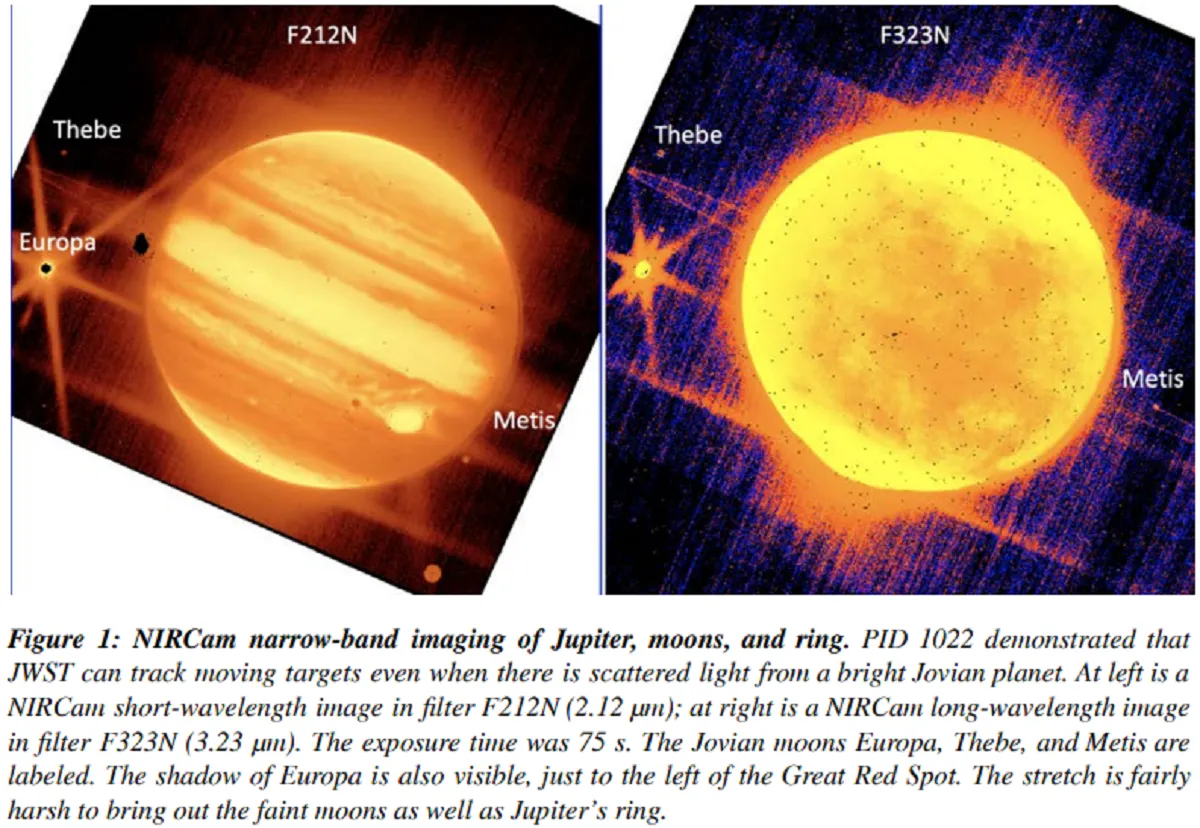
One of these tracking tests saw Webb being tasked with tracking Jupiter as it moved at an apparent speed of around 3.3 milliarcseconds per second, which was achieved. Below is the photo that Webb managed to capture, which also shows that a number of Jupiter's moons were observed.
...
The test, according to the report, "demonstrated that JWST can track moving targets even when there is scattered light from a bright Jovian planet."
A caption read: "The exposure time was 75 s. The Jovian moons Europa, Thebe, and Metis are labeled. The shadow of Europa is also visible, just to the left of the Great Red Spot. The stretch is fairly harsh to bring out the faint moons as well as Jupiter's ring."
This was only one of Webb's tracking tests, however. Scientists stepped up speeds all the way to 67 milliarcseconds per second, at which point it was tracking the asteroid 2004 JX20.
Webb was able to track all of the objects successfully, opening up the exciting possibility that the telescope could be used for observing near-Earth asteroids and comets.
In general, the report contained a glowing assessment of Webb's abilities, with its authors noting that the telescope's performance was better than expected "almost across the board"—and that various characteristics such as the cleanliness of its mirrors and the alignment of its optical equipment exceed requirements.
"In most cases, JWST will go deeper faster than expected," the report read. "In addition, JWST has enough propellant onboard to last at least 20 years.
"The authors acknowledge the tremendous amount of work by the entire international mission team to bring JWST through commissioning into science operations."

...
View 0 Comments
Submit Correction
View Editorial & AI Guidelines