...

By Aristos Georgiou
Science and Health Reporter
0
Share
Newsweek is a Trust Project member
See more of our trusted coverage when you search.Prefer Newsweek on Googleto see more of our trusted coverage when you search.
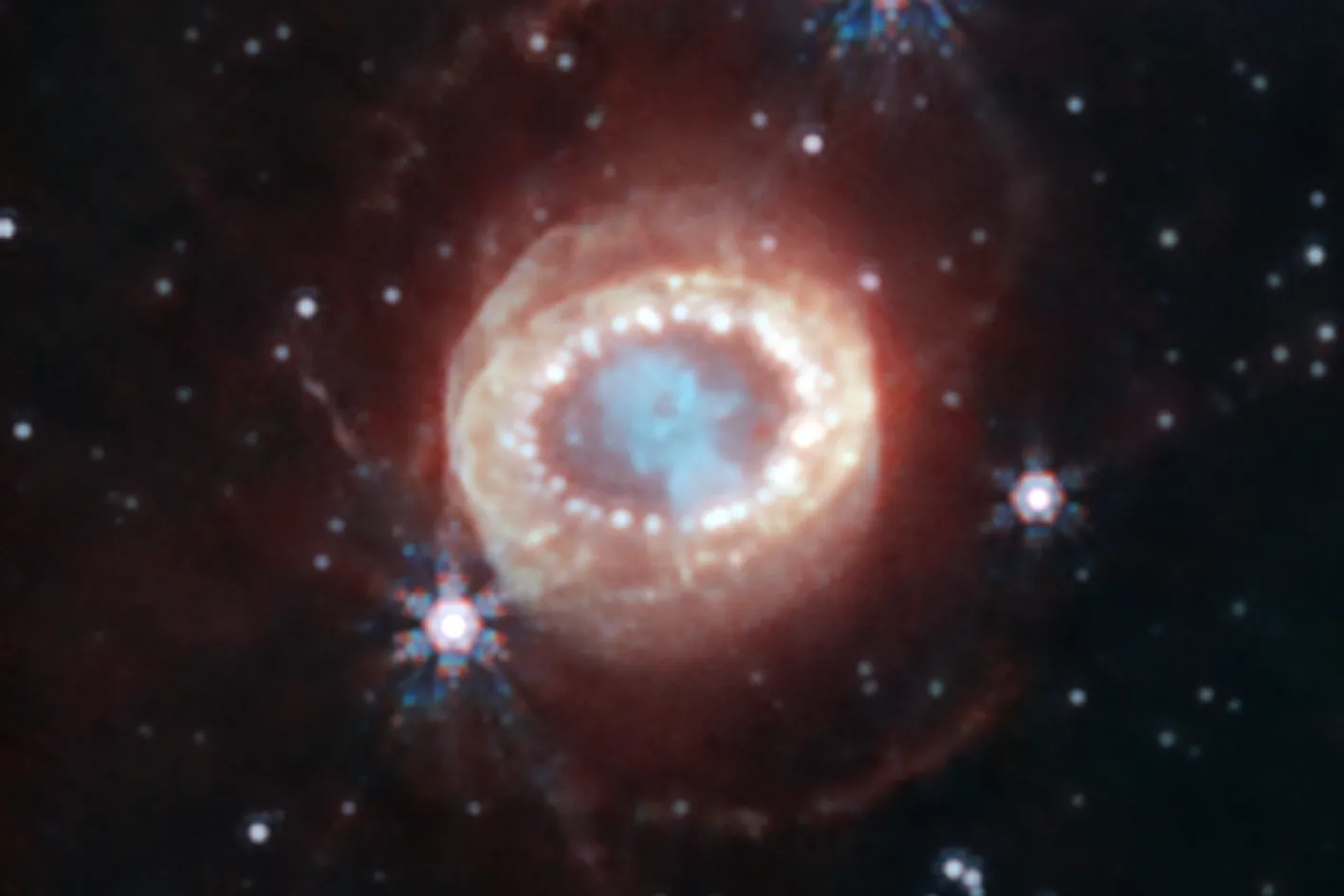
NASA's James Webb Space Telescope has revealed never before seen structures in a stunning supernova, the agency said Thursday.
The iconic remnant of the supernova, known as SN 1987A, is located around 168,000 light-years away in a satellite galaxy of the Milky Way known as the Large Magellanic Cloud.
For the past four decades or so, SN 1987A, which was discovered in 1987, has been the subject of intense observations at wavelengths ranging from gamma rays to radio waves.
Read More
Massive Explosion on Surface of Sun Captured in Breathtaking Detail4 min read

Meteor Spotted in Skies Over Siberia: Video3 min read

Firing Moondust Into Space to Create Sun Shield Could Combat Climate Change6 min read

The Webb has been studying the supernova in the near-infrared spectrum, using an instrument called a NIRCam that revealed previously unknown features. These features are small, crescent-like structures that have only become visible thanks to the telescope's unprecedented sensitivity and resolution.
...
In the middle of the image shown above, which was captured recently by the telescope, a region can be seen in the center of the supernova that looks like a keyhole. This central region is filled with gas and dust that was ejected by the supernova—cataclysmic explosions that occur when massive stars die.
The dust in this region is so dense that even the Webb's NIRCam is unable to penetrate it, producing the dark "hole" in the keyhole. Surrounding the inner keyhole is a bright equatorial ring that was formed from material ejected tens of thousands of years before the supernova explosion occurred.
Now, the Webb has uncovered the small crescent-like structures (as shown in the diagram below) that are thought to be part of the outer layers of gas spewed out by the supernova. The latest observations shed new light on our understanding of how supernovae and their remnants develop over time.
Although the supernova has been well studied over the past few decades, several unknowns about the cosmic event remain.

...
As a result, the Webb and other observatories, such as NASA's Hubble and Spitzer space telescopes and the Chandra X-ray Observatory, will continue to study the supernova over the coming years.
After its discovery in February 1987, the supernova was observed blazing with the power of 100 million suns for several months. Because of its proximity to Earth, SN 1987A has provided an ideal opportunity for astronomers to study the phases that occur before, during and after the death of a star.
The Webb is a collaboration among NASA, the European Space Agency and the Canadian Space Agency. It is the largest and most powerful space observatory ever built and has already made a number of fascinating discoveries since beginning scientific operations last year.
View 0 Comments
Submit Correction
View Editorial & AI Guidelines