
...


By Jordan King and Amanda Castro
0
Share
Newsweek is a Trust Project member
See more of our trusted coverage when you search.Prefer Newsweek on Googleto see more of our trusted coverage when you search.
A powerful heat dome is expected to intensify over the central and eastern United States during the July 4 holiday, sending temperatures soaring across more than 30 states and forcing communities to cancel events, adjust celebrations, and brace for dangerous conditions during one of the busiest outdoor weekends of the summer. Forecasters warn that the combination of triple‑digit heat, high humidity and unusually warm nights could pose serious health risks for millions of Americans.
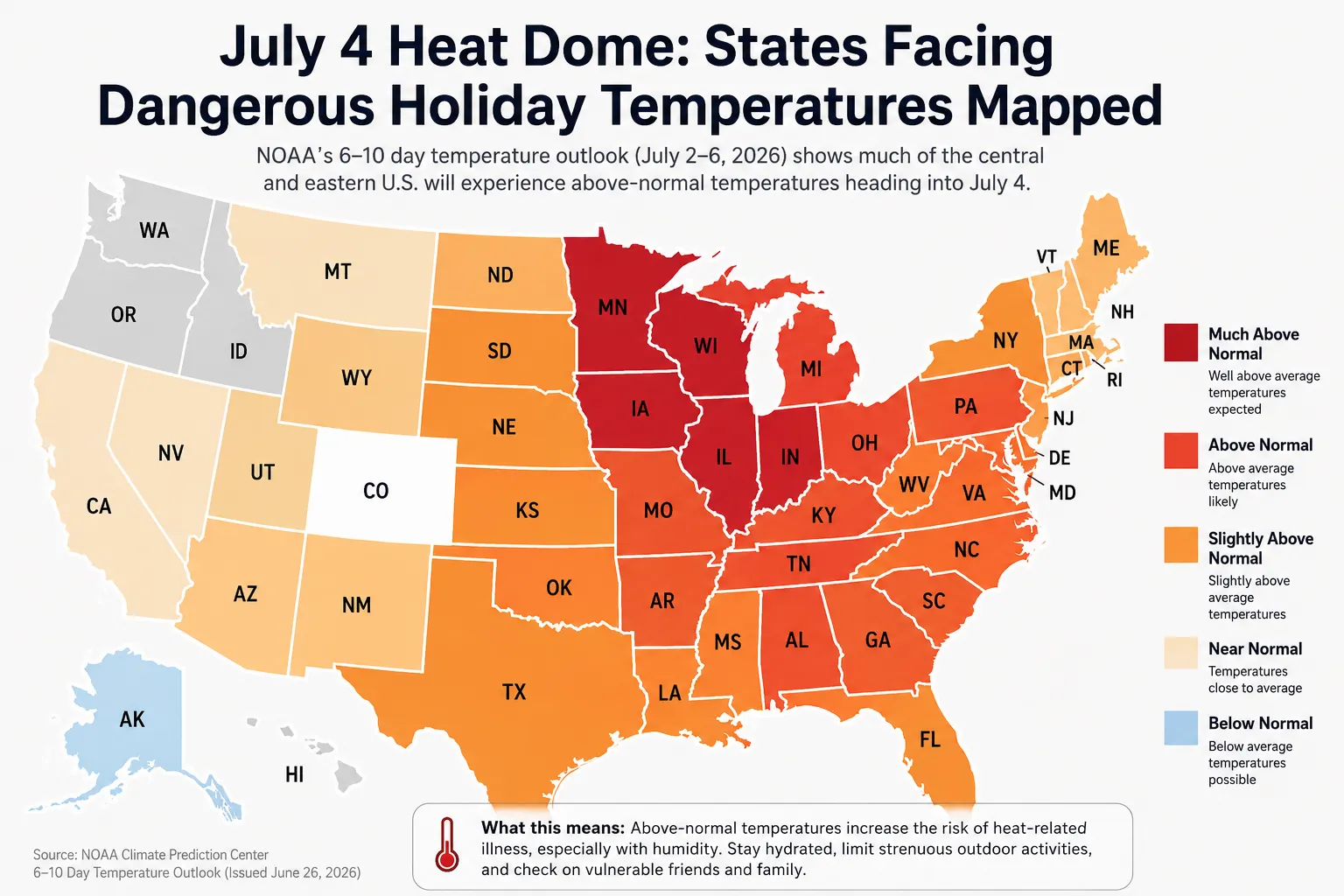
The National Weather Service’s Climate Prediction Center projects hotter‑than‑normal temperatures from July 2 to 6 across a wide swath of the country, with highs in the upper 90s and low 100s stretching from the Midwest into the East. States facing the greatest risk include Minnesota, Wisconsin, Iowa, Illinois, Indiana, Missouri, Michigan, Ohio and Kentucky, with above‑normal temperatures also expected across Tennessee, Arkansas, Mississippi, Alabama, Georgia, the Carolinas and much of the East Coast.
...
Read More on News
Overnight lows in many areas are forecast to remain in the mid‑ to upper‑70s, limiting relief and increasing the risk of heat‑related illness. Only parts of the Pacific Northwest and Alaska are expected to see cooler‑than‑average conditions.
What Forecasters Are Warning About
The Climate Prediction Center warned that the heat could pose a significant health risk during the July 4 holiday, particularly as many Americans are expected to spend long periods outdoors.
The agency has issued a high risk of extreme heat for July 4 across parts of the eastern Great Plains, the Mississippi, Ohio and Tennessee valleys, the Appalachians, the Southeast and the Mid-Atlantic. A broader moderate risk extends from the Great Plains to the East Coast through July 5, while a slight risk covers much of the Great Basin, Rockies, Great Plains and eastern U.S. through July 7.
“Another key consideration is the Nation's 250th Anniversary on July 4, with numerous outdoor activities planned,” the CPC said. “Staying hydrated and limiting exposure to very hot, humid weather is very important, especially vulnerable populations including older adults.”

...
Why a Heat Dome Is Forming
The hot weather is being driven by a large area of high atmospheric pressure—commonly known as a heat dome. As the high-pressure system strengthens, it traps hot air beneath it, allowing temperatures to build over several days while limiting cloud cover and rainfall, according to the National Weather System.
This persistent ridge of high pressure will keep temperatures well above average across much of the country through the start of next week. Combined with high humidity, the pattern is expected to push heat index values (what the temperature feels like) above 100 to 105 degrees in many areas, while unusually warm nights offer little relief, the CPC said in its hazards outlook.
Forecasters expect the ridge to gradually shift westward after July 4. That should bring some relief to parts of the East Coast later in the holiday weekend, while increasing the risk of extreme heat across portions of the interior West, including parts of the Great Basin and Rockies.
Cities Cancel July Fourth Events Amid Extreme Heat
Several Bay Area communities have scaled back or canceled July Fourth celebrations as dangerous heat and elevated wildfire risk force last‑minute changes
- Antioch, California — Canceled its July Fourth parade due to dangerous heat levels. Evening festivities and fireworks will remain in place because conditions are expected to ease after sunset.
- St. Helena, California — Postponed its fireworks show after fire officials warned that dry vegetation and elevated wildfire risk made a display unsafe. Non‑pyrotechnic activities at Crane Park will continue.
- Healdsburg, California — Canceled its fireworks show entirely, citing a red flag warning, multiple active fires in the region, and limited emergency resources that could not be diverted if a new blaze were sparked.
- Johnson County, Kansas — Canceled its World Cup watch party scheduled for Sunday due to extreme heat and safety concerns for large outdoor gatherings.
- New York City, New York — Appears to be limiting outdoor gatherings amid heat‑related advisories; state officials are being contacted for clarification on whether additional restrictions are planned.
- Oak Grove Racing & Gaming, New York — Canceled live racing on June 29 and 30 after triple‑digit heat indexes created unsafe conditions for horses, staff, and spectators.
DCA to Pause Flights on 4th of July
Flights at Ronald Reagan Washington National Airport (DCA) will face two planned ground stops this week as federal officials coordinate airspace protections for Independence Day events in the nation’s capital. The Federal Aviation Administration said operations will be paused from 10 a.m. to 1 p.m. on July 3, and again from noon through 11:59 p.m. on July 4, to accommodate flyovers, fireworks, and other security‑sensitive activities tied to America’s 250th birthday celebrations.
The FAA said it has been working with military, law‑enforcement, and event organizers for months to manage the unusually complex airspace demands around Washington, D.C. Holiday flyovers, ceremonial aircraft, and large crowds on the National Mall typically require temporary flight restrictions, but this year’s expanded anniversary programming has prompted longer pauses than usual.
Why the Timing Matters
Besides the usual annual celebrations on July 4, America is marking the nation's 250th anniversary with major events across the country.
In Washington, D.C., a day-long celebration is planned on the National Mall, including a parade, concerts and one of the nation's largest fireworks displays. New York Harbor will host the Sail4th 250 celebration, bringing together dozens of tall ships from around the world, while Philadelphia—the birthplace of the Declaration of Independence—will stage an expanded Wawa Welcome America festival featuring concerts, historical events and fireworks.

...
Communities across all 50 states are also holding parades, festivals, concerts and fireworks displays as part of the nationwide Freedom 250 celebrations, with millions of people expected to attend outdoor events over the holiday weekend.
Newsweek has broken down the details of events here.
View 0 Comments
Submit Correction
View Editorial & AI Guidelines