...

By Ian Randall
Deputy Science Editor
0
Share
Newsweek is a Trust Project member
See more of our trusted coverage when you search.Prefer Newsweek on Googleto see more of our trusted coverage when you search.
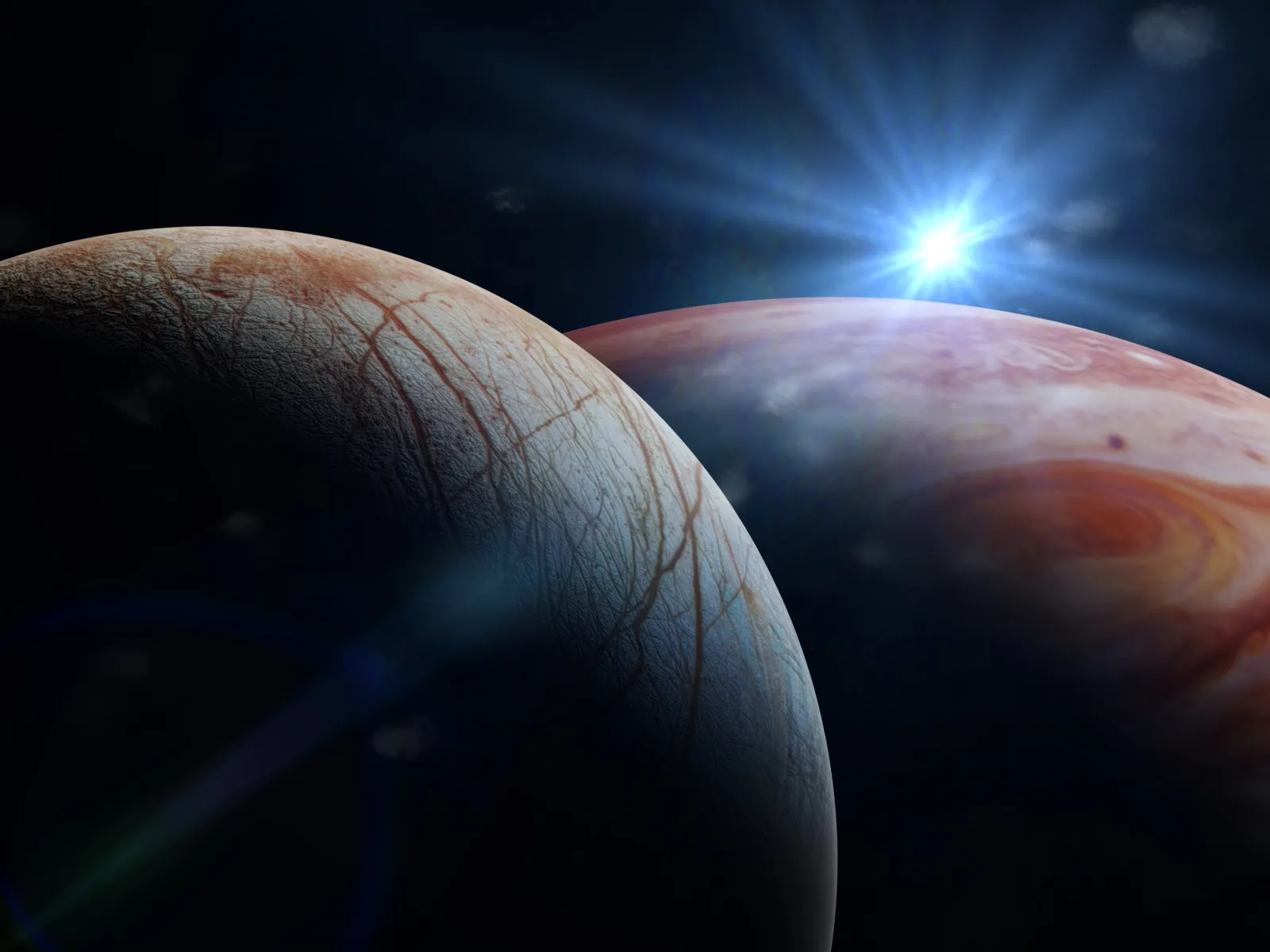
The icy surface of Jupiter's moon Europa appears to be constantly changing, new data from the James Webb Space Telescope has revealed.
This phenomena, the team explained, is heightened in so-called "chaos regions" where surface features like cracks, plains and ridges end up jumbled and ensnared together.
"We think that the surface is fairly porous and warm enough in some areas to allow the ice to recrystallize rapidly," said paper author and geologist Richard Cartwright of Johns Hopkins University in a statement.
Read More
Supermassive Black Hole Fires Gas ‘Bullets’—Never Seen Before3 min read

NASA Just Detected Ice in Another Star System for the First Time3 min read

NASA Just Found the Moon Is Uneven—What We Know So Far3 min read

The different rates of crystallization across the icy moon point to a complex mix of geological processes at play—and provide further evidence for Europa harboring a liquid ocean beneath its frozen surface.
...
Astronomers refer to what we would call ice as "water ice." This distinguishes it from other frozen molecules such as carbon dioxide in the form of "dry ice," for example.
Here on Earth, water ice has a hexagonal crystalline structure that results from the hydrogen bonding at play between the water molecules.
(This structure actually spreads out the molecules more than in liquid water, making ice less dense than water, explaining why ice floats.)
On the surface of Europa, however, water ice is constantly bombarded by charged particles, disrupting the crystalline structure to form "amorphous ice" with a disordered layout.
Scientists have long speculated that Europa's surface is covered by a very thin veneer of amorphous ice—only around a fiftieth of an inch thick—which shields crystalline ice beneath.
In the new study, however, the researchers found evidence of crystalline ice both at depth but also on the surface of Europa, in particular in an area known as Tara Regio.
"Also, in this same region—generally referred to as a chaos region—we see a lot of other unusual things," said Cartwright.
These, he explained, includes "the best evidence for sodium chloride, like table salt, probably originating from its interior ocean. We also see some of the strongest evidence for carbon dioxide and hydrogen peroxide on Europa. The chemistry in this location is really strange and exciting."

...
According to the researchers, this region of fractured surface materials hints at geological processes pushing up materials from below.
"Our data showed strong indications that what we are seeing must be sourced from the interior, perhaps from a subsurface ocean nearly 20 miles beneath Europa's thick icy shell," said paper author and physicist Ujjwal Raut of the Southwest Research Institute in a statement.
"When we see evidence of carbon dioxide at the surface, we think it must have come from an ocean below the surface.
"The evidence for a liquid ocean underneath Europa's icy shell is mounting, which makes this so exciting as we continue to learn more."
Do you have a tip on a science story that Newsweek should be covering? Do you have a question about Europa? Let us know via science@newsweek.com.
Reference
Cartwright, R. J., Hibbitts, C. A., Holler, B. J., Raut, U., Nordheim, T. A., Neveu, M., Protopapa, S., Glein, C. R., Leonard, E. J., Roth, L., Beddingfield, C. B., & Villanueva, G. L. (2025). JWST Reveals Spectral Tracers of Recent Surface Modification on Europa. The Planetary Science Journal, 6(5), 125. https://doi.org/10.3847/PSJ/adcab9
View 0 Comments
Submit Correction
View Editorial & AI Guidelines