...

By Hugh Cameron
Reporter
0
Share
Newsweek is a Trust Project member
See more of our trusted coverage when you search.Prefer Newsweek on Googleto see more of our trusted coverage when you search.
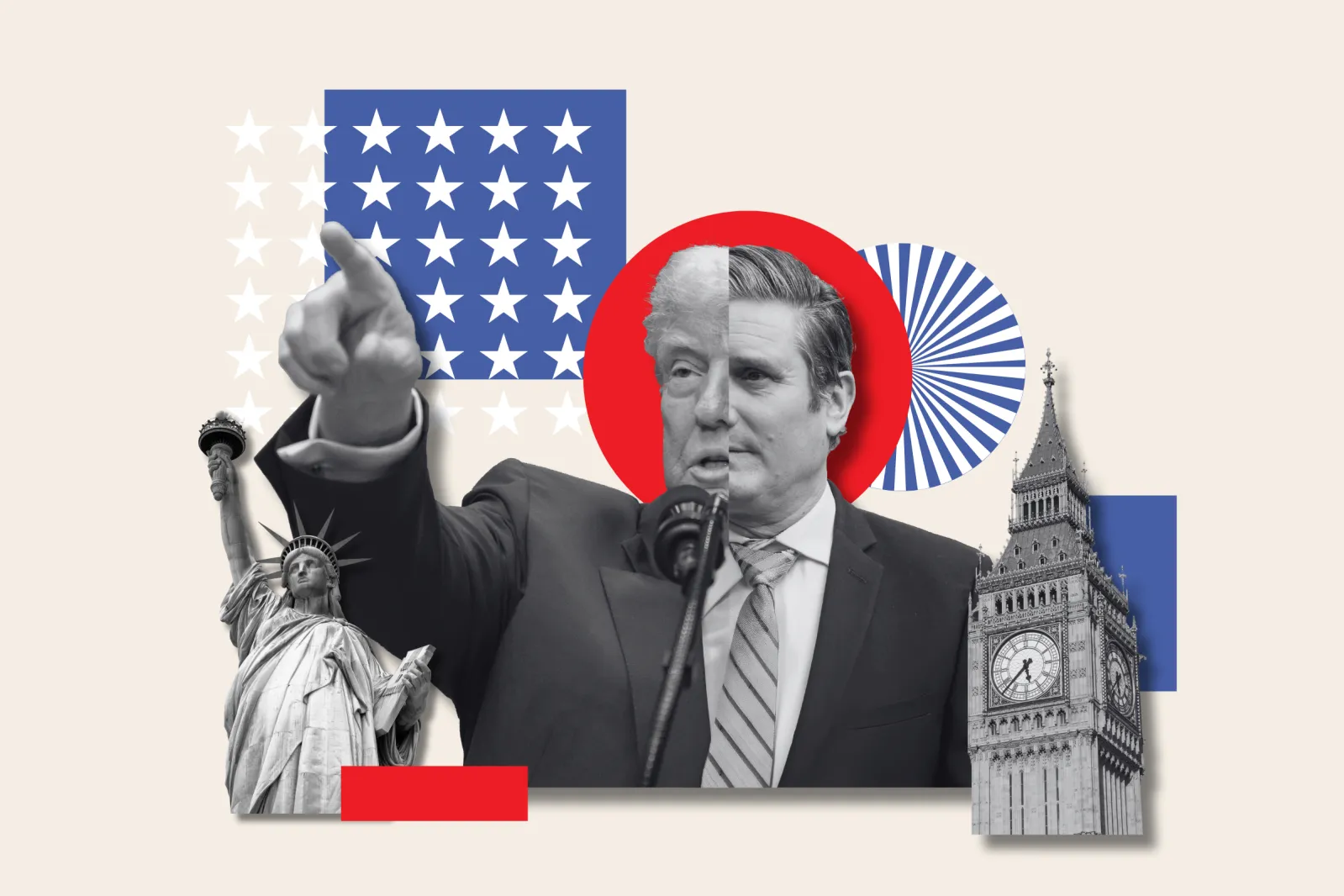
Sir Keir Starmer has been accused of employing anglicized forms of Trumpian rhetoric and emulating the U.S. president's stances on immigration in an apparent effort to stave off growing electoral threats from the country's truly MAGA-esque forces.
The British prime minister has channeled President Donald Trump in increasingly frequent and obvious ways. Seemingly borrowing from the Trump playbook, he pledged to "cut the weeds of regulation" in a January op-ed for The Times newspaper, reminiscent of the president's 2017 remark that "we're here today for one single reason: to cut the red tape of regulation."
More recently, Starmer described his approach to the development of nuclear power stations in England and Wales as "build, baby, build," echoing Trump's vow to "drill, baby, drill."
Read More on Politics
In December 2024, he criticized government workers in the U.K. civil service, saying that while there was not a "swamp to be drained here," too many were "comfortable in the tepid bath of managed decline." A union leader for those workers accused him of invoking "Trumpian language."
...
But toeing a tougher line on immigration has been at the center of the shift. In May, ahead of his Labour Party publishing a white paper on the issue, the prime minister accused the previous Conservative government of conducting a "one-nation experiment on open borders" and argued that without stricter controls the U.K. risked becoming "an island of strangers."
Starmer's language drew criticism from members of his own party and was compared to Enoch Powell's 1968 speech "Rivers of Blood"—in which the Conservative MP predicted that immigration and multiculturalism would reduce citizens to "strangers in their own country" and result in the eventual death of British national identity.
When approached by Newsweek for comment, a Downing Street spokesperson addressed the parallels between the two speeches, saying: "We've said multiple times that we reject the comparison completely." They pointed to Starmer's comments in the white paper speech, in which he acknowledged that migrants continue to make "a massive contribution" to the U.K.
Maria Sobolewska, a professor of political science at the University of Manchester in the U.K., told Newsweek: "In terms of rhetoric on immigration, I would describe what happened as a very significant lurch to the populist right. This kind of language heavily borrows from right-wing fear-mongering around separate lives and supposed immigrant self-segregation."
But as much as Starmer may be evincing more hard-line stances that reduce the political proximity between himself and President Trump, political scientist Colin Hay told Newsweek that the backdrop of this is the growing popularity of political party Reform UK, an offshoot of the now defunct UK Independence Party, or UKIP, led by Nigel Farage—a man that The Wall Street Journal dubbed "Trump with a pint."
Farage's party, which campaigns primarily on the promise of cutting net immigration figures, made enormous gains in the recent English local elections, winning 677 of the roughly 1,600 contested seats. Reform snatched support from Labour and the Conservatives and, in doing so, appears to have mounted the biggest challenge to the two-party structure of British politics in recent memory.
Farage has also borrowed from his ally Trump's agenda and rhetoric, such as by declaring after the local elections that he wanted "a DOGE in every county."

...
He also said that local workers involved in DEI or climate change initiatives should be "seeking alternative careers very, very quickly."
Hay told Newsweek that the election had "reinforced the impression in Labour's thinking" that a tougher stance on immigration is necessary to avoid hemorrhaging more of its voters. He added that, in any Americanized analogy of contemporary British politics, Farage would be cast in the role of Trump, and Starmer the one currently viewing the Democrats' 2024 defeat—fueled in part by anxieties over the U.S.-Mexico border—as a cautionary tale. "The Labour Party is not the carrier of Trumpian politics here," Hay said. "It is responding to it."
Karl Pike, professor of politics and author of Getting Over New Labour, similarly told Newsweek that Starmer's stance on immigration appeared driven by "a kind of electoral fear of Reform and of Farage's politics in particular."
However, he said that attempting to shore up its electoral chances by leaning to the right on immigration is not the "safe, genius strategy the Labour leadership thinks it is." He pointed to recent polling from Persuasion UK, which found that only about 11 percent of Labour voters could be classified as "Reform curious," while 29 percent would consider voting for the left-wing Green Party and 41 percent would consider supporting the Liberal Democrats.
"It is worth thinking of the vast majority of Reform voters as historically 'anti Labour voters' who are simply not, and seemingly never have been, in the Labour electoral universe," Persuasion UK wrote in the findings.
Sobolewska told Newsweek: "Instead of fixing the cost-of-living crisis which delivered them [Labour] the victory in the first place, [they] are adding political salience to an issue that is historically very bad for them indeed. At the same time, they ignore all the 40-odd seats where the liberal parties are second place, strangely believing that their lurch to the right will not cause backlash on the left."
Starmer's personal diplomacy with President Trump—rather than any political similarities, increasing or not—has seen payoffs. Trump praised the prime minister as "terrific" for the special relationship between the two countries after they struck a deal on enhanced market access and reduced trade barriers, particularly tariffs on British automobiles and steel.
But domestically, attempting to outflank right-wing electoral threats with his own "Trumpian" tactics could risk alienating the wider base that brought Labour to power, leaving Starmer stranded between two irreconcilable electorates.
View 0 Comments
Submit Correction
View Editorial & AI Guidelines