...

By Jenna Sundel
News Reporter
0
Share
Newsweek is a Trust Project member
See more of our trusted coverage when you search.Prefer Newsweek on Googleto see more of our trusted coverage when you search.
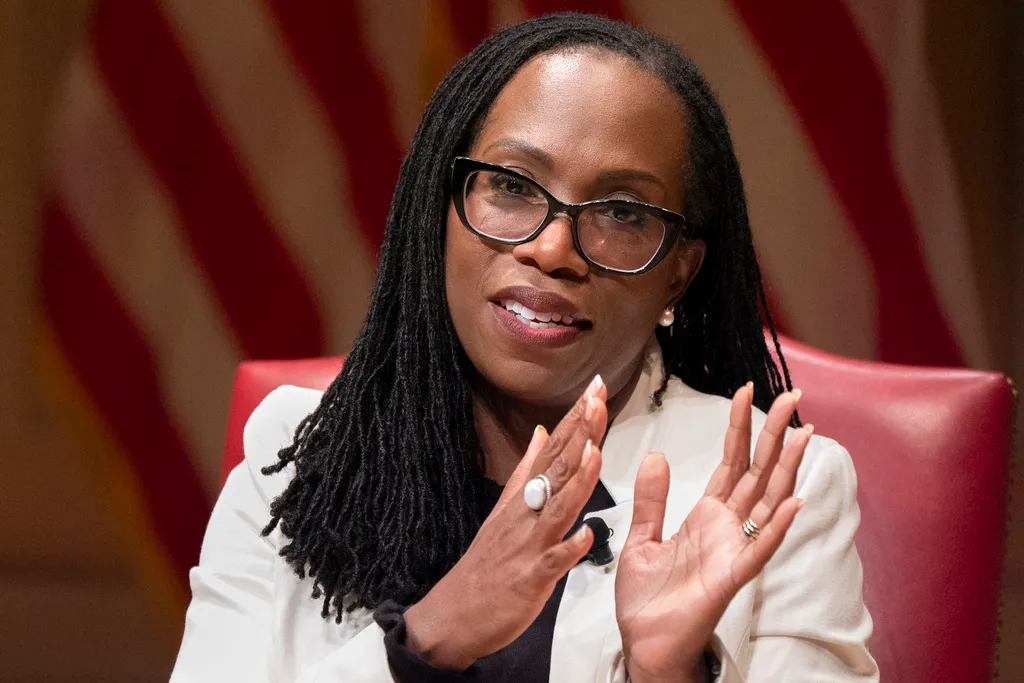
Justice Ketanji Brown Jackson expressed concern about a Supreme Court ruling allowing a congressman to continue with a lawsuit challenging the counting of mail-in ballots received after Election Day.
The Supreme Court ruling allows Representative Michael Bost, a Republican from Illinois, and two other political candidates to move forward with a lawsuit that contends counting ballots received after Election Day violates federal law. Under Illinois law, election officials are allowed to count mail-in ballots postmarked or certified no later than Election Day and received within two weeks of Election Day.
“Alarmingly, today’s ruling also has far-reaching implications beyond Bost’s election, since dispensing with our usual standing requirements opens the floodgates to exactly the type of troubling election-related litigation the Court purportedly wants to avoid,” Jackson, who was appointed to the court by President Joe Biden, wrote in a dissent released on Wednesday.
Read More on News
Justice Sonia Sotomayor joined Jackson’s dissent.
...
Why It Matters
Chief Justice John Roberts, appointed by President George W. Bush, delivered the majority opinion, writing, “Candidates have a concrete and particularized interest in the rules that govern the counting of votes in their elections, regardless whether those rules harm their electoral prospects or increase the cost of their campaigns.”
Jackson argued that the Court’s ruling will allow candidates to challenge elections “without offering any theory of how such rules harm them personally.”
Roberts said in the majority opinion that alternative approaches to determine standing, such as risk of election loss or failure to reach a certain vote threshold, “could channel many election disputes to shortly before election day—or worse, after.”
What To Know
Bost’s case was dismissed in district court, and the Court of Appeals for the 7th Circuit upheld the judgment on the ground that the petitioners lacked standing. The Supreme Court’s ruling reversed the appeals court’s judgment.
The Court majority ruled that candidates have an interest in the integrity of elections and the democratic process. The justices said that a different approach would require judges to determine substantial risk of harm to a candidate or their likelihood of winning or losing.
“Even if they could do so, this approach would still channel many disputes into postelection litigation. To bring a preelection suit, a candidate would have to plead and prove that voters who take advantage of the challenged rule will favor his rivals. Doing so while campaigning for those same voters’ support is not just awkward, but politically dangerous,” Roberts wrote.
Justice Amy Coney Barrett, appointed by President Donald Trump, wrote a concurring opinion, joined by President Barack Obama appointee Justice Elena Kagan. Barrett said she agreed that Bost has standing, but disagreed with the Court's reasoning “because he has suffered a traditional pocketbook injury, not because of his status as a candidate.”
“I cannot join the Court’s creation of a bespoke standing rule for candidates,” Barrett wrote. “Elections are important, but so are many things in life. We have always held candidates to the same standards as any other litigant.”
Jackson said Barrett “rightly rejects” the Court’s candidate-standing rule, but her pocketbook theory “is also insufficient to support Bost’s standing.”
What People Are Saying
Chief Justice John Roberts, delivering the majority opinion: “As a candidate for office, Congressman Bost has standing to challenge the rules that govern the counting of votes in his election.”
Justice Ketanji Brown Jackson, in a dissent: “Bost has plainly failed to allege facts that support an inference of standing under our established precedents. By carving out a bespoke rule for candidate-plaintiffs—granting them standing ‘to challenge the rules that govern the counting of votes,' simply and solely because they are 'candidate[s]' for office, ... the Court now complicates and destabilizes both our standing law and America’s electoral processes.”
What Happens Next
The case was returned to a lower court for further proceedings consistent with the Supreme Court's opinion.
Do you have a story that Newsweek should be covering? Do you have any questions about this story? Contact LiveNews@newsweek.com.
View 0 Comments
Submit Correction
View Editorial & AI Guidelines