...

By Suzanne Blake
Reporter
0
Share
Newsweek is a Trust Project member
See more of our trusted coverage when you search.Prefer Newsweek on Googleto see more of our trusted coverage when you search.
A renewed push for Medicare for All has gained traction, and it’s not just amongst progressive lawmakers.
A new poll suggests universal healthcare has appeal far beyond the Democratic base, including in conservative-leaning battleground congressional districts.
The survey, which was commissioned by Pramila Jayapal's Medicare for All political action committee and conducted by Democratic polling firm Greenberg Quinlan Rosner Research, found that 94 percent of Democrats support a universal, government-run health care system. That’s from 90 percent a year ago.
Read More on Politics
Support was also there among 60 percent of independents as well as 55 percent of voters in conservative-leaning battleground districts and 19 percent of voters who backed President Donald Trump in the 2024 election.
“Medicare for All is becoming more popular because people are starting to understand that it could potentially be less costly than our current system,” Kevin Thompson, the CEO of 9i Capital Group and the host of the 9innings podcast, told Newsweek.
Why It Matters
Health care consistently ranks among voters' top concerns, and the new polling suggests Medicare for All may have broader appeal than previously believed.
The fact that a majority of respondents in conservative-leaning battleground districts supported the idea could have larger implications for Democrats.
These districts are critical to determining control of Congress, and many Democratic candidates in competitive races have historically avoided embracing Medicare for All out of concern that the proposal could alienate moderate or swing voters.
...
What To Know
“Medicare for All is going to continue to attract support across party lines, as healthcare affordability is becoming increasingly difficult for more Americans,” Alex Beene, a financial literacy instructor for the University of Tennessee at Martin, told Newsweek.
“Its appeal in traditionally conservative areas reflects less of an ideological transformation than widespread dissatisfaction with a system in which Americans spend massive amounts on healthcare while many still struggle with premiums, deductibles, and access to providers,” he added.
The poll surveyed 1,200 likely 2026 voters nationwide and oversampled voters in battleground districts.
However, not everyone is convinced Medicare for All has broad political viability.
The center-left Searchlight Institute recently urged Democrats to pursue universal coverage without replacing private insurance.
“Every Democrat should be able to say that we want universal healthcare in this country,” the group's president, Adam Jentleson, told Semafor. “But any time you talk about healthcare, you either fall in the Medicare for All lane, or for incremental reforms. That is not the path forward.”
Furthermore, a September survey by Republican polling firm FabrizioWard for the conservative group Seniors Matter for America found opposing results from the Jayapal poll. In that survey, voters in competitive congressional districts preferred a Republican candidate by a 50 percent to 38 percent margin when told the Democrat supported replacing existing coverage with a government-run health system.
What Lawmakers Are Saying
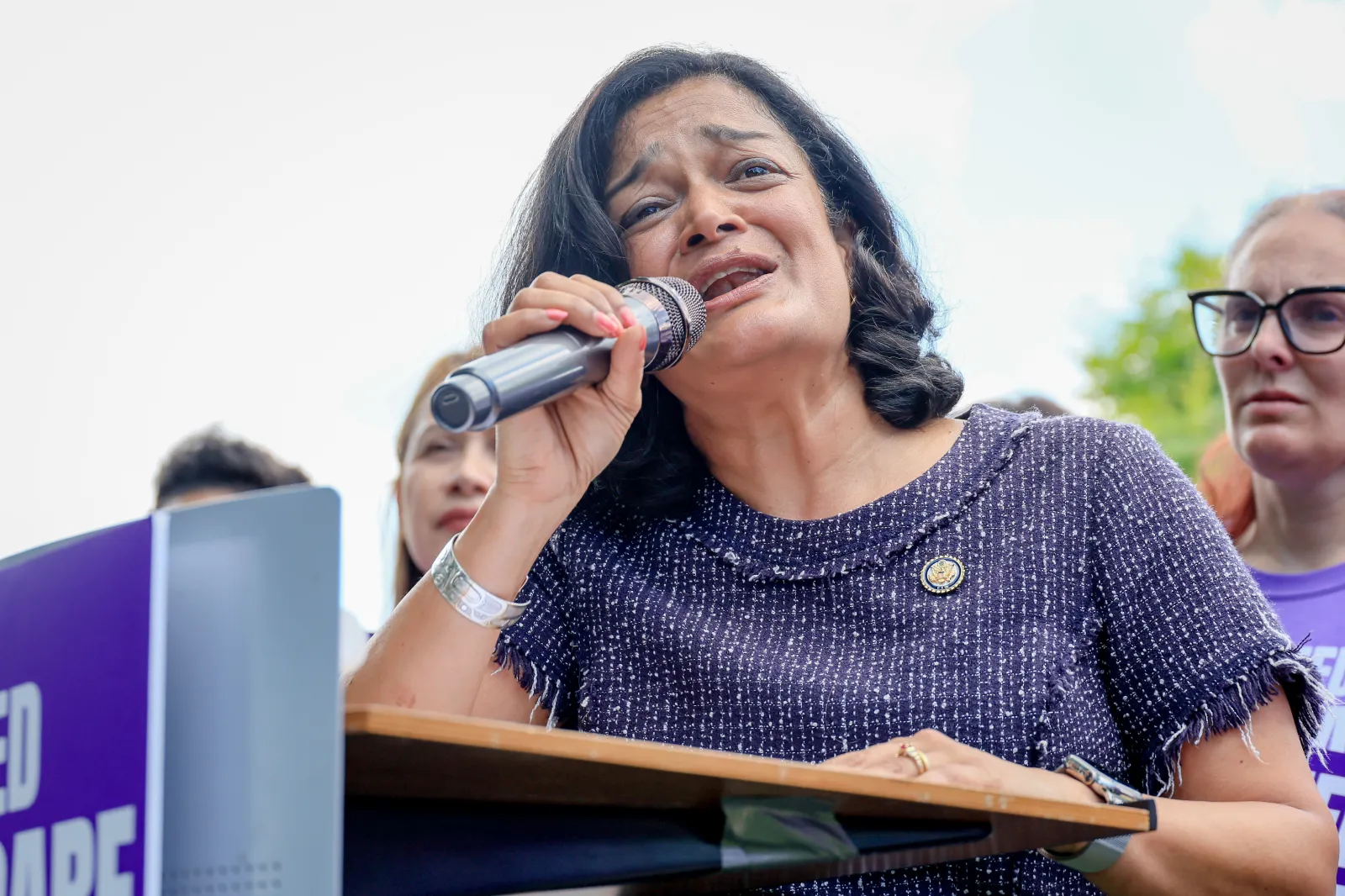
Jayapal, a longtime proponent for a single-payer health care system, told POLITICO that she hopes to use the next several years to build support within the Democratic party.
"I'm very clear-eyed that you can't pass a big bill like universal health care without a trifecta," Jayapal told the outlet. "So what I want to do is use the next two years to move the discussion forward and prepare the world for a trifecta in 2029."
Jayapal also said she plans to urge Democratic colleagues to hold the first-ever congressional markup of a Medicare for All bill when lawmakers return to Washington in October.
What Medicare for All Would Do
Medicare for All generally refers to a single-payer health care system in which the federal government provides comprehensive health insurance coverage for all Americans.
While different versions have been proposed over the years, the concept would largely replace the current mix of employer-sponsored insurance, private plans and government programs with a national health insurance system.
“Healthcare today is often unnecessarily convoluted, with people not knowing what they are paying for or even what they are being charged for when receiving treatment,” Thompson said, adding that Medicare for All could theoretically be cheaper.
Still, while this type of system would likely expand coverage and eliminate many out-of-pocket medical expenses, the concerns of higher taxes and potential disruptions to the existing health insurance market keep many from supporting the idea.
Globally, most countries already have universal or near-universal coverage, although they get there through very different systems, said Michael Ryan, a finance expert and the founder of MichaelRyanMoney.com.
“I think the surprising thing is that Medicare for All is still treated as an unusually radical idea when the broader concept of universal health coverage is pretty ordinary around the world,” Ryan told Newsweek.
“The U.S. remains the outlier. That helps explain why I think the idea can eventually cross political lines.”
What Happens Next
Medicare for All still faces significant political obstacles.
While Democrats could gain control of the House, Senate or both chambers in November, Jayapal has said that passing a universal health care bill would likely require unified Democratic control of Congress and the White House.
“I do eventually believe some form of Medicare for All could come to fruition, but not under the current or next administration,” Thompson said. “It will take serious time, debate, and discussion to get that passed through Congress.”
Contact Newsweek editors on this story: Jason Lemon and Cristina Diciu.
View 0 Comments
Submit Correction
View Editorial & AI Guidelines