10
Loading video...

By Daniel Bush
White House Correspondent
0
Share
Newsweek is a Trust Project member
See more of our trusted coverage when you search.Prefer Newsweek on Googleto see more of our trusted coverage when you search.
It's official: JD Vance is Donald Trump's heir apparent.
The first-term Ohio senator accepted the Republican Party's 2024 vice presidential nomination Wednesday in a speech at the Republican National Convention introducing himself to the nation and offering a glimpse of the GOP's post-Trump future.
Vance gave the keynote address on a night focused on foreign policy and national security, as Republicans argued the country was weaker at home and abroad under President Joe Biden.
Read More on U.S.
The evening included an appearance by the families of U.S. service members who died in the United States' 2021 withdrawal from Afghanistan, as well as remarks from the parents of an American taken hostage by Hamas in its attack on Israel last fall.
...
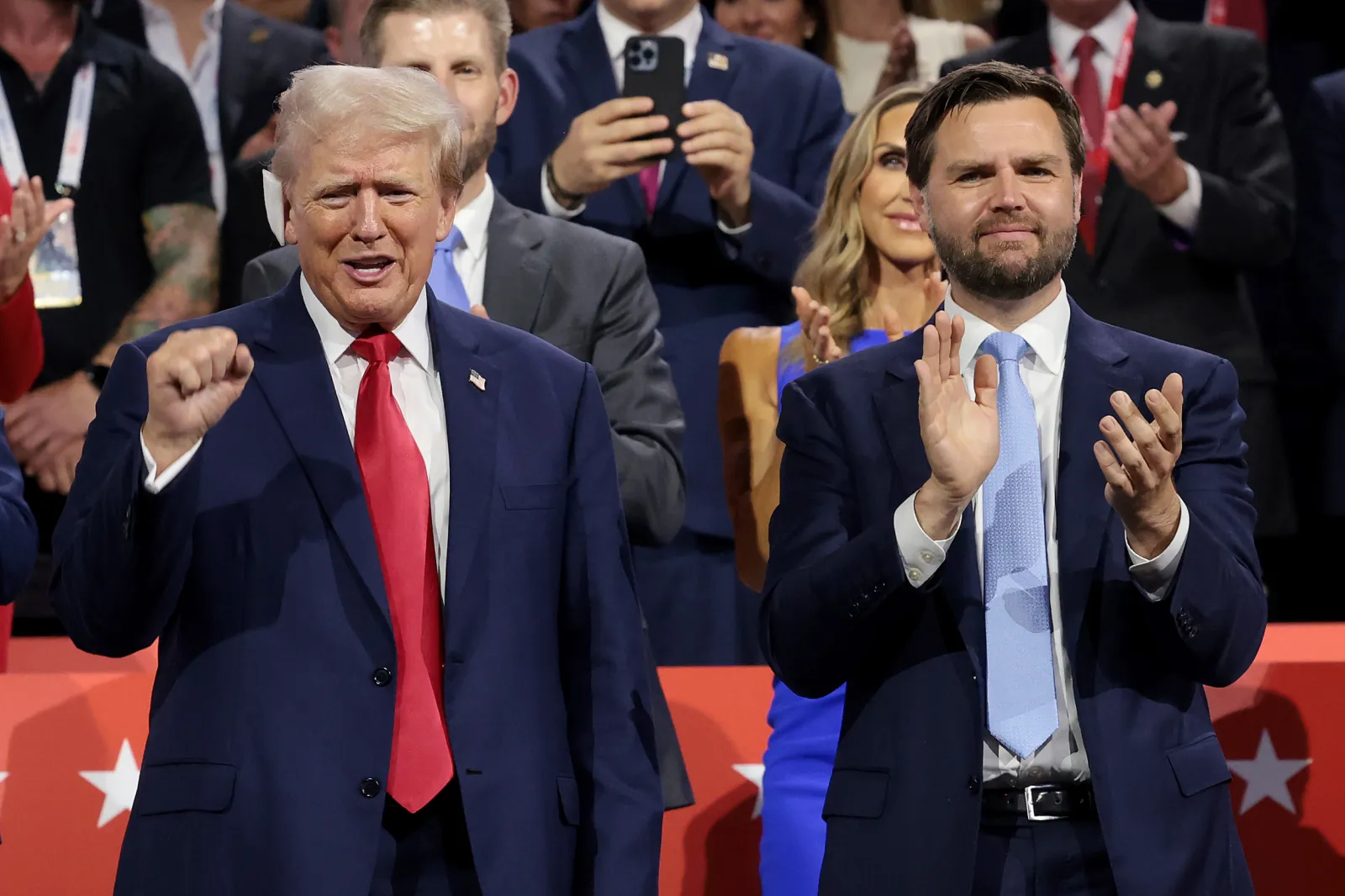
Trump watched the proceedings from a VIP box inside the arena as he has all week, with a bandage over his right ear that he's worn since his assassination attempt last Saturday.
Here are key takeaways from Day 3 of the RNC.
Bridge to a Younger Generation
In a video message ahead of Vance's speech, a narrator said the Ohio senator embodied an "American story" that's "just getting started." The message was clear: Trump may be the current leader of the Republican Party, but Vance is on deck.
Vance, who turns 40 next month, is the first millennial on a major party presidential ticket. If Trump wins in November, Vance would become the second youngest vice president in U.S. history (Richard Nixon was also 40 at the time he became vice president; John C. Breckinridge was the youngest, at 36).
By choosing Vance, Trump anointed a potential successor nearly four decades his junior in a move aimed at neutralizing concerns about his own age. If reelected, Trump, who is 78, would be the second oldest president in history behind only Biden, who is 81 and facing pressure from Democrats to drop out of the race amid questions about his age and mental acuity.

...
The nomination of Vance also gave the RNC a jolt of fresh energy that would have been lacking if Trump had chosen an older running mate. Vance didn't explicitly criticize Biden's age, as other Republicans have done throughout the convention. But he tied the president to decades-old policies, like the passage of the North American Free Trade Agreement, that underscored how long Biden has been on the national political scene.
As Vance put it: "Joe Biden has been a politician in Washington longer than I've been alive."
Rust Belt Strategy
While Vance took a subtle jab at Biden's age, his appeal to Rust Belt voters was as explicit as can be. Vance repeatedly mentioned four states—Ohio, Michigan, Pennsylvania and Wisconsin—during his speech Wednesday, previewing the message he'll take on the campaign trail after the convention.
Trump narrowly won Michigan, Pennsylvania and Wisconsin in 2016 but lost all three in 2020, helping sink his reelection bid. In Vance, Trump now has an Ohio native as his running mate who launched his career with a memoir about his family's working-class roots in the region.
Vance leaned into his origin story Wednesday. He spoke of his family's burial plot in Kentucky and told stories about his grandmother, a woman he called "Mamaw," who left behind 19 loaded handguns scattered throughout her house after she died, according to Vance. "That's who we fight for. That's American spirit," Vance said of his grandmother.
The colorful childhood tales drew loud applause from the RNC crowd. But they betrayed a more calculated political strategy by Trump to boost support with the white working-class voters he needs to beat Biden in November.
Vance's Trump Flip-Flop
In a 2016 interview with Charlie Rose, Vance described himself as a "Never Trump guy." Vance also made a comparison between Trump and Hitler in a message to a college roommate, called Trump "reprehensible" in a tweet, and said in another social media post that he planned to vote for a third-party candidate in 2016.
That was then. In recent years, Vance has said he was wrong about Trump. Since his election to the U.S. Senate in 2022, Vance has touted Trump's record in office and emerged as an outspoken defender of Trump.
Predictably, Vance didn't mention his earlier disagreements with Trump on Wednesday. He hailed Trump as a strong leader and sprinkled his acceptance speech with warm personal anecdotes about the former president.
Politicians often flip-flop. But there are few, if any, examples in recent political history that compare. It's a remarkable about-face by Vance—and a highly unusual foundation for a partnership between running mates who might serve together in the White House.
All In on America First
As a senator, Vance has been a vocal critic of continued U.S. aid to Ukraine, joining a growing number of Republicans in Congress who support Trump's "America First" foreign policy.
Ukraine wasn't a top issue Wednesday at the RNC. But Vance and other Republican officials embraced Trump's worldview while arguing that America needed stronger leadership in global affairs after four years of Biden.
"A nation led by President Trump is a nation stronger, safer and more secure," said Lee Zeldin, a former House Republican from New York, in a sentiment echoed by multiple speakers throughout the night.
Biden drew heavy criticism Wednesday for the U.S. withdrawal from Afghanistan and his response to the Hamas attack against Israel. Vance also singled out Biden for supporting the "disastrous invasion of Iraq," and channeled Trump by chiding U.S. allies that don't spend more on defense.
"No more free rides for nations that betray the generosity of the American taxpayer," Vance said, in a reference to NATO members that do not meet their defense spending obligations. He added that, under a second Trump presidency, the United States "will put the citizens of America first."
Trump's isolationist rhetoric was at odds with the Republican Party's establishment wing when he first ran for president in 2016. Eight years later, Trump's approach has reshaped the party.
View 0 Comments
Submit Correction
View Editorial & AI Guidelines