...

By Maria Morava
Relationships Reporter
0
Share
Newsweek is a Trust Project member
See more of our trusted coverage when you search.Prefer Newsweek on Googleto see more of our trusted coverage when you search.
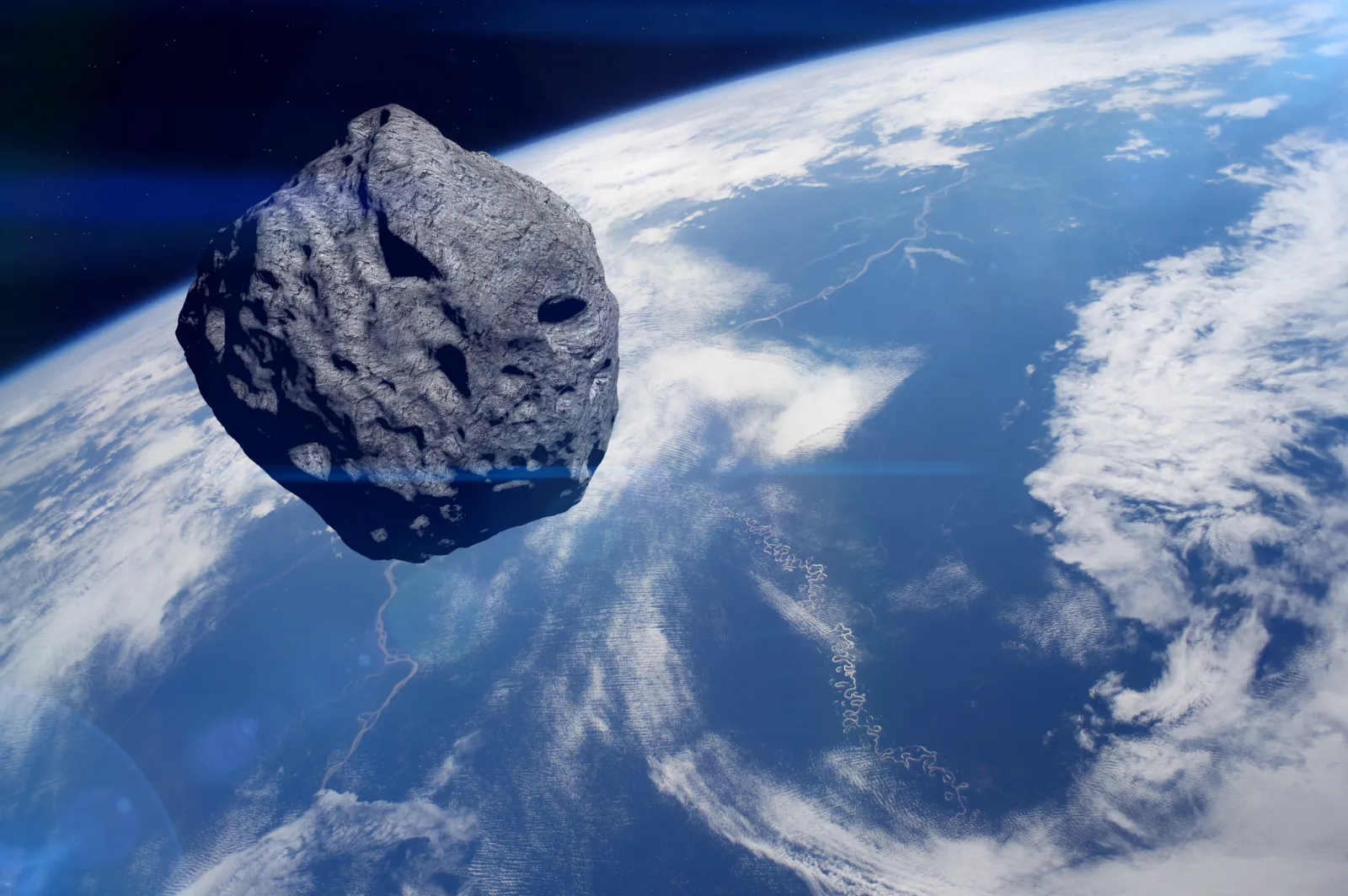
An asteroid is the most likely reason the dinosaurs went extinct—but could something similar happen to us?
A new study has compared the likelihood of a devastating asteroid impact to other causes of death, revealing some surprising results about our chances of being struck in our lifetime.
The research, set to be published in The Planetary Science Journal, aims to put these cosmic risks into a clearer perspective and highlight the importance of planetary defense initiatives.
Read More on Science
...
The Odds of a Killer Asteroid
In their study, physicist professor Carrie Nugent of the Olin College of Engineering in Massachusetts and her colleagues simulated the orbits of five million near-Earth objects (NEOs) with diameters greater than 140 meters. By tracking potential Earth impacts over 150 years, they were able to calculate the frequency of such events.
The authors found that the chance of an asteroid greater than 140 meters hitting the Earth is more likely than both the chance of an individual being struck by lightning—or attacked by a coyote.
Analysis also revealed that the estimated impact frequency for NEOs larger than 140 meters is about one every 11,000 years.
According to the researchers, the work provides a framework for policymakers to "prioritize planetary defense and encourage funding for asteroid detection and deflection missions if need be."
What Would Happen if an Asteroid Hit Earth?
The effects of an asteroid impact would vary widely, depending on several factors, including its size, where it lands and its velocity.
The researchers said that a 140−200 meter NEO landing in the ocean may have zero fatalities, while a slightly larger one has the chance of affecting one million people if it hits a highly populated area. Even larger NEOs would affect the entire world if they hit.
Even if a NEO were to strike Earth, the researchers noted, "there is still a good chance that most people would survive if it were on the smaller end."
The Case for Planetary Defense
The study is not meant to fuel fears but to provide a clear argument for planetary defense by putting the risks of asteroid impacts into context.
The researchers pointed to NASA's Double Asteroid Redirection Test (DART) Mission, which proved that humans can design spacecraft capable of deflecting asteroids.
A recent report from the National Academies explored planetary defense, the researchers noted, adding: "The committee considers work on this problem as insurance, with the premiums devoted wholly toward preventing the tragedy."
This perspective ultimately frames the effort not as simply a response to an imminent threat—but as an essential safeguard for the future of the planet.
Do you have a tip on a science story that Newsweek should be covering? Do you have a question about asteroids? Let us know via science@newsweek.com.
Reference
Nugent, C. R., Andersen, K. P., Bauer, J. M., Jensen, C. T., Kristiansen, L. K., Hansen, C. P., Nielsen, M. M., & Vestergård, C. F. (2025). Placing the Near-Earth Object Impact Probability in Context. The Planetary Science Journal, 6(8), 190. https://doi.org/10.3847/PSJ/adf0e3
View 0 Comments
Submit Correction
View Editorial & AI Guidelines