10
Loading video...

By Anna Skinner
Associate News Editor
0
Share
Newsweek is a Trust Project member
See more of our trusted coverage when you search.Prefer Newsweek on Googleto see more of our trusted coverage when you search.
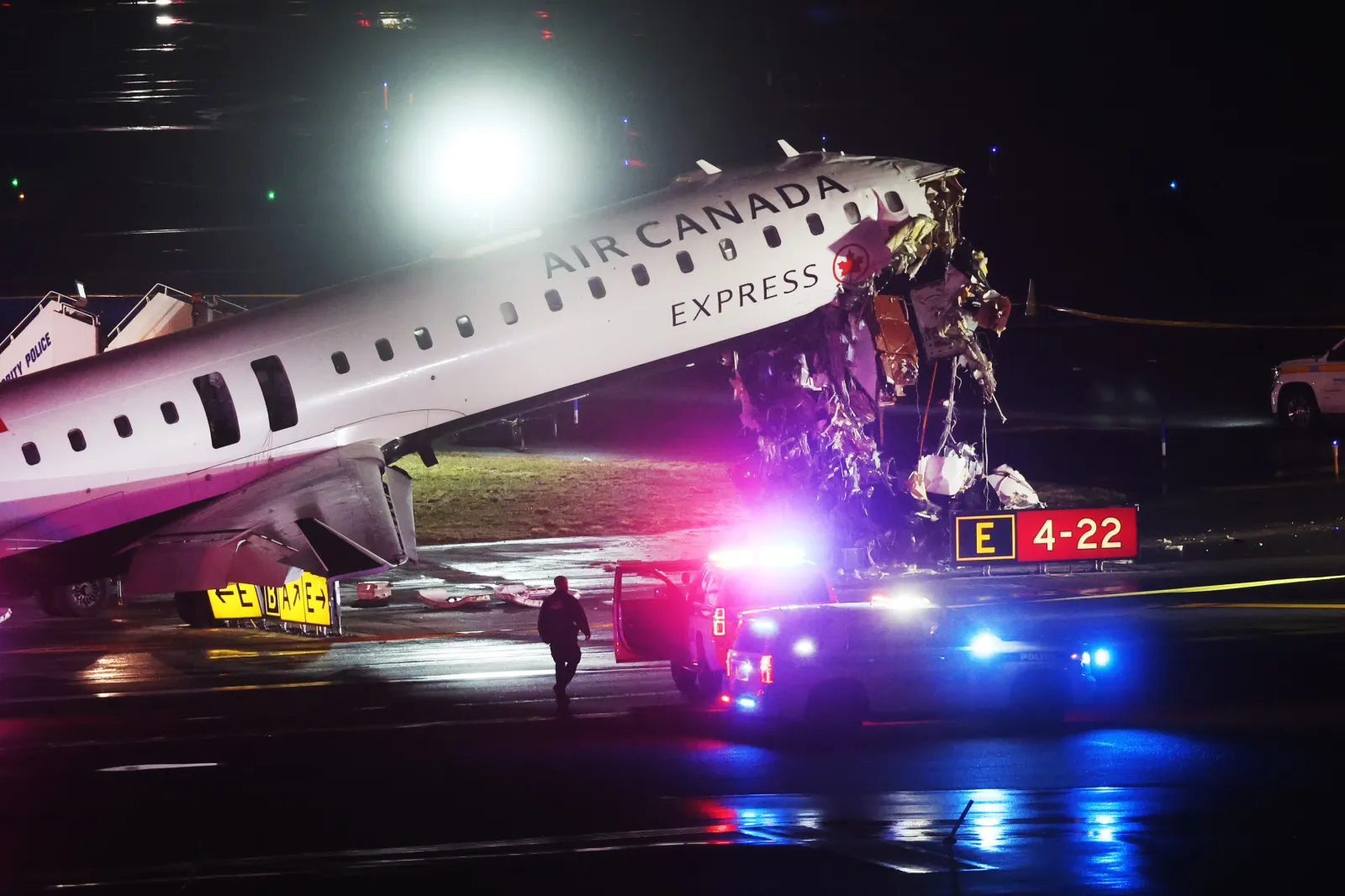
A detailed meteorological snapshot is shedding new light on the conditions present when an Air Canada Express flight collided with a Port Authority fire‑rescue vehicle late Sunday night at New York’s LaGuardia Airport, killing two pilots and injuring dozens of passengers and emergency personnel.
The collision occurred shortly after 11:45 p.m. local time, when the Jazz Aviation-operated Air Canada Express CRJ‑900 struck a Port Authority aircraft rescue and firefighting truck on the runway, a Federal Aviation Administration (FAA) spokesperson told Newsweek.
The aircraft had just arrived from Montreal with 76 people on board. Both the pilot and co‑pilot were killed, and 41 passengers and crew were taken to hospitals, authorities said. The FAA and the National Transportation Safety Board (NTSB) are investigating, with the National Transportation Safety Board (NTSB) in charge of the investigation.
Read More on Weather
...
The Port Authority of New York and New Jersey said in a statement that the jet had struck the vehicle, which was responding to a separate incident around 11:45 p.m. The airport remained closed as of 10:20 a.m. Monday morning. Photos and videos from the scene showed severe damage to the front of the aircraft, with cables and debris hanging from a mangled cockpit. Nearby, a damaged emergency vehicle lay on its side.
In audio air traffic audio reviewed by Newsweek, moments after the fire-rescue truck received permission to cross the runway, a controller is heard repeatedly telling it to stop.
Weather During the LaGuardia Plane Crash
Light rain was falling and mist was present at the time of the crash, AccuWeather chief meteorologist Jonathan Porter said in an email sent to Newsweek on Monday morning.
"Visibility decreased from 7 miles at 11 p.m. Eastern time to 4 miles by midnight," Porter said. "Between 11 p.m. and midnight, 0.07 of an inch of rain fell at the airport. Around the time of the incident, there was a northeast wind at 8 miles per hour with an air temperature of 49 degrees F at 11 p.m. Eastern and 47 degrees F at midnight. The ceiling, defined as the height of lowest broken or overcast cloud layer, was reported as 9,500 feet at 11 p.m. Eastern and 9,000 feet at midnight.”
While federal investigators have not yet indicated that weather contributed directly to the crash, the deteriorating visibility, ongoing light rain, and mist described by Porter may become factors in the NTSB's analysis. Airport operations were already strained due to a separate emergency response earlier in the night, raising questions about runway coordination amid multiple incidents.
Dozens of passengers were evaluated for injuries ranging from minor to serious, with 32 people having since been released from the hospital. New York Governor Kathy Hochul called the incident “heartbreaking” and expressed condolences to the victims and their families.
In a polarized era, the center is dismissed as bland. At Newsweek, ours is different: The Courageous Center—it's not "both sides," it's sharp, challenging and alive with ideas. We follow facts, not factions. If that sounds like the kind of journalism you want to see thrive, we need you.
When you become a Newsweek Member, you support a mission to keep the center strong and vibrant. Members enjoy: Ad-free browsing, exclusive content and editor conversations. Help keep the center courageous. Join today.


View 0 Comments
Submit Correction
View Editorial & AI Guidelines