10
Loading video...

By Joe Edwards
Reporter
0
Share
Newsweek is a Trust Project member
See more of our trusted coverage when you search.Prefer Newsweek on Googleto see more of our trusted coverage when you search.
Lake Powell has been thrown a temporary lifeline as federal officials move to prop up its falling water levels, but the emergency measure could carry consequences for ecosystems and communities across the Colorado River Basin for years to come, according to officials and experts.
In an effort to stabilize the reservoir and protect hydropower generation at Glen Canyon Dam, the U.S. Bureau of Reclamation (USBR) announced plans last month to begin releasing water from Flaming Gorge Reservoir while also reducing downstream releases to Lake Mead. The moves are intended to prevent Lake Powell from dropping below critical thresholds, but officials and experts warn it may strain future water supplies, disrupt recreation and local economies,, reduce power output downstream, and damage fish populations.
Flaming Gorge Release
Flaming Gorge Reservoir, located mainly in southwestern Wyoming and partly in northeastern Utah, is formed by a thin-arch dam on the Green River, a major tributary of the Colorado River. The Colorado River—home to Lakes Mead and Powell, the largest and second-largest man-made reservoirs in the U.S., respectively—irrigates more than 5 million acres of farmland and supplies water to 40 million people across the West, according to the National Agricultural Law Center.
Read More on News

...
Stretching about 1,450 miles, the river serves seven basin states—Wyoming, Utah, Colorado and New Mexico in the Upper Basin; Arizona, California and Nevada in the Lower Basin—as well as Mexico. These states have been negotiating new water-sharing agreements to replace those set to expire this year, though no consensus has been reached.
USBR warned last month that prolonged drought had reduced Colorado River system storage to about 36 percent capacity, with extreme March heat and record-low snowpack worsening conditions. It said those factors heighten risks to critical water and power infrastructure, as projections show that Lake Powell could fall below the minimum level of water needed for Glen Canyon Dam to generate electricity by August without major intervention.
If levels drop below the 3,490-foot minimum power pool, releases would be restricted to outlet works, increasing operational risks, downstream impacts and supply uncertainty while cutting power generation, it said.
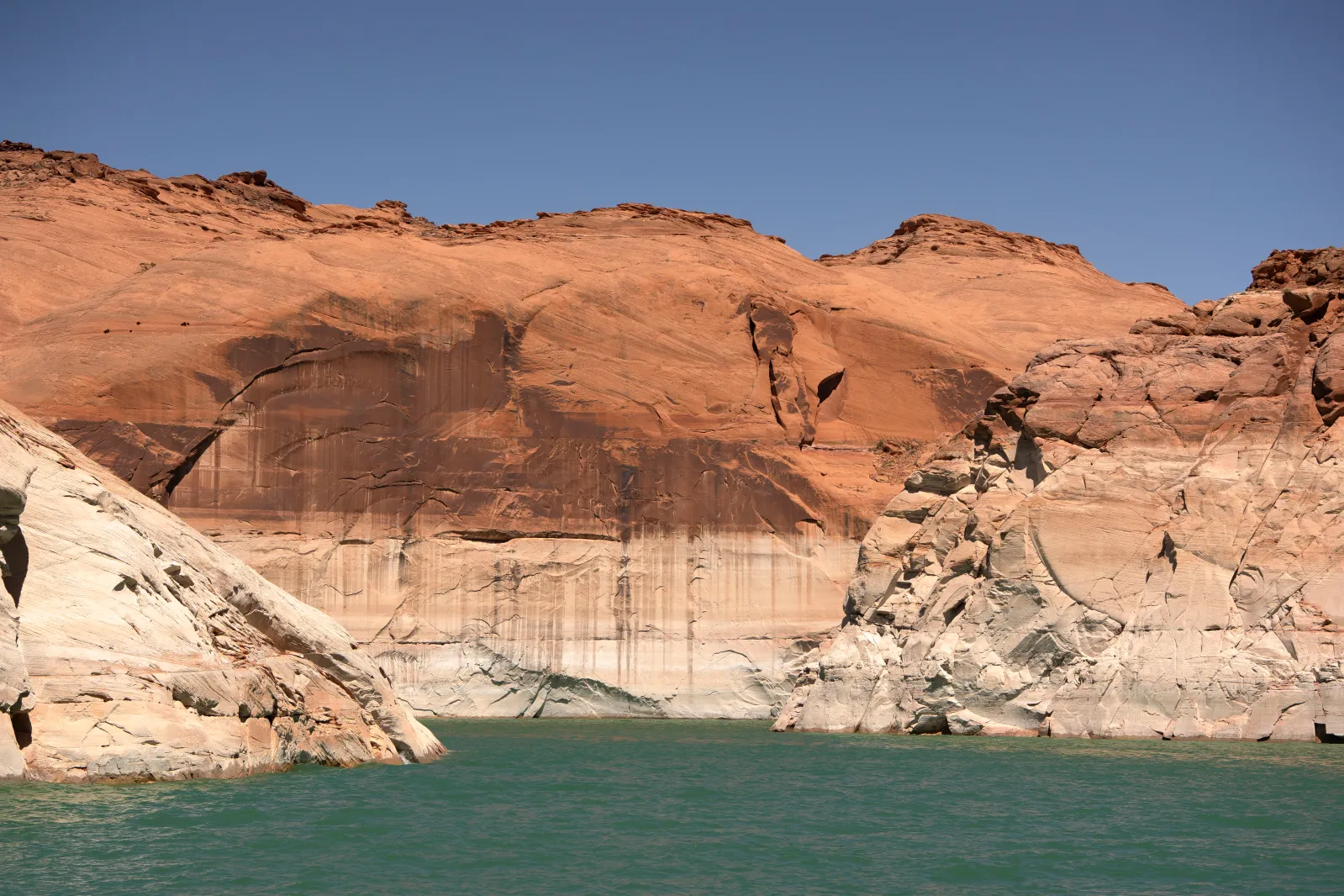
...
In response, USBR announced plans in April to stabilize Lake Powell by releasing 660,000 acre-feet to 1 million acre-feet from the upstream Flaming Gorge Reservoir through April 2027, as well as reducing Powell's downstream releases to Lake Mead by 1.48 million acre-feet through September 2026, aiming to raise Powell's levels by about 54 feet by 2027.

...
Flaming Gorge Releases Raise Long-Term Concerns
Wyoming Water Commissioner Brandon Gebhart said in a statement reported by KSJD that the move could close three of five boat ramps at the reservoir.
“What we are approving...will have significant negative impacts on our water resources, local economies and recreation both this year and for years to come," he said, according to the outlet. "It will also impair our ability to respond to poor hydrologic conditions in the future. Our consideration and approval are not taken lightly, and we wouldn't be recommending this release except for the historically dire conditions.”
Becky Mitchell, who represents Colorado on the Upper Colorado River Commission, said in a statement sent to Newsweek: “The Upper Division States are taking unprecedented action to protect critical elevations at Lake Powell in the face of the dire conditions this year.”
The statement added that the “significant volume of the release may limit the availability of water to respond in future dry years, and impact flexibility and available resources in the future. This highlights the need to move to more sustainable, supply-driven operations at Lake Powell and Lake Mead that would not require this type of crisis management.”
'Desperate Move'
Doug Kenney, director of the Western Water Policy Program at the University of Colorado Boulder, described the rapid drawdown of Flaming Gorge to prop up Lake Powell as “a desperate move.”
“For the benefits to exceed the costs, it really needs to be paired with a plan that uses the 1-year reprieve to finally stabilize and rebuild storage in both reservoirs. I don't see any evidence that such a plan exists,” Kenney told Newsweek.
Federal water managers have warned that Glen Canyon Dam’s ability to pass water downstream is reduced if Lake Powell falls below the minimum power pool level.
At that point, water can no longer be released through the dam’s powerplant penstocks (the large pipes that feed the turbines), and releases must rely on the river outlet works instead.

...
“Losing the ability to generate hydropower at Glen Canyon Dam is a very manageable problem for the western grid. What's not so easily resolved is the fact that the hydropower penstocks are, by far, the most effective way to release water downstream from Lake Powell," Kenney said.
“When water levels drop below minimum power pool, Glen Canyon Dam functions more like a plug than a gate. Unless and until that infrastructure constraint is addressed—perhaps by drilling new outlet gates further down the face of the dam—that's very bad news for every water user downstream.”
Power Concerns
USBR also said it planned to cut annual releases from Lake Powell to Lake Mead by 1.48 million acre-feet—from 7.48 to 6.0—through September 2026 as part of its effort stabilize the system, a reduction of about 20 percent.
The agency said cutting releases from Lake Powell will speed up the drop in Lake Mead’s levels, potentially reducing Hoover Dam’s power-generating capacity by as much as 40 percent as soon as this fall.
“Reclamation and its lower basin partners are collaborating to conserve water in Lake Mead and maintain its water levels, even as releases from Lake Powell are planned to decrease,” the agency said.

...
Jordy Fuentes, director of the Arizona Power Authority, which manages Arizona's allocation of hydroelectric power generated from the Hoover Dam said the dam’s electricity price could rise enough over the coming year to make it "unaffordable" for many current users, according to Tucson.com, though it noted not all experts concurred.
Recreational Impacts
Beyond the obvious water and power concerns, USBR has also acknowledged the move will also have recreational impacts across several popular sites.
Lower flow rates in the Grand Canyon will affect rafting conditions and may make fishing more challenging, while at Lake Mead National Recreation Area, lower water levels may further limit boating access.
Climate change-driven water levels, as well as 20 years of ongoing drought, have reshaped the lake's shorelines, according to the National Park Service. As Lake Mead’s water levels keep falling, extending boat launch ramps is becoming increasingly challenging and costly, it warned.
The plans could also have significant implications for local fish species in Flaming Gorge Reservoir.
“The greatest biological concern from a sustained drawdown is the potential impact to the kokanee salmon fishery, which is important recreationally, economically and biologically. Kokanee are one of the most frequently targeted sport fish in Flaming Gorge Reservoir, and they also serve as the primary forage base supporting the reservoir’s trophy lake trout population,” Wyoming Game and Fish Department Regional Fisheries Biologist John Walrath told Newsweek.
Natural kokanee reproduction is a key driver at Flaming Gorge, contributing about 40-80 percent of each year's class depending on conditions. While stocking can help offset poor spawning years, it cannot fully sustain the fishery if natural reproduction declines, Walrath said.

...
Kokanee spawn along shorelines in October, with eggs overwintering until April, leaving them vulnerable to dewatering—research shows drawdowns of more than 10 feet during this period can reduce production by about 20 percent, even when deeper habitat is available, Walrath added.
“Current projections indicate Flaming Gorge Reservoir could reach approximately 6,006 feet (34 feet below full pool) in elevation by October 2026, which is when kokanee spawning begins. That would be one of the lowest elevations the reservoir has experienced since filling," he said.
“Because the reservoir has spent very little time at or below that elevation, much of the available shoreline gravel below that point may contain higher levels of fine sediment and may not provide high-quality spawning habitat. As a result, kokanee may be forced to spawn in shallow areas or in habitat that would lead to poorer egg survival.
“The timing of additional fall and winter releases is especially important. If kokanee spawn within a narrow band of suitable gravel and subsequent releases draw the reservoir down through that same elevation range, a large portion of the naturally produced year class could be lost. In a worst-case scenario, if only a limited band of clean spawning gravel is available and the reservoir drops through that band during incubation, natural kokanee production for that year could be substantially reduced or considered a failed year-class.”
Some impacts would emerge over time, as a weak kokanee year class leads to fewer fish for anglers and less forage for predators in later seasons, Walrath said. Repeated poor reproduction could lower kokanee numbers, reduce catch rates and angler satisfaction, and affect the growth and condition of multiple trout species.
“Because Flaming Gorge is managed as a complex, multi-species fishery, impacts to kokanee and forage availability can ripple through the reservoir," he added said. "The immediate concern is loss of spawning and nursery habitat; the longer-term concern is reduced recruitment, less forage, slower predator growth, poorer fish condition, and reduced angling opportunity over time.”
View 0 Comments
Submit Correction
View Editorial & AI Guidelines