...

By Joe Edwards
Reporter
0
Share
Newsweek is a Trust Project member
See more of our trusted coverage when you search.Prefer Newsweek on Googleto see more of our trusted coverage when you search.
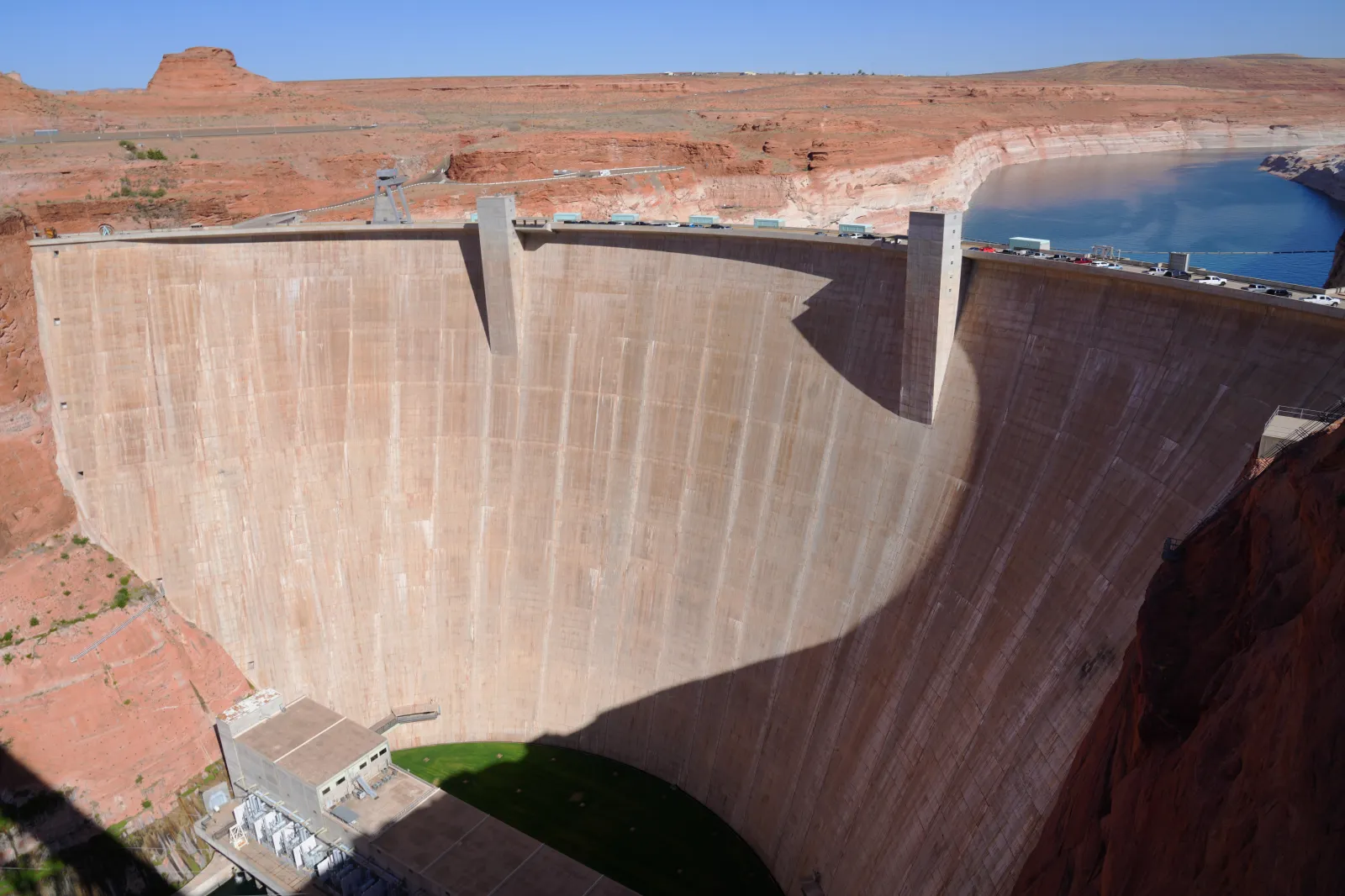
The long-running effort to keep water levels high enough at Lake Powell has prompted a more radical proposal from one Colorado River advocate: send the reservoir's water downstream to Lake Mead and effectively retire Lake Powell as a primary storage reservoir.
Lake Powell, the second-largest reservoir in the U.S., sits along the drought-stricken Colorado River along with Lake Mead—the nation’s largest reservoir. The river supplies water to some 40 million people across the West, as well as providing irrigation for more than 5 million acres of farmland.
What to Know
"If we have the courage to take a step back and think about, 'Why was Glen Canyon Dam built? Is that still working?' The answer is no," said Zanna Stutts, program director at the Glen Canyon Institute, as reported by KUTV in Salt Lake City.
Read More on News
Federal water managers at the Bureau of Reclamation earlier this year ordered emergency actions to shore up Lake Powell, moving water from upstream Flaming Gorge reservoir and reducing releases to Lake Mead. KUTV said Stutts considers the measures a temporary fix.
"We can't keep doing this," Stutts said. "This is reservoir triage that we're working with right now, instead of thinking about long-term strategies to work with the actual amount of water that the river can provide. If we think about why the Bureau of Reclamation is taking these actions to protect elevation...at Lake Powell, it's because of the infrastructure limitations of the dam."
...
Stutts said the dam was built based on mid-20th-century expectations about Colorado River flows, which have declined by about 20 percent since approximately 2000, meaning the river now carries less water than designers anticipated when the project was conceived, as per KUTV.
Stutts said Glen Canyon Dam lacks a low-level outlet, meaning about 6 million acre-feet of water below a certain elevation cannot be released. She said that while Lake Powell is often reported as 23 percent full, much of that water is effectively inaccessible, and argued that modifications to the dam's infrastructure should be considered.
“Lake Mead and Lake Powell are the nation's two largest reservoirs," she said. "They are both sitting at around a quarter full. And so I think it's worth asking the question: We have the two largest reservoirs in the country, and we can't fill either one. What might it look like if we were to take the water that is currently stored in Lake Powell, send it downstream through the Grand Canyon, and instead store it in Lake Mead?"
Related Story

How Dangerous Is Lake Mead as Dive Team Operations Quietly Suspended
Stutts said water now stored in Lake Powell could be routed downstream to Lake Mead through bypass tunnels drilled around the base of Glen Canyon Dam. She said that would create a free-flowing stretch of the Colorado River through the current reservoir area while allowing the dam to remain in place as emergency storage if Lake Mead were ever to refill. KUTV reported that such a change would eliminate hydropower generation at the dam, though Stutts said declining water levels are already putting the facility's power-producing capability at risk.
"Without these emergency actions taken by the Bureau of Reclamation, Glen Canyon Dam wasn't going to be producing hydropower as of this summer," she said. "If the Bureau is correct, and these actions are able to prop the system up until next year, we're really just banking on what Mother Nature is going to deliver in terms of precipitation and snowpack next year. We're kicking the can down the road one more year, and that's not a long-term management strategy. I think we need to grapple with the idea that the reliability of electricity production at Glen Canyon Dam only goes so far as we actually have water in the system to produce that."
"Congress has specifically required the coordination of Lake Powell and Lake Mead operations since the 1968 Colorado River Basin Project Act," a U.S. Bureau of Reclamation (USBR) spokesperson told Newsweek via email. "As drought conditions persist across the Southwest, Lake Powell’s storage plays an essential role in protecting reliable water delivery, hydropower generation, and key infrastructure throughout the system.
"Reclamation continues to work closely with partners, tribes, and stakeholders to address the ongoing drought and low‑runoff conditions, guided by the best available science. Existing agreements and operational tools help reduce the risk of both Lake Powell and Lake Mead declining to critical levels, and work is progressing on developing new operational guidelines for the river that will support long‑term stability and resiliency."
The idea of focusing on Lake Mead and retaining Lake Powell as a backup isn’t new. The Glen Canyon Institute has proposed a "Fill Mead First" strategy that would consolidate most of the two lakes’ stored water in Lake Mead rather than maintaining two partially filled reservoirs. The group describes the proposal as an expansion of an idea that had been advanced previously by others.
Under the proposal, water currently stored in Lake Powell would gradually be moved downstream to Lake Mead in a series of stages. Initially, Lake Powell would be drawn down toward minimum power pool levels, exposing previously inundated portions of Glen Canyon.
A second phase would lower the reservoir further, toward the dam's outlet works. The final phase would involve constructing diversion tunnels around Glen Canyon Dam to allow the Colorado River to flow freely through Glen Canyon while continuing to route water downstream. The institute says Lake Powell could then serve as a backup reservoir during wetter years, while most long-term storage would be concentrated in Lake Mead.
The institute says Lake Powell would be used as a backup reservoir in flood years, while most of the water currently stored in the two reservoirs would be consolidated in Lake Mead.

...
As of July 5, Lake Powell was 23 percent full and held 35 percent of its average storage for that date, according to Bureau of Reclamation data.
What to Watch for Next (Rain!)
From now through early fall, the headwaters and tributary regions that supply Lake Powell and, downstream, Lake Mead—especially the Upper Colorado River Basin in Colorado, Utah and Wyoming—are expected to be warmer than normal, while NOAA’s seasonal outlook favors near- to above-normal precipitation across much of the interior West, suggesting periodic monsoon-driven moisture but not necessarily enough to offset the effects of elevated evaporation and long-term drought stresses.
Contact Newsweek editors on this story: John Fitzpatrick and Gray R. Thomas
View 0 Comments
Submit Correction
View Editorial & AI Guidelines