
...

By Joe Edwards
Reporter
0
Share
Newsweek is a Trust Project member
See more of our trusted coverage when you search.Prefer Newsweek on Googleto see more of our trusted coverage when you search.
Officials have indicated that Lake Powell, the nation's second-largest reservoir by capacity, could potentially see water levels drop low enough to halt hydropower generation by December 2026.
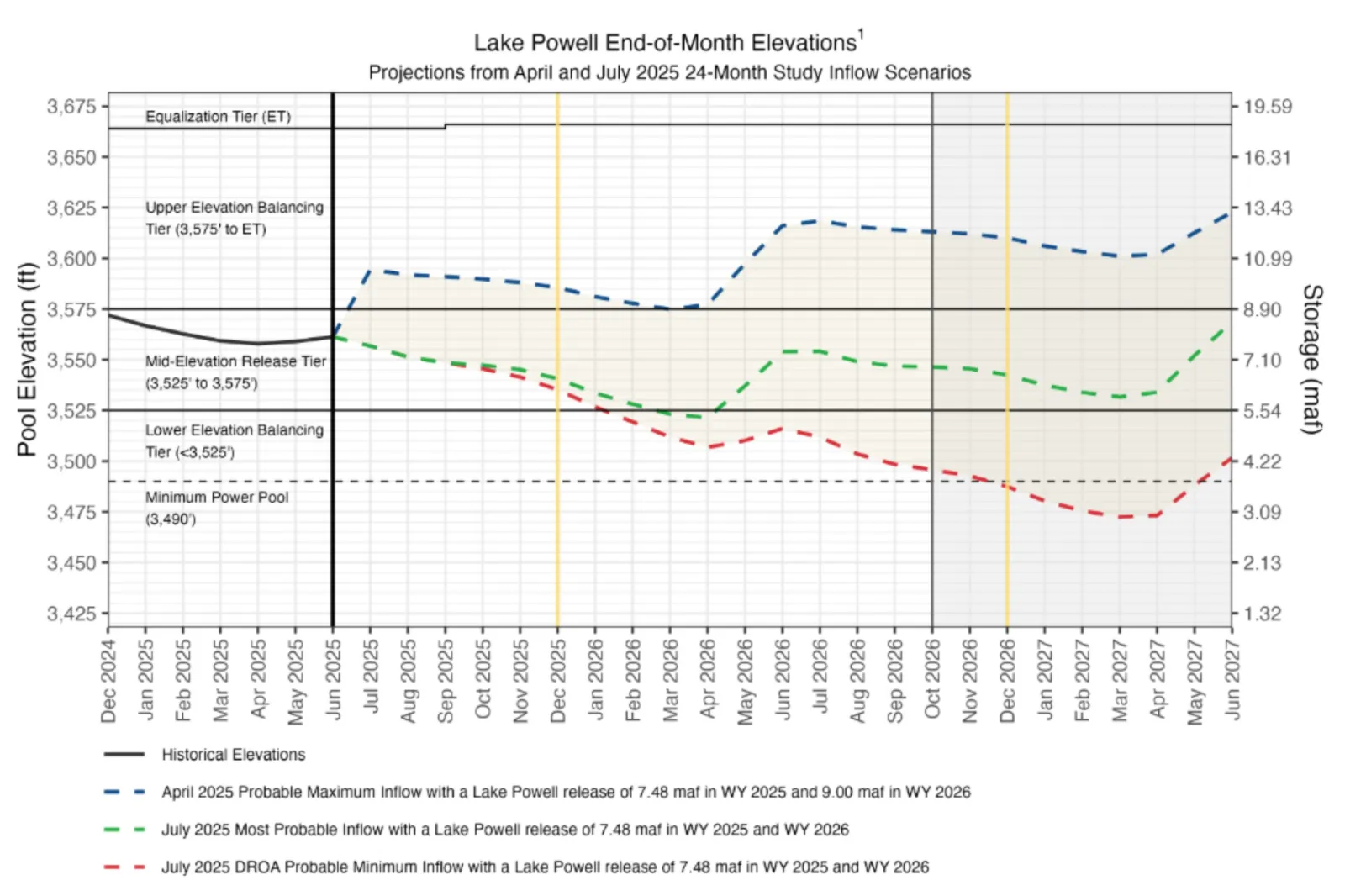
Forecasts indicated declining storage levels and projected that the reservoir, situated on the Colorado River between Utah and Arizona, would likely fall below the minimum power pool for Glen Canyon Dam turbines within 18 months.
Why It Matters
Lake Powell is a linchpin of the western U.S. water and energy systems, storing up to approximately 24 million acre-feet of water. The Glen Canyon Dam provides power to approximately 5 million people in Arizona, Colorado, Nevada, New Mexico, Utah and Wyoming.
Read More on News
This comes after the reservoir, as well as its downstream counterpart Lake Mead, hit historic lows in 2022.
...
What To Know
In its "probable minimum" forecast for Lake Powell's end-of-month physical elevations, based on 24-month study inflow scenarios, the U.S. Bureau of Reclamation (USBR) indicated that the reservoir could drop below its minimum power pool—which refers to the minimum elevation needed to keep the dam's hydropower turbines operational—of 3,490 feet as early as December 2026.
As of Tuesday, the USBR reported that storage at Glen Canyon Dam was at 7,706,910 acre-feet, representing less than half (47.2 percent) of the typical storage level for that date. The agency said this was the lowest value observed on July 15 in the last 30 years.
According to the USBR, the 2025 water year, which begins annually on October 1 and ends September 30, is currently the 6th driest on record since 1964 for the Colorado River Basin.
"If next year is below average, then we're setting ourselves up for some very difficult decisions in the basin," Colorado water expert Eric Kuhn told The Colorado Sun.
The seven basin states, including Colorado, Arizona, and California, have been in negotiations to finalize a new water management framework before existing guidelines expire at the end of 2026.
...
What People Are Saying
A USBR spokesperson told Newsweek: "Reclamation continues to closely monitor hydrologic conditions in the Colorado River. We are proactively working with our partners to ensure readiness if drought response actions are needed.
"Projections beyond the 2026 operating years for Lake Powell (water year) and Lake Mead (calendar year) assume a continuation of current guidelines, which are expected to change through ongoing development of post-2026 guidelines.
"We are actively engaging with our Colorado River Basin partners as we work towards long-term operational agreements for the river after 2026."
Gene Shawcroft, chair of the Colorado River Authority of Utah, in a statement: "You can't reduce what doesn't come down the stream. And that's the reality we're faced with.
"The only way we're going to achieve a successful outcome is if we're willing to work together—and not just protect our own interests."
Becky Mitchell, Colorado's commissioner to the Upper Colorado River Commission, said: "The quantification of hydrologic shortage is incredibly important. No amount of lawyering is going to fix the math problem...we must live with the river we have, not the river we want."
What Happens Next
A separate study earlier this year found that increasing wastewater recycling to 40 percent in the Colorado River Basin could save around 900,000 acre-feet of water each year, which would be enough to supply nearly two million homes.
Update 7/18/25, 12:25 p.m. ET: This article was updated with comment from a USBR spokesperson.
View 0 Comments
Submit Correction
View Editorial & AI Guidelines