10
Loading video...

By Alyce Collins
Senior Reporter
0
Share
Newsweek is a Trust Project member
See more of our trusted coverage when you search.Prefer Newsweek on Googleto see more of our trusted coverage when you search.
A woman has revealed the "brutal" reality of going out in the sun without sunscreen, as she now endures an annual treatment that feels like her skin is being torn apart.
At the start of 2026, Belinda Shipman scheduled a full-body mole-mapping scan at a clinic as she was interested in having a general health-and-wellness check. Unfortunately, the scan led to some shocking findings, as doctors discovered multiple lesions on her shoulder that looked suspicious.
Shipman, who is originally from Australia but now resides in the U.K., was devastated when she received a call from the clinic, urging her to see a specialist dermatologist. She told Newsweek that she went to get checked "straight away," leading to weeks of tests and imaging.
Read More on Health
A biopsy confirmed that one of the lesions on Shipman’s shoulder was basal cell carcinoma, a type of skin cancer caused by exposure to light from the sun. Testing also revealed that, on her face, Shipman had actinic keratoses (precancerous scaly lesions) and squamous cell carcinoma.
...
"The doctor did surgery on the basal cell carcinoma on my shoulder, which was the original concern," Shipman said. "Then I was also diagnosed with precancerous cells on my face and other body parts, as well as squamous cell carcinoma in situ, which is known as Bowen Disease."
This is a rare skin disorder that leads to slow-growing, scaly patch on the outermost layer of skin. The National Organization of Rare Diseases explains that it is a precancerous condition that is commonly caused by chronic sun exposure.
Skin cancer is the most-common cancer in the U.S, with current estimates suggesting that 1 in 5 Americans will develop it during their lifetime. The American Academy of Dermatology Association says that risk factors include exposure to UV radiation, indoor tanning, and sunburns during childhood or adolescence.
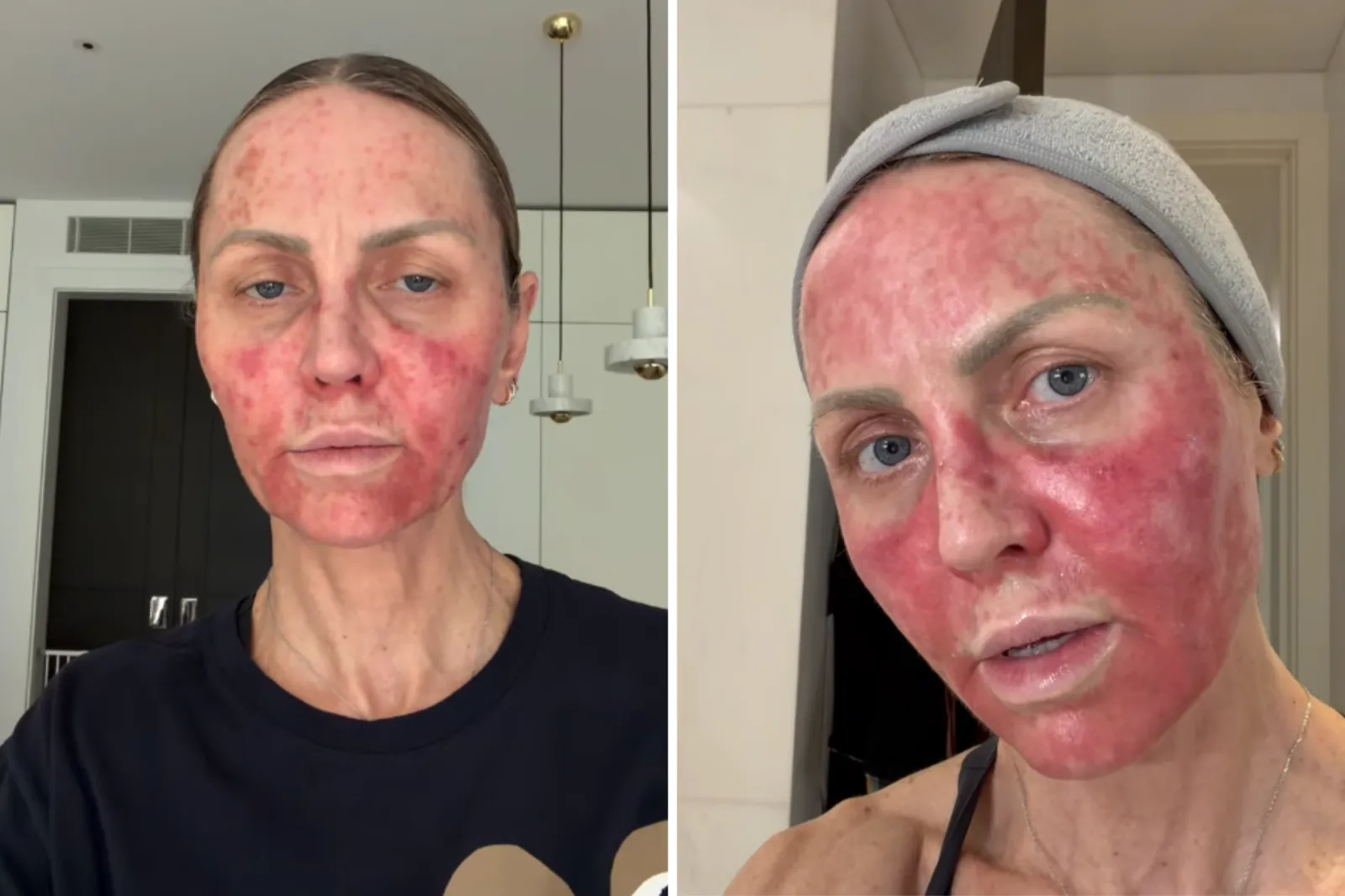
Due to the extent of Shipman’s skin damage, doctors recommended a topical chemotherapy treatment to kill the abnormal cells. She was prescribed Tolak, a 4 percent fluorouracil cream that is used once a day for a four-week period. While it destroys the precancerous cells, common side effects include irritation, redness, dryness and peeling.
As terrifying as the ordeal was, Shipman was willing to try the topical treatment if it saved her from a daunting cancer journey in the future.
"I embraced the process because I knew I needed to," Shipman continued. "I was originally fine until I woke up around day 10 with what looked like a severe allergic reaction all over my face. Then, each evening, when I was applying the cream, the pain was like applying acid to raw flesh."
Throughout February, Shipman documented her experience on Instagram (@belindashipman) to show the physical impact of the monthlong treatment. She shared videos outlining her painful side effects and showing how her skin became increasingly inflamed. By day 18, her entire face was red and blotchy, and it would only get more severe.

...
Many of Shipman’s videos went viral online, as she became more motivated than ever to warn others about the dangers of sun damage. A video posted on February 23, taken four days after completing 28 days of Tolak, discussing how "brutal" skin cancer treatment can be if sun damage isn’t taken seriously. The clip has amassed more than 1.9 million views and over 28,000 likes on Instagram at the time of writing.
"It was the worst pain, and the inability to sleep drove me slightly mad. It was like my face, body and mind were literally being torn apart," Shipman told Newsweek. "I have a 21-year-old sun worshipper who is obsessed with tanning and twins following suit, so the urgency for me was on another level. I needed to get the message out loud and clear, so I started to video my face every day, which was tough but necessary."
She continued: "My message is to not skip sunscreen, and any exposed skin needs covering. Do not tan because baking in the sun is a big no, and tanning beds also."
Shipman’s doctor said her reaction to the treatment was one of the worst cases she had seen, but, thankfully, her skin is now clear. As a result, she has been urged to repeat the treatment on her face every year, and she is currently undergoing a second course of treatment on her neck and chest.
This experience has taught Shipman the importance of looking after her skin and staying out of the sun when possible.
"Anyone who says they don’t use sunscreen is genuinely playing with fire. There’s a lot of toxicity around using sunscreen, as some people think it causes cancer—which is wrong. If people are worried about chemicals, there are so many mineral sunscreens available now, so there’s no excuse," Shipman said.
Is there a health issue that's worrying you? Let us know via health@newsweek.com. We can ask experts for advice, and your story could be featured on Newsweek.
View 0 Comments
Submit Correction
View Editorial & AI Guidelines