...

By Jasmine Laws
Reporter
0
Share
Newsweek is a Trust Project member
See more of our trusted coverage when you search.Prefer Newsweek on Googleto see more of our trusted coverage when you search.
Adult-use cannabis legalization has generated more than $20 billion in tax revenue across different states since sales first began in 2014, according to new data from the Marijuana Policy Project.
The latest update, which includes figures through the first quarter of 2024, shows the economic scale of legal marijuana markets and the range of policy models used by different states.
Why It Matters
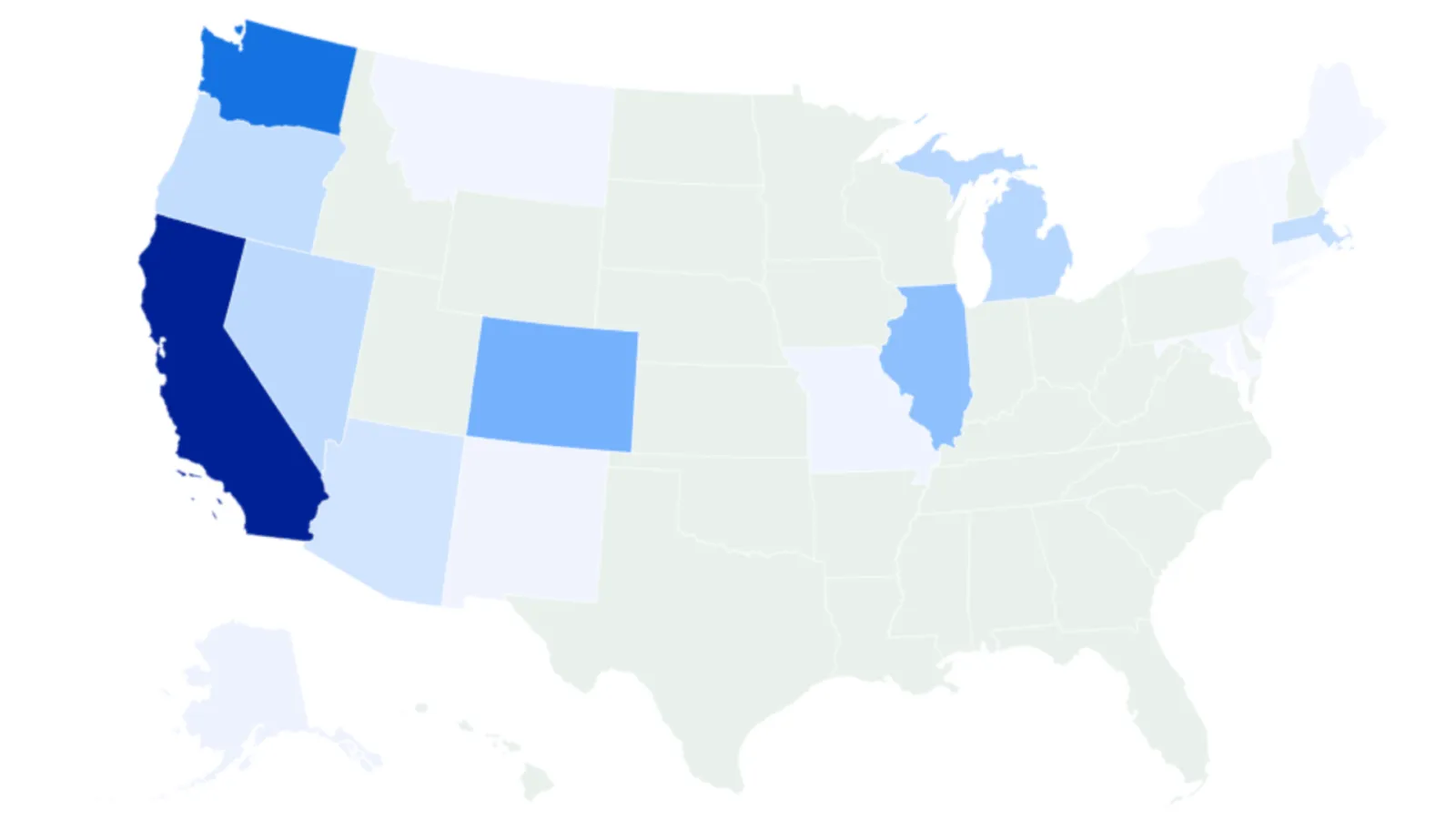
As of March 2024, 24 states had legalized and taxed adult-use cannabis sales, with 22 of those states generating tax revenue. Together, the sales brought in $20,068,051,561, according to cumulative tax collections reported between January 1, 2014, and March last year.
Read More on News
Legal cannabis states brought in a record-breaking $4 billion in adult-use tax revenue in 2023—the most ever collected in a single year.
According to the Marijuana Policy Project, this growing revenue stream has funded public education, substance abuse treatment, law enforcement training, infrastructure projects and social equity initiatives.
Several states also use cannabis taxes to support reinvestment in communities "disproportionately affected by the war on cannabis," per the organization, which is dedicated to legalizing cannabis.
What To Know
California leads all states, with $5.7 billion in adult-use cannabis tax revenue since launching legal sales in 2018. Washington follows with $4.1 billion since 2014.
Rahi Abouk, director of Cannabis Research Institute at the William Paterson University, told Newsweek that tax revenue is high in California because of several factors, including the culture and higher population.
Washington was the state with the second-highest tax revenue, most likely because it has a higher tax rate, Caulkins added, and because it has "done better than some other states at preventing illegal sales that do not pay taxes."
Dr. Arthur Robin Williams, a professor at the Columbia University Department of Psychiatry, told Newsweek that California and Washington also "have higher rates of cannabis use than the rest of the country and were early adopters of medical and adult recreational cannabis sales."
"Having more progressive constituents, it is not a surprise that they also have some of the highest tax rates on cannabis products," he added.
California is also simply just a "gigantic state," Jonathan Caulkins, a professor at Carnegie Mellon University, told Newsweek.
Meanwhile, Colorado, the first state to open legal cannabis stores in 2014, has collected $2.4 billion in tax revenue.
Other states in the top 10 earners of tax revenue from adult-use marijuana include:
- Illinois: $1.98 billion
- Michigan: $1.22 billion
- Nevada: $1.1 billion
- Oregon: $1 billion
- Massachusetts: $989 million
- Arizona: $703 million
- Alaska: $161 million
The report shows that even newer markets have quickly brought in substantial revenue—with Missouri, which began sales on February 6, 2023, earning $136 million through to the first quarter of 2024.
Other newer markets that have seen substantial tax revenue from adult-use marijuana include:
- Maryland (sales began July 1, 2023): $40 million
- Connecticut (sales began January 10, 2023): $29.5 million
- New York (sales began December 29, 2022): $21 million
- Rhode Island (sales began December 1, 2022): $15.7 million
- Vermont (sales began October 1, 2022): $24 million
Smaller states and those with slower rollouts are also reporting steady gains. Montana, for example, has reported $106 million since beginning sales in 2022. Maine, which began sales in October 2020 and has had a more gradual expansion, has taken in $80 million.
Two states—Delaware and Ohio—legalized adult-use marijuana in 2023 but had not begun sales by March 2024.
States still developing their systems—such as New York, which has faced slow licensing and competition from unregulated sellers—may begin to see larger returns as regulatory frameworks mature.
Tax revenue models vary by state, with some levying excise taxes by product weight or potency, and others applying flat retail percentage rates.
The Marijuana Policy Project noted in its report that tax figures did not include medical cannabis revenues, business licensing fees or federal taxes, meaning the fiscal footprint of legal cannabis might be even larger.
What People Are Saying
Jonathan Caulkins, a professor at Carnegie Mellon University, told Newsweek: "The most important thing to recognize here is taxes don't represent economic benefit or creation of value. It just transfers money from you to the government."
He added that the main impacts of marijuana legalization include that it "moves a bunch of economic activity from off the books to on the books." He said that it also means that economic activity is "much more efficient," as after legalization, "we have people who are much more knowledgeable about plants growing it."
Dr. Arthur Robin Williams, a professor at Columbia University's Department of Psychiatry, told Newsweek: "As with nicotine products and beverage alcohol, states and municipalities can layer additional excise taxes on cannabis based products to drive revenue streams. While there has been a lot of hype about how lucrative this can be for states, there is downward pressure on tax rates for cannabis products as higher costs drive consumer behavior to black markets"
Rahi Abouk, director of the Cannabis Research Institute at William Paterson University, told Newsweek: "The tax revenue from [marijuana] legalization may be utilized in several dimensions depending on the state and local laws. For example, in Washington State, the tax revenue is used to fund public schools and healthcare. In Colorado, part of the tax revenue is used to fund the police."
Dr. Kevin Hill, director of addiction psychiatry at Beth Israel Deaconess Medical Center, and an associate professor of psychiatry at Harvard Medical School, told Newsweek: "There are pros and cons to legalizing cannabis. While taxes have created a new revenue stream, it is unclear if the economic benefits have outweighed the costs of legalization, particularly from a public health perspective. In many states, only a nominal portion of tax revenues has been invested in cannabis research, making this a missed opportunity."
Amie Goodin, a professor in the Department of Pharmaceutical Outcomes and Policy (POP) and the Center for Drug Evaluation and Safety (CoDES) at the University of Florida, told Newsweek: "Several states have opted to direct a portion of tax revenue from adult cannabis use sales into their general funds, which could be a useful boost for state funds. All states, to the best of my knowledge, that collect adult use cannabis tax revenues use at least a portion of these revenues to cover regulatory costs incurred for monitoring legal cannabis production and sales, and this is important because it covers consumer safety regulations."
Almut Winterstein, Director for Consortium for Medical Marijuana Clinical Outcomes Research at the University of Florida, also told Newsweek that it was important states devote a portion of their revenue to support research on clinical outcomes of cannabis use because "evidence on cannabis safety is very incomplete and stems from research several decades ago that does not reflect the high potency cannabis products used now."
She added: "Patients, clinicians and consumers need to have comprehensive information on benefit risk of cannabis whether used recreationally or medically to make informed decisions. This information is also important for lawmakers to draft policies that provide important safeguards."
Benjamin Hansen, a professor of economics at the University of Oregon, told Newsweek that the legalization of marijuana "can create legitimate jobs which create income taxes, social security taxes. It also creates excise taxes which can and should be used to offset harms of marijuana use."
He added: "There's evidence of tax competition incentives. Places like Oklahoma legalized marijuana in part because so much was coming from Colorado. Mature markets are seeing taxes drop in part because prices continue to drop because marijuana is quite easy to produce. This suggests we could charge even higher taxes, based on percentages, or taxes that are based on other units instead of prices."
What Happens Next
With adult-use markets expanding and more states considering legalization, nationwide cannabis tax revenues are expected to continue rising.
Update 04/22/25, 01:57 p.m. ET: This article has been updated with comment from Amie Goodin and Almut Winterstein.
Update 04/23/25, 03:05 a.m. ET: This article has been updated with comment from Benjamin Hansen.
View 0 Comments
Submit Correction
View Editorial & AI Guidelines