...


By Amir Daftari and John Feng
0
Share
Newsweek is a Trust Project member
See more of our trusted coverage when you search.Prefer Newsweek on Googleto see more of our trusted coverage when you search.
Tensions in the southern Caribbean are rising as the United States strengthens its military presence near Venezuelan waters, escalating pressure on President Nicolás Maduro.
U.S. naval and air assets have been deployed to combat drug trafficking and safeguard regional maritime routes, with some already used in operations this week targeting illicit shipments, signaling the potential for further confrontation with Caracas.
Newsweek has reached out to the U.S. State Department and Venezuela's Foreign Ministry for comment.
Read More on News
Why It Matters

...
The deployment reflects the Trump administration's assertive approach to countering drug trafficking while signaling pressure on the Venezuelan government. Late on Tuesday, U.S. forces in the region launched a missile strike that destroyed a suspected drug boat linked to Venezuela, killing those on board, Trump said on his Truth Social platform.
By positioning advanced warships and long-range aircraft near Venezuelan waters, Washington is seeking to demonstrate both tactical capability and political resolve. In response, Venezuela is mobilizing troops and military assets, raising the prospect of a direct standoff in the southern Caribbean.
What To Know
The U.S. has deployed at least eight warships and one submarine to the eastern Caribbean:
- USS Gravely
- USS Jason Dunham
- USS Sampson
- USS Iwo Jima
- USS San Antonio
- USS Fort Lauderdale
- USS Lake Erie
- USS Minneapolis-Saint Paul
- USS Newport News
Arleigh Burke-Class Destroyers
The Gravely, Jason Dunham and Sampson are Arleigh Burke-class guided-missile destroyers conducting counter-narcotics patrols, maritime surveillance, and escort missions. Their advanced radar and missile systems provide both defensive and offensive capabilities for the broader U.S. naval presence.
Each Navy vessel carries a strike package that includes Tomahawk cruise missiles with a range of over 1,000 miles.
Amphibious Ready Group
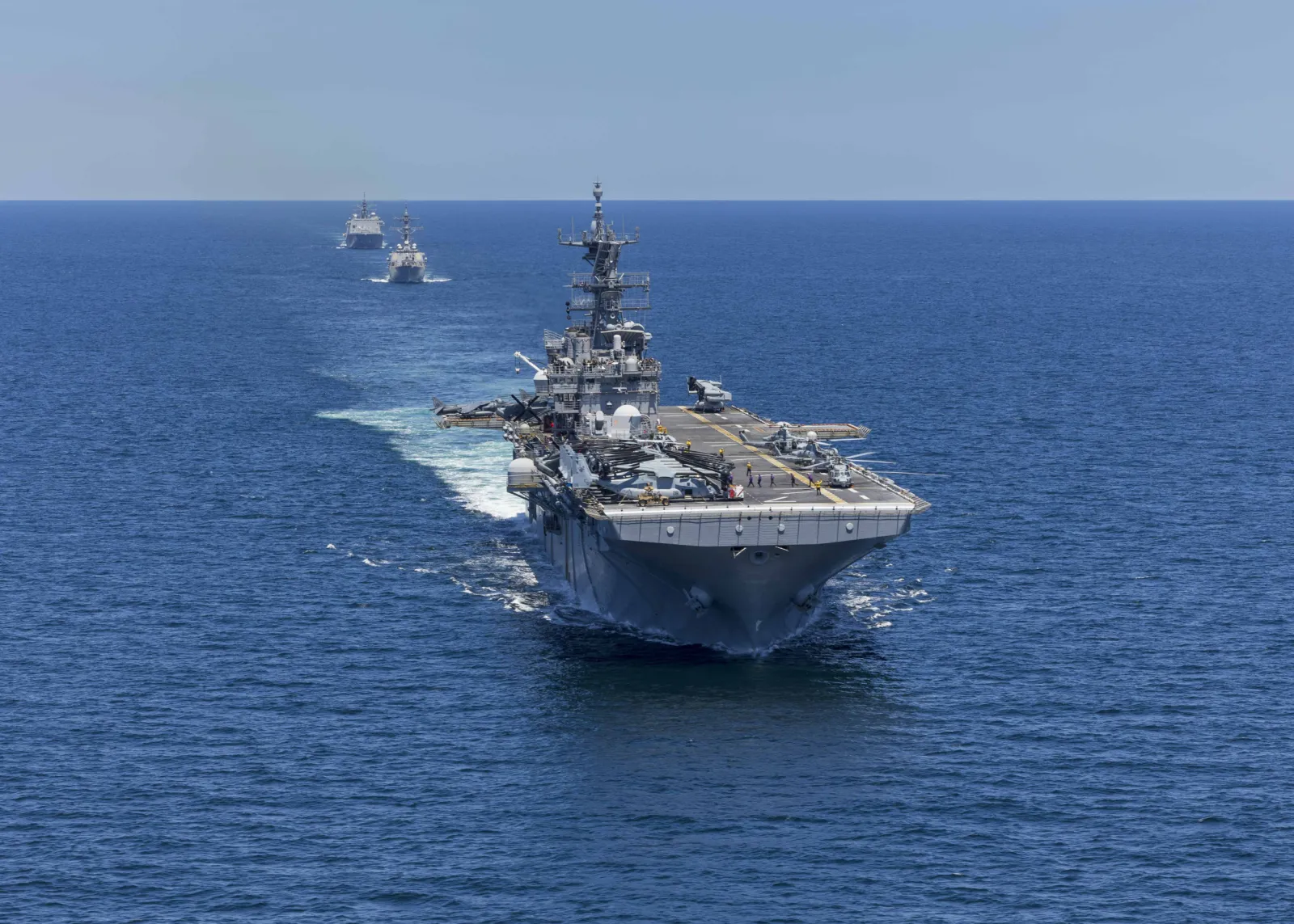
The Iwo Jima, a Wasp-class amphibious assault ship, is the lead command vessel of the Iwo Jima Amphibious Ready Group, which includes the San Antonio and Fort Lauderdale San Antonio-class transport and logistical support ships. More than 2,500 U.S. Marines of the 22nd Marine Expeditionary Unit are embarked on the three ships as a rapid-response force, alongside over 1,000 Navy sailors.
Photos released by the Navy showed the Iwo Jima carrying MV-22B Osprey tiltrotor transport craft and AV-8B Harrier II fighters aircraft en route to the Caribbean. The San Antonio and Fort Lauderdale both can launch hovercraft for amphibious operations.
...
Combat Support Ships
The Lake Erie, a Ticonderoga-class guided-missile cruiser, provides long-range missile coverage with its Tomahawk loadout as well as offering the task force additional command capabilities.
The Minneapolis-Saint Paul is a Freedom-class littoral combat ship that conducts patrols and interdiction operations in coastal areas. It can fire the RIM-116 RAM missile for air defense missions.
Submarine Operations
The Newport News, a Los Angeles-class nuclear-powered fast-attack submarine, is at least one of the Navy boats en route to the Caribbean this week. It adds a stealth dimension to the naval presence, but also has a formidable loadout of Tomahawk land attack missiles.
The Newport News is additionally equipped with advanced sonar to support surveillance as well as Harpoon anti-ship missiles and Mark 48 torpedoes for potential interdiction of surface ships.

...
Air and Coast Guard Asset
U.S. air assets extend the reach of naval forces with continuous surveillance, reconnaissance, and strike capability. The Navy's P-8A Poseidon maritime patrol aircraft—designed for anti-submarine warfare and presently deployed to San Juan airport in Puerto Rico—are conducting long-range patrols in the eastern Caribbean, supplemented by P-3 Orion patrol planes used by U.S. Customs and Border Protection.
MQ-9 Reaper drones provide persistent reconnaissance, while F/A-18 Hornets stand ready to provide air support. Additional Coast Guard vessels already in the region could operate alongside the naval forces.
What People Are Saying

...
Alex Plitsas, senior fellow at the Atlantic Council: "The military buildup off of Venezuela provides options for the president given recent developments.
"First, at a minimum it provides a show of force in the hopes of convincing Maduro to change course. Second, it provides viable military, strike options to go after cartels and criminal gangs that were recently designated as terrorist organizations. Third, it provides options to strike at the Maduro regime itself.
"The Trump administration has made statements linking Maduro to these criminal groups who are now designated terrorist organizations. The United States has also made it clear that Maduro is not the legitimately elected president of Venezuela after having committed electoral fraud to stay in power."
What Happens Next
The U.S. military continues its Caribbean operations against Venezuelan-linked drug networks, while Caracas maintains defensive measures.
Observers are closely monitoring the deployments to assess whether tensions escalate or a diplomatic resolution emerges, with the region's stability hanging in the balance.
View 0 Comments
Submit Correction
View Editorial & AI Guidelines