...

By Suzanne Blake
Reporter
0
Share
Newsweek is a Trust Project member
See more of our trusted coverage when you search.Prefer Newsweek on Googleto see more of our trusted coverage when you search.
A new report found low-income Americans are far more likely to buy a home in the next four months compared with their wealthier counterparts, reflecting a potential shift in the national housing market.
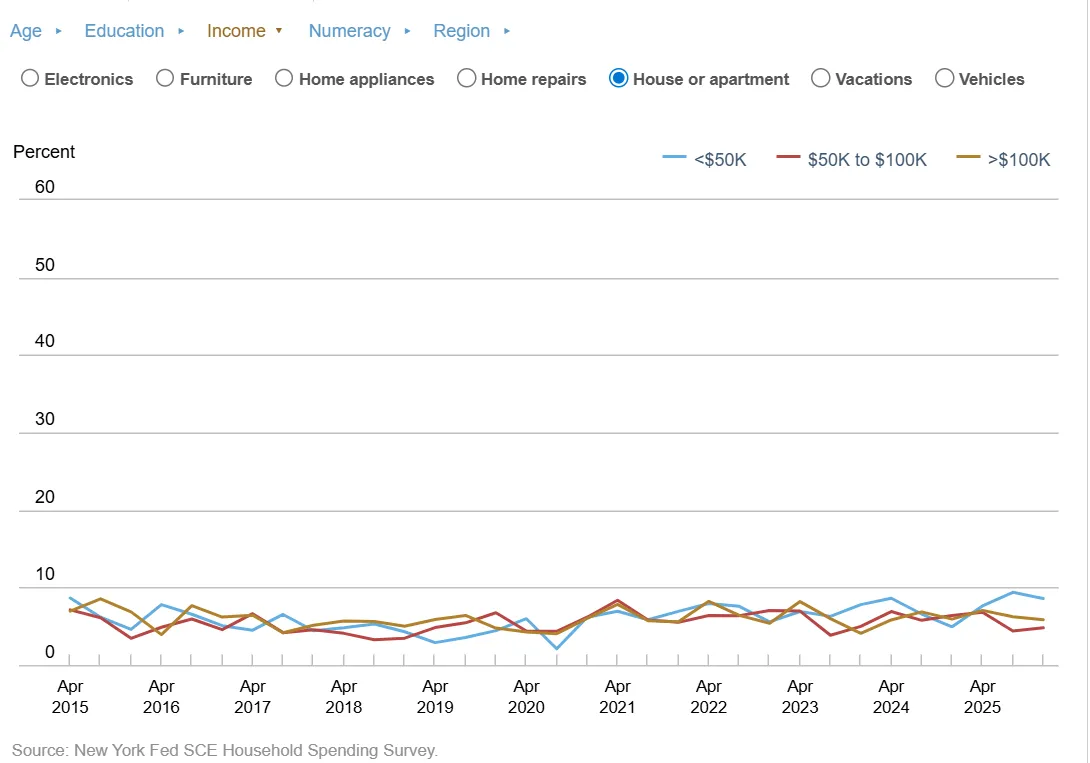
The Federal Reserve Bank of New York’s latest data shows that 8.6 percent of Americans making under $50,000 plan on buying a home in the next four months compared with 5.9 percent of those earning over $100,000.
Why It Matters
The data reverses previous notions by analysts that income is directly tied to one’s ability or desire to buy a home. The shift to lower-income Americans buying could reflect geographic trends as well as larger adjustments within the housing market.
Read More on Personal Finance
...
What To Know
The Federal Reserve Bank of New York released its December Household Spending Survey, reporting the median year-over-year increase in monthly nominal household spending at 4.9 percent in December, up from 4.1 percent in August and 4.6 percent in December 2024.
The shares of households that reported making a large purchase on furniture, home repairs vehicles, and vacations decreased in December, while shares reporting spending on homes, home appliances and electronics increased. However, Americans’ plans to a buy a home were split, depending on income group.
While 8.6 percent of Americans making under $50,000 plan on buying a home in the next four months, only 5.9 percent of those making over $100,000 said the same.
“Wealthier Americans have locked in lower rates and have significant equity versus those that are either renting or looking to purchase,” Kevin Thompson, CEO of 9i Capital Group and host of the 9innings podcast, told Newsweek. “So, there is really no need to move at this current time when sitting on what some consider ‘free money.’”
Still, Realtor.com senior economist Joel Berner said this is a surprising development, especially because the income required to purchase the median home at a 6 percent rate on a 30-year mortgage and satisfy the 30 percent rule is well over $50,000.
“At a $50K annual income, if you're spending 30 percent of your income on just the principal and interest of a mortgage payment, you can only afford about a $208K home. There just aren't that many of those on the market to go around,” Berner told Newsweek.
Overall, the median expected monthly overall spending growth over the next 12 months increased to 3.4 percent in December from 3 percent in August, the New York Fed found.
Some experts say the surge in lower-income Americans planning to buy signals panic rather than promise.
“Lower income Americans aren't optimistic, they're desperate,” Michael Ryan, finance expert and founder of MichaelRyanMoney.com, told Newsweek. “When you're priced out of 90+ percent of listings, intentions don't reflect confidence. Instead, they reflect the anxiety that waiting another year will shut the door completely. Higher earners can afford to be patient. They're not rushing because they already own, they're earning returns on investments, and they can time the market.”
Poorer households systematically buy high and sell low, he said, while wealthier households do the opposite.
“Lower-income buyers are playing a game where ‘wait and see’ isn't a strategy but a gamble that prices come down faster than their purchasing power erodes.”
What People Are Saying
Thompson, also to Newsweek: “What this shows is that renting versus buying is showing signs of leveling off, but the larger variable is the job market. People tend to rent when the job market is less certain so they can maintain short-term mobility.”
“I don’t foresee this changing anytime soon. People are simply comfortable with their lower rates. There’s no reason to give up a 3.5 percent (or lower) mortgage unless a significant life event forces a move. Expect the housing market to remain constrained.”
Berner, also to Newsweek: “It's encouraging that lower-income Americans still feel like homeownership is attainable to them, and not something only for the wealthy, but affordability is a major challenge in the housing market and will remain that way.”
Alex Beene, financial literacy instructor for the University of Tennessee at Martin, to Newsweek: “Studies like this will produce some finger-pointing at some Americans for having their financial priorities out of sync with their incomes, but there are so many other factors to consider when assessing this data. The lower income could reflect the time of life these potential buyers are in, with some having starting and growing families that are looking for homes despite not having yet achieved a higher income.”
What Happens Next
Beene said potential homebuyers' target areas will continue playing a key role, as some locales offer lower housing prices. “In general, we’re going to see more home buying in 2026 simply because many buyers feel like they’ve waited long enough, and mortgage rates look to be sticking in their current range for the foreseeable future.”
View 0 Comments
Submit Correction
View Editorial & AI Guidelines