
10
Loading video...

By Anna Skinner
Associate News Editor
0
Share
Newsweek is a Trust Project member
See more of our trusted coverage when you search.Prefer Newsweek on Googleto see more of our trusted coverage when you search.
Hurricane Genevieve has become the first major hurricane of the 2026 Eastern Pacific season—and the first major hurricane in either the Eastern Pacific or Atlantic basins this year—as it became a Category 5 storm on Monday morning.
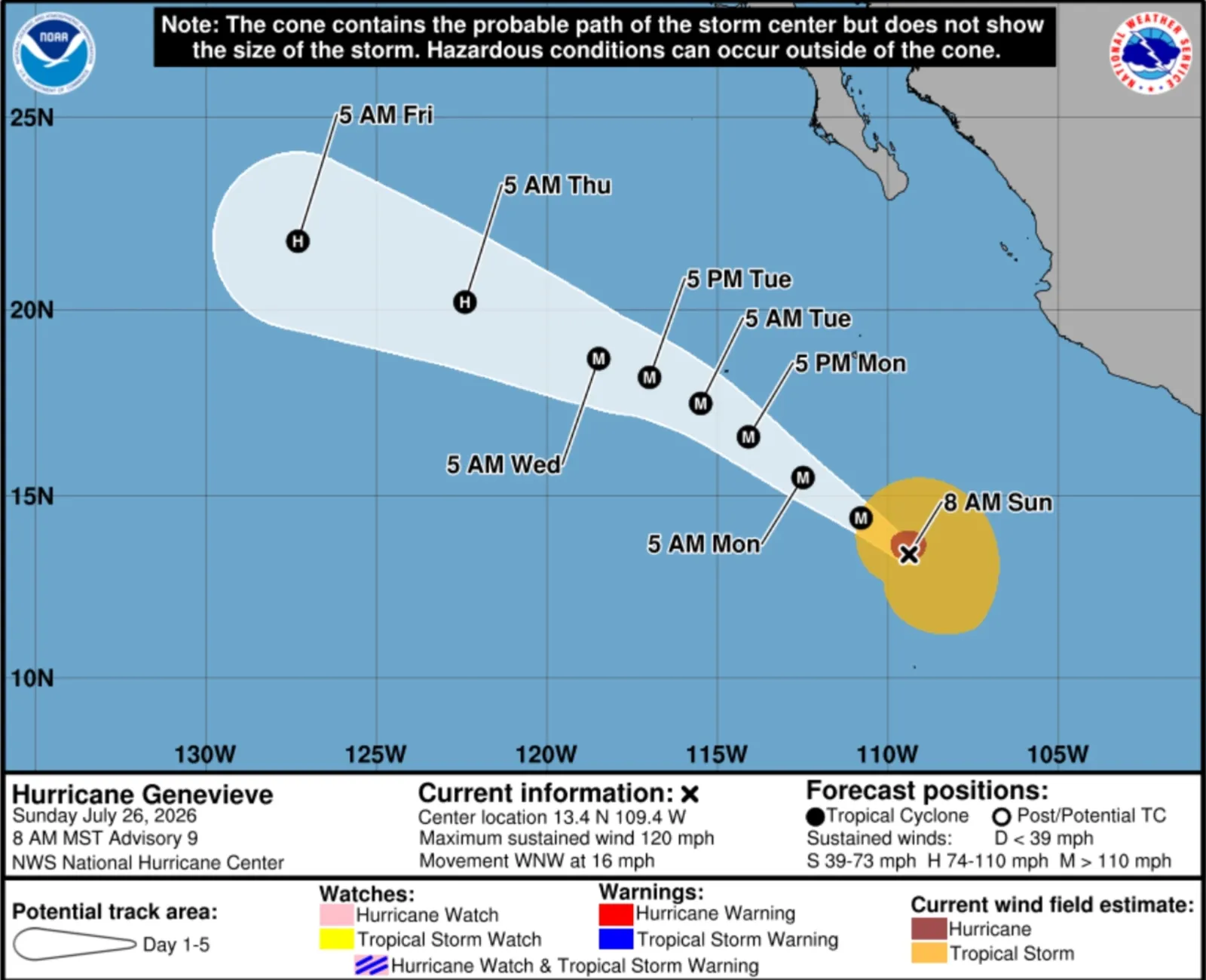
Early on Sunday, Genevieve was a Category 3 hurricane with sustained winds of 120 mph as it churned over the open waters of the eastern Pacific Ocean southwest of Mexico. By July 27, the storm had rapidly intensified, with maximum sustained winds increasing to around 130 to 135 knots (150 to 155 mph), making it a powerful Category 4 hurricane.
Later, the National Hurricane Center (NHC) reported that Genevieve's winds had strengthened further to 160 mph, officially upgrading it to a Category 5 hurricane on the Saffir-Simpson Hurricane Wind Scale—the highest classification and the first Category 5 hurricane in the eastern Pacific for two years.
Read More on Weather
While the storm is not expected to make landfall, forecasters previously warned it would strengthen further over the coming days before a gradual weakening trend begins later in the week.
In addition to Genevieve, the NHC also is tracking Hurricane Fausto, which is taking aim at Hawaii.
Newsweek reached out to the NHC by email for comment.
...
What Is a Major Hurricane?
A major hurricane is defined as a Category 3, 4 or 5 storm on the Saffir-Simpson Hurricane Wind Scale (SSHWS), with sustained winds of at least 111 mph. These hurricanes are capable of causing devastating wind damage and significant coastal impacts when they approach populated areas. Genevieve crossed that threshold Sunday after a period of rapid intensification that saw the storm strengthen dramatically.
During a Category 3 hurricane, if the storm reaches or nears land, "devastating damage will occur," the NHC said in a webpage dedicated to the SSHWS.
"Well-built framed homes may incur major damage or removal of roof decking and gable ends," the agency's webpage said. "Many trees will be snapped or uprooted, blocking numerous roads. Electricity and water will be unavailable for several days to weeks after the storm passes."
Where Is Major Hurricane Genevieve?
According to the NHC, Genevieve’s center was located about 530 miles southwest of Manzanillo, Mexico, and it was headed west-northwest at 14 mph.
Hurricane Genevieve: Live Tracker Maps
Animated weather footage from windy.com shows Genevieve churning off the coast of Mexico with strong winds.
Satellite footage also clearly captures the storm, showing a distinct eye in the center.
Despite its strength, heavy rain is expected to remain well offshore during the storm's life span.
Though the storm is not expected to make landfall, some coastal impacts are expected.
"Swells generated by Genevieve are affecting portions of the southwestern coast of Mexico and will likely reach southern portions of the Baja California Peninsula tonight or Monday," the NHC said in the public advisory. "These swells are likely to cause life-threatening surf and rip current conditions."
Forecast models indicate Genevieve will remain over open water, eventually encountering cooler sea surface temperatures and a less hospitable environment that will prompt weakening. However, meteorologists expect the storm to maintain major hurricane status through at least Wednesday morning.
Genevieve's milestone arrival marks the first high-end storm of the 2026 season in either major North American basin, with the Atlantic currently quiet and no other tropical cyclones under active monitoring by the NHC.
Contact Newsweek editors for this story: Steve Mollman and Anthony Murray.
Update, 07/27/26 05:22 a.m. ET: this article has been updated to reflect the upgrade to a Category 5 storm.
View 0 Comments
Submit Correction
View Editorial & AI Guidelines