...

By Sam Stevenson
Associate News Editor
0
Share
Newsweek is a Trust Project member
See more of our trusted coverage when you search.Prefer Newsweek on Googleto see more of our trusted coverage when you search.
New nationwide polling shows that President Donald Trump remains underwater 15 months after his second inauguration, with approval trailing disapproval across most states and demographic groups.
Figures published by Civiqs offer an early signal of political risk as attention quietly turns toward the 2026 midterm elections.
Voters in swing states—where Trump's margins are narrower but still negative—are likely to play an outsize role in shaping the next phase of his presidency.
Read More on Politics
Newsweek contacted the White House via email for comment outside regular business hours.
White House spokesperson Davis Ingle previously told Newsweek: "The ultimate poll was November 5, 2024, when nearly 80 million Americans overwhelmingly elected President Trump to deliver on his popular and commonsense agenda.
"No other President in history has accomplished more for the American people than President Trump, who is working tirelessly to create jobs, cool inflation, increase housing affordability, and more. The President has already made historic progress not only in America but around the world, and this is just the beginning as his agenda continues taking effect."
Why It Matters
Trump returned to office in January 2025 with strong Republican support but limited backing beyond his base.
Since then, his approval rating has remained consistently negative nationally, even as partisan and geographic divides have hardened rather than softened.
What To Know
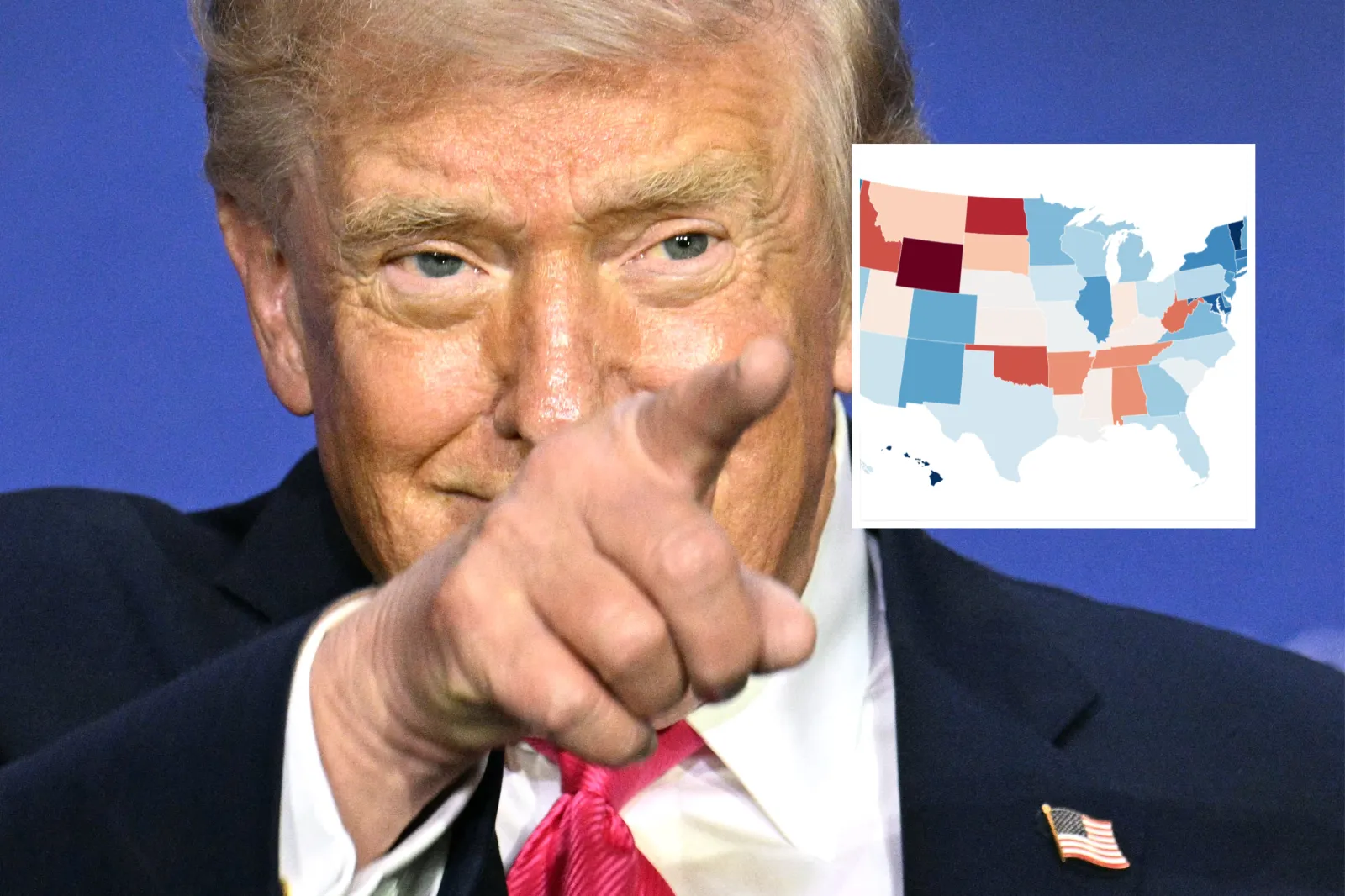
Almost exactly 15 months into his second term, Trump's national approval rating stands at 37 percent, with 58 percent disapproving and 5 percent neutral, according to Civiqs data from 99,409 registered voters' responses between January 20, 2025, and April 20, 2026.
This gives him a net approval rating of -21 nationally. The overall picture is familiar: Deep red states continue to back him, deep blue states remain firmly opposed, and battleground states show more nuanced—but still unfavorable—numbers.
Deep Red States: Trump's Base Remains Intact
Trump continues to perform best in heavily Republican states, particularly across the Plains and Appalachia.
Wyoming leads the nation with 58 percent approval, followed by North Dakota at 56 percent.
West Virginia, Oklahoma, Idaho, Tennessee, Arkansas and South Dakota all show majority approval or near‑majority support, with disapproval typically hovering around 40 percent.
In these states, Trump's coalition appears durable.
Despite national headwinds, opinions here show little sign of shifting, reflecting long‑standing partisan alignment rather than short‑term reactions to events.
Lean Red States: Support Softens at the Edges
A second group of states leans Republican but shows more mixed attitudes.
Indiana, Kansas, Kentucky, Louisiana, Mississippi, Montana, Nebraska and Utah all cluster tightly around the high‑40s for approval, with disapproval close behind.
Ohio also sits near the middle, at 41 percent approve and 53 percent disapprove.
These states illustrate a narrower cushion for Trump. Support remains competitive, but majority approval is no longer guaranteed, leaving room for change if broader conditions worsen.
Swing States: Underwater Across the Board
Every major battleground state shows Trump underwater, though not by overwhelming margins.
Arizona and North Carolina both record 42 and 41 percent approval, respectively, with disapproval in the mid‑50s.
Pennsylvania stands at 39 percent approve and 55 percent disapprove. Michigan and Nevada each post approval at 37 percent with 58 percent disapproval.
Wisconsin shows a similar pattern at 39 percent approve and 57 percent disapprove, while Georgia posts 37 percent approval and 58 percent disapproval.
None of these states currently favors Trump, but several remain within a single‑digit or low double‑digit range, underscoring why they are likely to remain central to future electoral battles.
Deep Blue States: Opposition Is Firmly Entrenched
Trump's weakest numbers continue to come from the West Coast, New England and much of the Northeast.
Hawaii and Vermont post the highest disapproval nationwide, both at 78 percent.
Maryland, Massachusetts, California, Washington, Oregon and New York all show about two‑thirds or more of voters disapproving.
Approval in these states rarely exceeds 30 percent, reinforcing the depth of opposition rather than temporary dissatisfaction.
Compared with polling snapshots from late 2025 and early 2026, these states show little movement.
Demographic Fault Lines Remain Clear
Approval divides sharply along age, education, gender and party lines.
Voters under 35 disapprove by more than 40 points, while those aged 50 and older are far more evenly split. Men are nearly divided, but women disapprove by more than 30 points.
Education widens the gap further. Approval falls from 41 percent among noncollege graduates to 26 percent among postgraduates.
Nearly all Democrats disapprove, while Republicans remain overwhelmingly supportive, leaving independents—who disapprove by double digits—as the key group pulling Trump's numbers downward.
What Happens Next
As the midterm cycle approaches, those narrow but negative margins in swing states could prove decisive in shaping turnout, campaign strategy and control of Congress.
View 0 Comments
Submit Correction
View Editorial & AI Guidelines