...

By Dan Gooding
Associate News Editor
0
Share
Newsweek is a Trust Project member
See more of our trusted coverage when you search.Prefer Newsweek on Googleto see more of our trusted coverage when you search.
Over a third of the United States federal government's revenue comes from the country's four most-populous states, but they often get back less than they contribute.
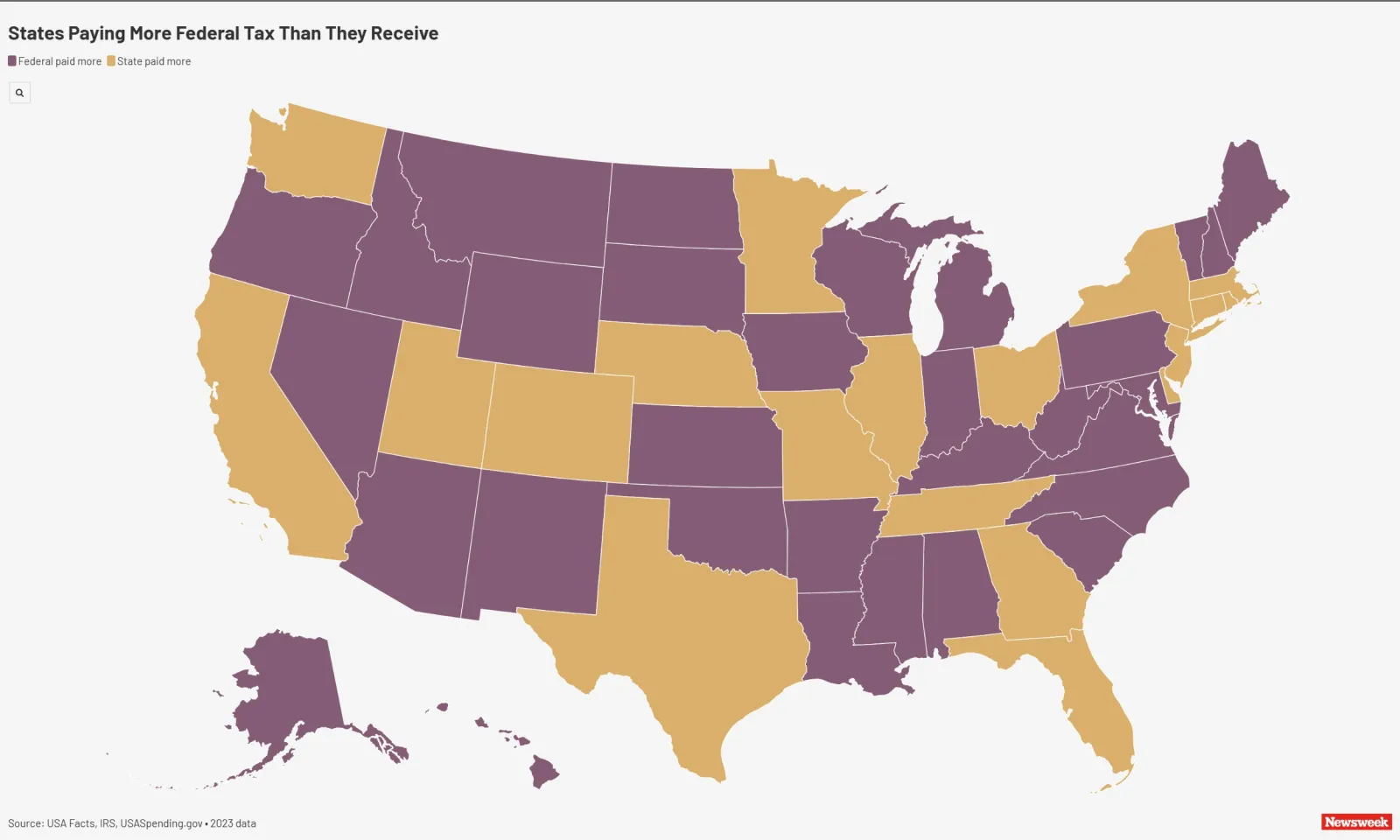
Known as "donor states," 19 states contribute more in federal taxes than they receives back in federal spending, according to data compiled by USAFacts, a non-partisan nonprofit that tracks government spending. The calculus is determined using the "balance of payments," which is the difference between the federal taxes paid by a state's residents and businesses and the federal funds the state receives for programs like Medicaid, SNAP, infrastructure and education. A negative balance indicates that the state is a donor state.
The Trump administration has pushed for states to more responsibility in funding everything from healthcare to food assistance, though the majority of U.S. states rely on the federal government to fund those programs.
Read More on U.S.
"We have 90,000 governments in the country that collect income taxes, collect payroll taxes, corporate income taxes, that goes frequently to the federal government and then the federal government redistributes a lot of that money back to people that that are in various programs or to various things that the government funds," said Richard Coffin, chief of research at USAFacts.
The federal government collected around $4.6 trillion from states in 2023, redistributing around $4.5 trillion back through government assistance programs like Medicaid and Social Security.
Thirty-one states, plus the District of Columbia, received more than they paid in. New Mexico, for example, sent around $12.4 billion to the federal government in taxes, but received over $41.8 billion back in federal funds. By contrast, Florida, one of 19 donor states, paid in $310.6 billion and received $293.4 billion back.
Predictably, the states that have more people and more jobs — especially higher-paying jobs — will tend to pay more to the federal government, Coffin said, compared to the states and communities that have smaller populations and workforces.
However, there are outliers. Delaware, for example, has a far higher per-capita outlay than other states because of how many companies are registered there. Delaware residents were paying around $24,574 in 2023, compared to the $4,866 paid by those in nearby West Virginia.
"For the states receiving money, it really comes down to where the programs are going," Coffin said. "A large portion of them go to means-tested programs, which are programs that are meant for people with certain income levels, generally lower income levels and so that's things like Medicaid, SNAP, all that kind of stuff.
"So, where you see higher number of low-income people, those states will end up getting more money."
Federal funds are also used by states for their education departments and infrastructure projects. With the latter, areas with greater need for "shovel-ready" investments will therefore see a higher level of federal spending.
USAFacts' findings have been backed by other analysts, with the California Budget and Policy Center finding in March that the Golden State paid $83 billion more in federal taxes than it received in federal support in 2022. The analysts warned that cuts in federal spending under the Trump administration could lead to an even bigger gap in the future.
The so-called One Big Beautiful Bill, signed by President Trump on July 4, included tax and spending changes that could impact communities across the U.S., with a greater emphasis on states taking on the cost burden for SNAP and Medicaid benefits.
"That would, in theory, lower the amount that the federal government pays, so it would probably even this distribution a little bit more," Coffin said. "It would mean that states that get more back from the federal government might actually get a little bit less back. I'm not sure it would change how much people pay in, though, because it didn't really change the tax structure."
Newsweek reached out to the U.S. Treasury for comment on these concerns via email Tuesday afternoon.
Population differences also lead to varying levels of spending per person by the federal government, with states that have smaller but older populations requiring more help than those with larger, younger populations. States with a large military presence also tend to see more government spending than those without.
"A military base in a state in theory could create jobs there and has a very direct impact on the community," Coffin said. "But the benefit of it is far broader than that. It's for the national good.
"I live in Seattle. If money goes to Boeing to create something for the military, it certainly creates jobs and economic opportunities directly in my community, but also the broader public good from that affects the whole country."
View 0 Comments
Submit Correction
View Editorial & AI Guidelines