
By Ryan Chan
China News Reporter
0
Share
Newsweek is a Trust Project member
See more of our trusted coverage when you search.Prefer Newsweek on Googleto see more of our trusted coverage when you search.
A Newsweek map illustrates Japan's planned deployment of its new long-range missiles to deter and defend against potential attacks from its main adversaries, China and North Korea.
The deployment is part of Japan's effort to strengthen its standoff defense capabilities, the ability of a military force to engage and defeat an enemy from a significant distance, outside the range of the attacker's radar defences or missiles. The Defense Ministry in Tokyo previously told Newsweek that such capabilities are intended to target naval and landing forces attempting to invade the country.
Newsweek has reached out to the Chinese Foreign Ministry for comment via email. North Korea's Embassy in Beijing did not immediately respond to a written request for comment.
Read More on World
Why It Matters
Japan plays a key role in the United States' strategy to contain China's rapid military buildup, helping form a north-south defensive line of islands along with Taiwan and the Philippines.
While Tokyo is deeply concerned about the impact of potential Chinese aggression against Taiwan it also has territorial and maritime disputes with Beijing in the nearby East China Sea.
Taiwan, a self-ruled island and U.S. security partner, lies close to Japan's outlying southwestern islands,
Nuclear-armed North Korea often threatens Japan by firing missiles into waters near the U.S. ally. Tokyo is developing counterstrike missiles for self-defense, capable of hitting enemy bases—a move Pyongyang has accused of stoking "war fever."
What To Know
Japan's Defense Ministry provided an update on the deployment plan for domestically built missiles intended for standoff defense on Friday, saying it will enable the Self-Defense Forces to intercept and eliminate invading forces "at a rapid pace and at long range."
...
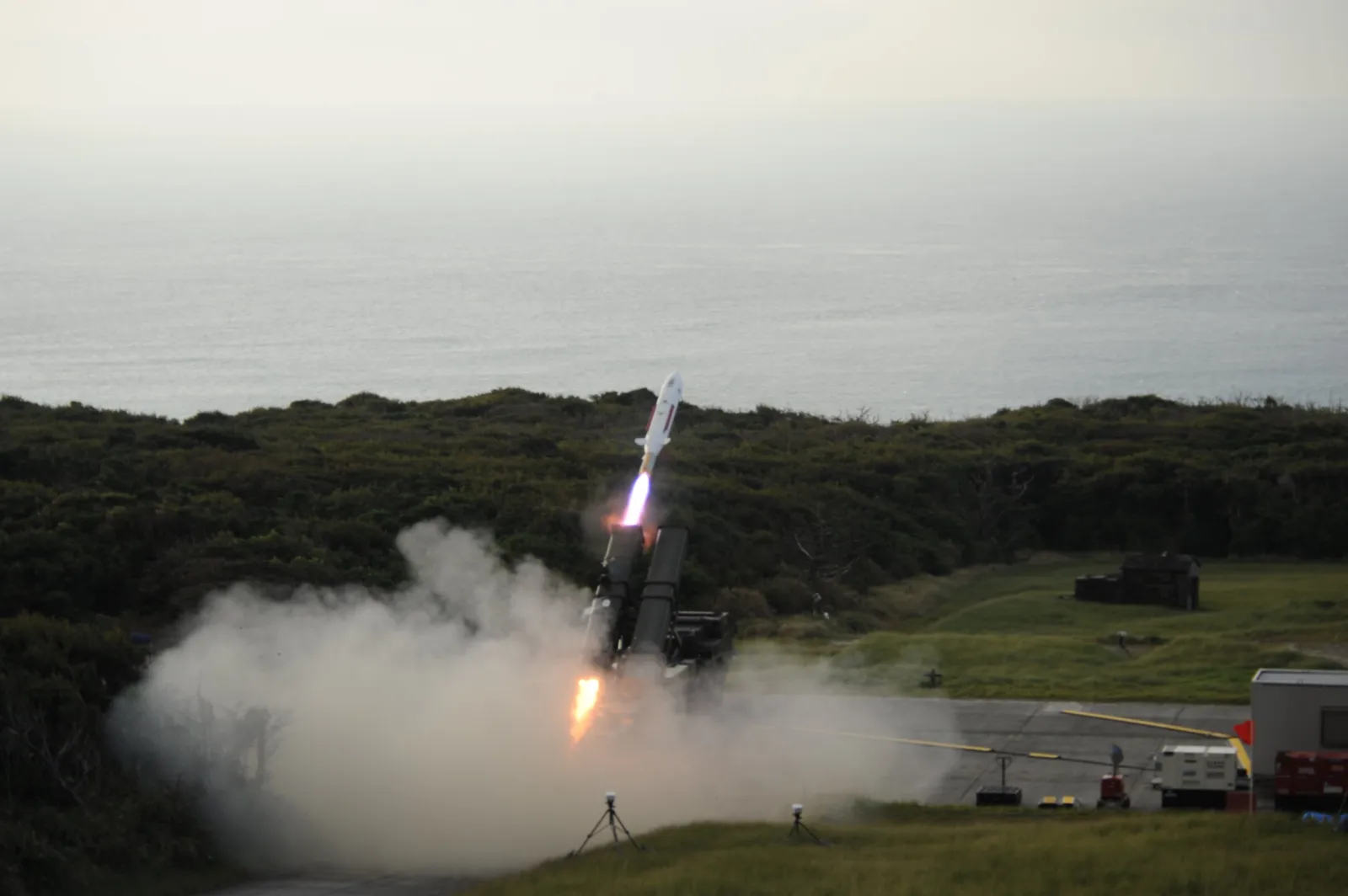
The Type 12 anti-ship missile has improved capability and a range of 620 miles. The ground-launched variant will be deployed at Camp Kengun in Kumamoto Prefecture—on the southernmost main island of Kyushu—in fiscal years 2025 and 2026.
A training unit based at Camp Fuji in Shizuoka Prefecture on Honshu—Japan's largest main island—will be equipped with the same variant of the upgraded Type 12 missile in fiscal year 2027. In Japan, the fiscal year runs from April 1 to March 31 of the following year.
Japan's Defense Ministry also announced that it will bring forward the deployment of both the ship-launched variant and the air-launched variant of the upgraded Type 12 missile, moving the timeline from the originally planned fiscal year 2028 or later to fiscal year 2027.
Coincidentally, that is the year Washington has warned that Beijing aims to be capable of invading Taiwan. The Chinese Communist Party claims sovereignty over Taiwan—despite never having governed the island—and has vowed to use force to achieve reunification if necessary.
The Japanese destroyer JS Teruzuki, homeported at Yokosuka Naval Base in Kanagawa Prefecture on Honshu, will be modified to carry the missiles. Meanwhile, F-2 fighter aircraft based at Hyakuri Air Base in Ibaraki Prefecture on Honshu will also be equipped with them.

...
The second missile planned for deployment is the Hyper Velocity Gliding Projectile, or HVGP, a ballistic missile designed for island defense. Armed with a hypersonic vehicle as its warhead, it can travel at more than five times the speed of sound and maneuver in flight.
Japan's Defense Ministry said the HVGP will be deployed at three sites. The first is Camp Fuji for training, where it will be deployed in fiscal year 2025.
Two more operational units will be formed for HVGP deployment in fiscal year 2026. One will be based at Camp Kamifurano on Hokkaido—Japan's northernmost island, separated from Russia by sea—and the other at Camp Ebino in Miyazaki Prefecture on Kyushu.
According to defense outlet Naval News, Japan will develop three HVGP variants: the 560-mile-range Block 1, the 1,240-mile-range Block 2A, and the 1,860-mile-range Block 2B.
In addition to targeting land-based sites such as enemy bases, the HVGP could potentially strike warships, including aircraft carriers, in the future, Naval News reported. China currently operates two aircraft carriers, with a third expected to be commissioned soon.
What People Are Saying
Japan's Defense Ministry said in a press release on Friday: "In light of the most severe and complex security environment surrounding Japan since the end of the war, we are working tirelessly to build up our standoff defense capabilities more quickly."
Guo Jiakun, spokesperson for China's Foreign Ministry, said at a press conference on Friday: "Owing to its history of militarist aggression [in World War II], Japan's military and security moves have been closely watched by its Asian neighbors and the international community."
What Happens Next
The development of standoff missiles is progressing smoothly, according to Japan's Defense Ministry, which noted that the upgraded Type 12 missile will conduct a second test launch in October, while the HVGP completed its final test launch between in the summer.
View 0 Comments
Submit Correction
View Editorial & AI Guidelines