...

By Daniella Gray
Reporter
0
Share
Newsweek is a Trust Project member
See more of our trusted coverage when you search.Prefer Newsweek on Googleto see more of our trusted coverage when you search.
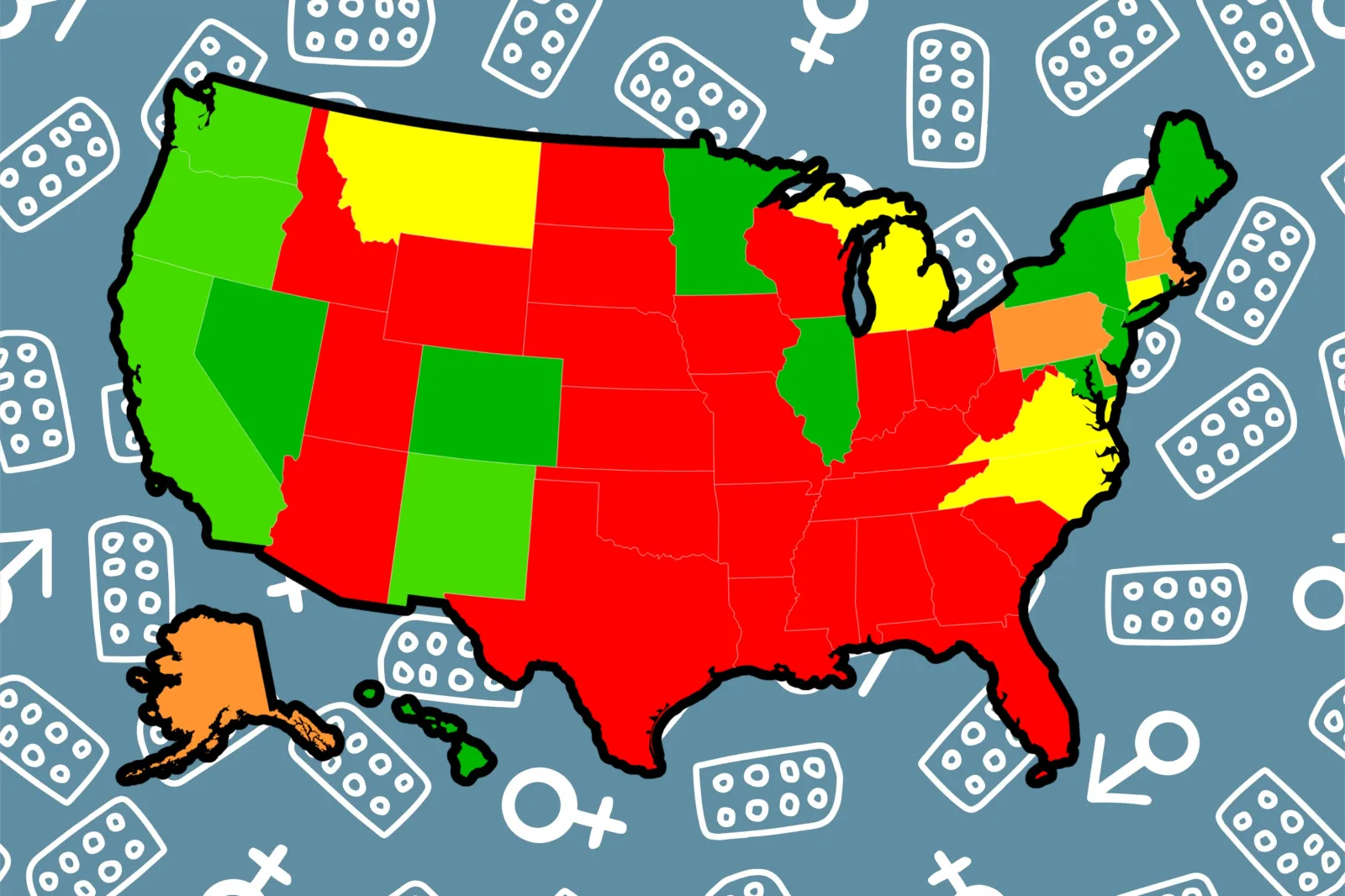
A map reveals that more than half the U.S. is failing when it comes to sexual and reproductive health access.
The newly released state‑by‑state analysis from the podcast rePROs Fight Back shows deep regional divides, with 16 states earning relatively strong marks even as the nation overall scores an “F” for the seventh year in a row.
Jennie Wetter, director of rePROs Fight Back, said that attacks on sexual and reproductive rights have been driven both federally and at the state level, leaving the most vulnerable without access to care.
Read More on Health
The report evaluated all 50 states as well as Washington, D.C., using 11 criteria covering access to contraception, abortion services, sex education, affordability of care, Medicaid expansion and gender-affirming health care.
The report shows significant variation between states, with outcomes differing widely across the country.
Only five states—California, New Mexico, Oregon, Vermont and Washington—earned top “A” grades. These states scored highly for protecting abortion access, expanding Medicaid, mandating comprehensive and medically accurate sex education, and safeguarding access to gender-affirming care.
Another 11 states and Washington, D.C. earned “B” grades, bringing the total number of states with a “B” or higher to 16. These higher-performing states tend to have broader insurance coverage for abortion, fewer abortion restrictions and stronger protections for reproductive autonomy.
In contrast, 25 states received failing grades—including Texas, Florida, Georgia, Ohio and Arizona. Many of these states enforce near-total abortion bans, restrict insurance coverage for abortion, block Medicaid expansion or limit access to contraception for minors. Several also ban or severely restrict gender-affirming care for transgender youth.
States were scored across three main areas:
- Prevention, including sex education requirements and minors’ access to birth control;
- Affordability, such as Medicaid expansion and insurance coverage of abortion;
- Access, covering abortion restrictions, emergency contraception availability and gender-affirming care.
Each state received a composite score out of 100 and a corresponding letter grade, with pluses or minuses applied for additional policy factors.
The report places significant blame on recent federal actions, particularly reductions and disruptions to Title X, the country’s only federal program providing low-cost contraception, cancer screenings and STI testing. It also cites sweeping Medicaid changes projected to eliminate coverage for millions of people over the next decade.
The accompanying map makes one thing clear: reproductive freedom in America is no longer evenly distributed. While large parts of the West Coast and Northeast remain comparatively protective of reproductive rights, much of the South and Midwest now offer far more limited access.
Do you have a tip on a health story that Newsweek should be covering? Do you have a question about sexual and reproductive health? Let us know via health@newsweek.com.
View 0 Comments
Submit Correction
View Editorial & AI Guidelines