
...

By Jenni Fink
Senior Editor
0
Share
Newsweek is a Trust Project member
See more of our trusted coverage when you search.Prefer Newsweek on Googleto see more of our trusted coverage when you search.
As travelers across the U.S. brace for longer airport security lines amid a federal government shutdown, there are 18 airports where TSA isn't impacted because the airport uses private contractors instead of union workers.
As a federal government shutdown disrupts airport operations nationwide, travelers are seeing sharply different experiences at security checkpoints. While many major hubs have reported long TSA lines caused by staffing shortages, missed paychecks, and officer call‑outs, a small group of airports continue to operate with few delays because their employees are all still being paid as if there was no shutdown.
Why Are Some Airports Not Impacted by Government Shutdown
At most U.S. airports, TSA officers are federal employees who must work during shutdowns without pay, often for weeks at a time. During past shutdowns, this has led to widespread absenteeism, burnout, and resignations—resulting in security lines stretching for hours at some airports.
Read More on News
By contrast, airports enrolled in the Screening Partnership Program (SPP) rely on private screening companies contracted and overseen by TSA. While TSA still sets all security procedures, oversees operations, and maintains a federal presence at these airports, the screeners themselves are not federal employees.
Airports participating in the TSA's SPP use private screeners that are largely insulated from shutdown‑related staffing shortages because their employees are paid through pre‑funded federal contracts rather than congressional appropriations, whereas federal TSA employees have to go without pay. That financial stability allows airports to maintain normal staffing levels even when the rest of the federal government is partially closed.
The program, created in 2004, remains relatively rare. As of early 2026, roughly 20 U.S. airports participate in SPP, according to TSA documentation.
Which Airports Don't Use Federal TSA Employees
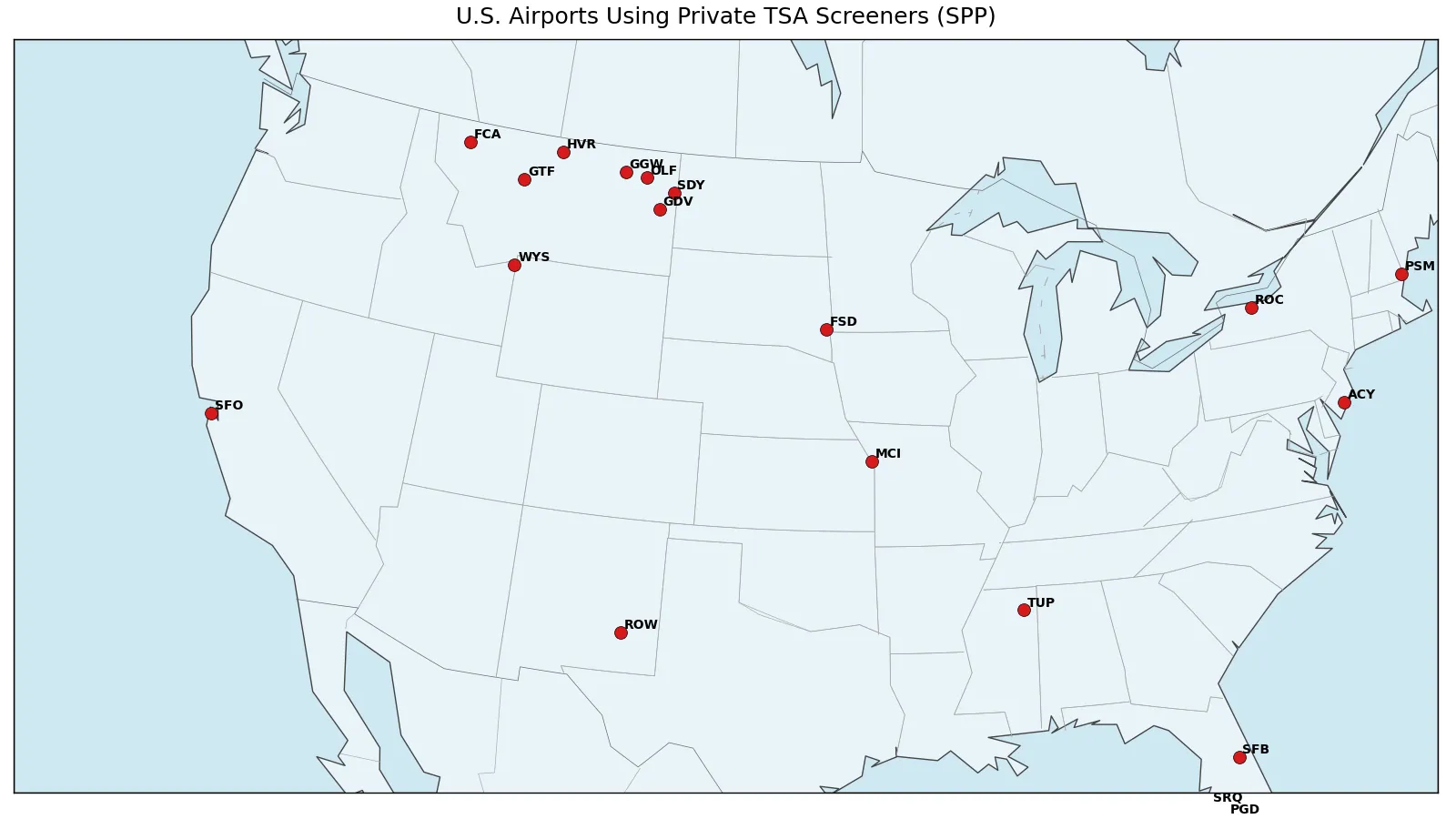
Among the most prominent examples is San Francisco International Airport (SFO), the largest and best‑known SPP airport. SFO has used private screeners since the early 2000s and is frequently cited by TSA and airport officials as proof that large hubs can operate efficiently outside the traditional federal staffing model.
“The money’s already been allocated, the payments have already been made, and that continues without interruption,” SFO spokesperson Doug Yakel told The Associated Press. “That is a very nice place to be.”
Other airports using private screeners include:
- Kansas City International Airport (MCI) — Missouri
- Frederick Douglass Greater Rochester International Airport (ROC) — New York
- Tupelo Regional Airport (TUP) — Mississippi
- Atlantic City International Airport (ACY) — New Jersey
- Orlando Sanford International Airport (SFB) — Florida
- Sarasota–Bradenton International Airport (SRQ) — Florida
- Punta Gorda Airport (PGD) — Florida
- Glacier Park International Airport (FCA/GPI) — Kalispell, Montana
- Great Falls International Airport (GTF) — Montana
- Yellowstone Airport (WYS) — West Yellowstone, Montana (seasonal)
- Havre City–County Airport (HVR) — Havre, Montana
- Glasgow (Wokal Field) Airport (GGW) — Glasgow, Montana
- Sidney–Richland Regional Airport (SDY) — Sidney, Montana
- L.M. Clayton Airport (OLF) — Wolf Point, Montana
- Dawson Community Airport (GDV) — Glendive, Montana
- Sioux Falls Regional Airport (FSD) — South Dakota
- Roswell International Air Center (ROW) — New Mexico
- Portsmouth International Airport at Pease (PSM) — New Hampshire
How to Check TSA Wait Times
Travelers looking to avoid long security lines can monitor TSA wait times in real time using several official and third‑party tools.
The MyTSA mobile app, operated by TSA, allows travelers to check estimated wait times at participating airports based on crowdsourced data and TSA input. The app also provides real‑time alerts about security lane closures, weather disruptions, and checkpoint congestion.
Many airports also publish checkpoint wait times directly on their official websites or through airport‑specific apps. Some larger hubs integrate live security data into flight information displays or airport maps.
While wait times can fluctuate rapidly—especially during peak travel hours—airports using private screeners have historically shown greater consistency during shutdowns, but travelers are advised to still get to the airport two hours early for a domestic flight and three hours for an international flight.
Is TSA PreCheck Impacted by Airport Security Delays
TSA PreCheck lanes are generally less affected by shutdown‑related disruptions, but they are not immune.
At federally staffed airports, PreCheck lanes can still experience delays if staffing shortages force TSA to consolidate screening operations or temporarily close dedicated lanes. During previous shutdowns, some airports suspended PreCheck lanes altogether during off‑peak hours due to insufficient staffing. Several airports have had to close TSA PreCheck lanes and are sending people through regular screening lanes for expedited screening, according to the MyTSA app.
At SPP airports, PreCheck lanes tend to remain fully operational because private contractors can maintain staffing levels regardless of federal payroll disruptions. TSA oversight and standards remain identical, but operational flexibility allows these airports to avoid many of the bottlenecks seen elsewhere.TSA has stated that screening procedures, technology, and security standards are the same at SPP and federally staffed airports, meaning PreCheck travelers should not see differences in the screening experience—only in wait times.
While the vast majority of U.S. airports still rely on federally employed TSA officers, the shutdown is renewing debate over whether the Screening Partnership Program should be expanded.
Supporters argue that private screening offers greater resilience during federal disruptions and more flexibility in staffing and scheduling. Critics, including TSA unions, warn that privatization could undermine worker protections and long‑term accountability.
“We will never advocate for any privatization of any federal employees. We don’t believe that’ll work,” Johnny Jones, secretary-treasurer of the TSA union’s bargaining unit, told the Associated Press.
For now, the impact is practical rather than political. Travelers departing from airports shown on TSA wait times maps with minimal delays may simply be benefiting from an alternative staffing model—one that continues to function even when Washington does not.
View 0 Comments
Submit Correction
View Editorial & AI Guidelines