
By Joe Edwards
Reporter
0
Share
Newsweek is a Trust Project member
See more of our trusted coverage when you search.Prefer Newsweek on Googleto see more of our trusted coverage when you search.
Americans in multiple states may have a chance to see the northern lights on Thursday.
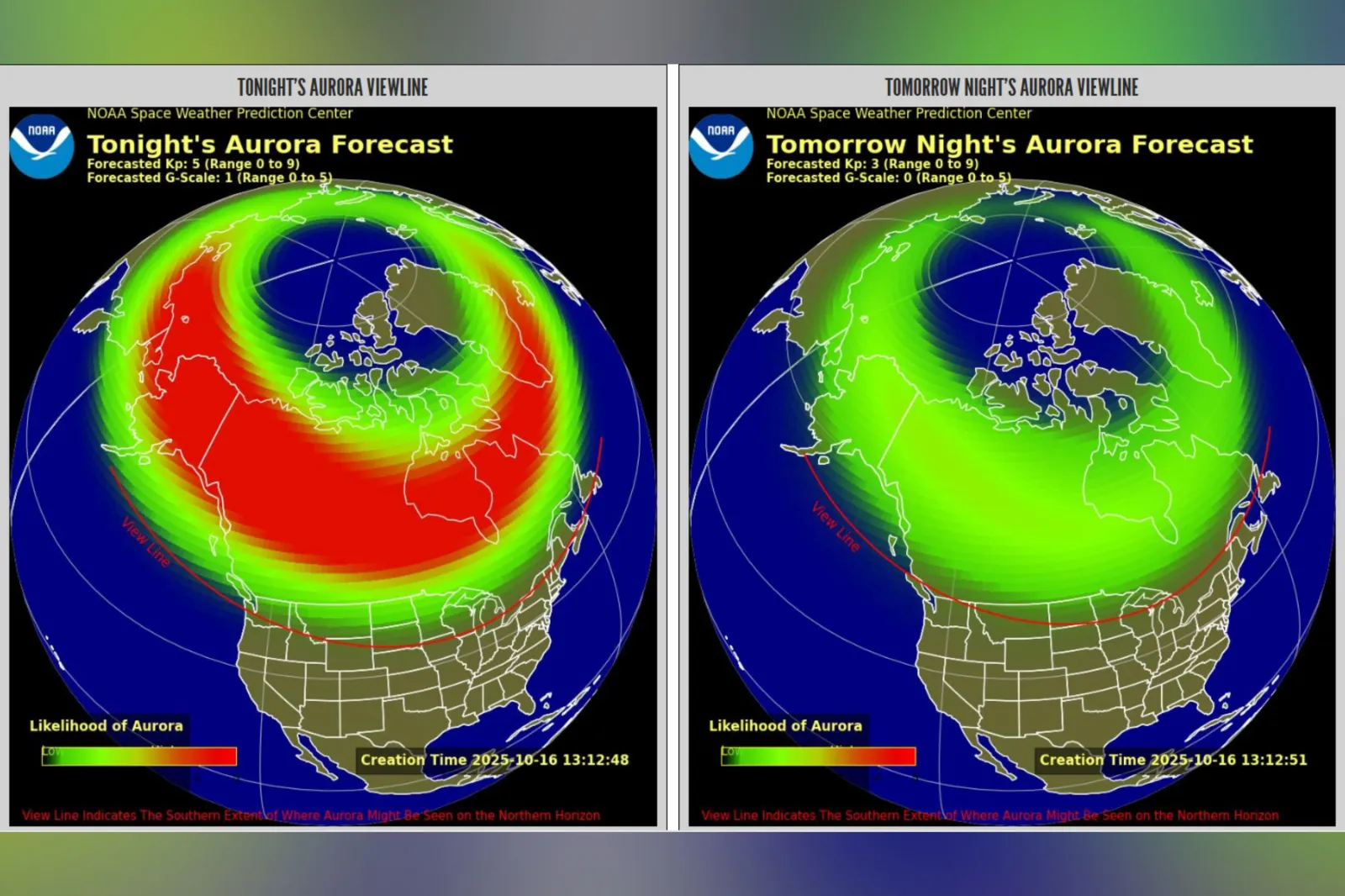
According to a forecast from the National Oceanic and Atmospheric Administration's (NOAA) Space Weather Prediction Center (SWPC), the aurora borealis could be visible in as many as 12 states on Thursday night.
Why It Matters
While NOAA's forecast doesn't ensure a sighting, it offers a chance for residents of states ranging from Washington to Maine to catch a glimpse of the celestial phenomenon.
Read More on News
What To Know
According to the SWPC's viewline forecast, the aurora borealis may be visible over parts of Washington, Idaho, Montana, Wyoming, South Dakota, Iowa, Wisconsin, Michigan, New York, Vermont, New Hampshire, and Maine.
...
The SWPC explains that the northern lights occur when electrons collide with the upper parts of Earth's atmosphere. These electrons get a boost of energy in a region of Earth's magnetic field on the night side of the planet.
Once energized, they travel along the magnetic field toward the polar areas. When they hit oxygen and nitrogen atoms high in the sky, they transfer their energy to the atmosphere, which "excites" these atoms and molecules. As the gases calm down, they release that energy as glowing light, it says.
During "large" events, the aurora may be visible as far south as parts of the Southern U.S., Europe, and Asia. In "very large" events, it can be seen even farther away from the polar regions, according to the agency.
The SWPC said on Tuesday that some geomagnetic storm activity would be likely by late Thursday with the arrival of solar material and magnetic fields from the sun, known as a coronal mass ejection, which left the sun over the course of October 11-13.
The agency then said the aurora could become visible over some northern and Midwest states from New York to Idaho.
What People Are Saying
NOAA's Shawn Dahl told Newsweek: "There were several recent quite slow moving coronal mass ejections (CME) from October 11-13, that could influence Earth today or the 17th, and we currently have G1-G2 Watches out accordingly, although we have a low level of confidence about that forecast due to the off-Earth line of most of the CMEs material. We are not yet seeing any 'early' indications of imminent CME arrivals, but that doesn't mean we won't see some influence yet tonight. So at this time our forecast still holds but, as mentioned, with a low level of confidence for a grazing or flanking edge effect from the CME passages.
"Still, our forecast often changes as more activity develops and we are currently analyzing yet another CME blast (much more energetic this time) on October 16, to see if that might influence Earth in the next 2-3 days as well. However, early analyses suggest that CME will also most likely be mainly ahead and north of Earth's orbit. Although some outlier results are suggesting a flanking edge impact at Earth."
Space Weather Prediction Center operations chief Mike Bettwy previously told Newsweek: "General tips include viewing late at night, away from city lights, and taking pictures with your iPhone or other technology since the aurora may be visible on those devices even though the human eye may not always detect it."
The Space Weather Prediction Center says: "The aurora is not visible during daylight hours. The aurora does not need to be directly overhead, but can be observed from as much as 1,000 km [620 miles] away when the aurora is bright and if conditions are right."
What Happens Next
The SWPC issues aurora viewline forecast updates frequently on its website.
Update, 10/16/2025, 12:35 p.m. ET: This article was updated with comment from Shawn Dahl.
View 0 Comments
Submit Correction
View Editorial & AI Guidelines