...

By Giulia Carbonaro
Senior Reporter
0
Share
Newsweek is a Trust Project member
See more of our trusted coverage when you search.Prefer Newsweek on Googleto see more of our trusted coverage when you search.
A potential trade war between the U.S. and the European Union (EU) would have disastrous consequences for the states that exchange more goods with the bloc, according to a recent study by LendingTree, while only a couple would be relatively unscathed.
Why It Matters
Donald Trump has threatened the imposition of sweeping tariffs on goods imported from allied countries, including the EU, during his second term in order to correct the U.S. trade deficit with these countries.
Read More on News
While tariffs play a central role in Trump's political vision for the country, and the president has promised that they will bring prosperity to the nation and enrich Americans, experts have warned against their negative impact on the U.S. economy. Tariffs are expected to increase the price of everyday goods for Americans, who would eventually take the brunt of Trump's trade wars.
What To Know
As of March 12, Trump introduced a 25 percent tariff on all steel and aluminum imports from around the world—including the 27 countries forming the EU, which include giants like France, Germany, and Spain. In response, the EU has announced new tariffs on U.S. goods worth $28 billion (€26 billion), "from boats to bourbon to motorbikes."
The promise of retaliation from the bloc unleashed a tit-for-tat response from the president, who threatened to impose a 200 percent tariff on alcoholic products from EU countries unless the union stepped back from its "nasty 50 percent tariff on whiskey."
Many experts and business leaders are worried that these tense exchanges might escalate into a full-on trade war with the EU.
This would have massive consequences for the bloc: last year, the U.S. was the EU's biggest trade partner, representing 20.6 percent of the bloc's imports and taking 13.7 percent of its exports, according to Eurostat. The Netherlands was the largest importer of goods from the U.S., while Germany was the largest exporter to the U.S. in the EU.
As of December 2024, the EU exported $49.4 billion (€45.4 billion) of goods to the U.S., while importing about $30 billion (€27.5 billion) from the country. In 2024, the EU's most exported manufactured goods to the U.S. (overall 91 percent of its exports to the country) were machinery and vehicles (39 percent), followed by chemicals (32 percent) and other manufactured goods (20 percent). Food and drink represented a much smaller share.
Among the EU's imports of manufactured goods from the U.S. (69 percent), the most imported were machinery and vehicles (31 percent), followed by chemicals (25 percent) and other manufactured goods (14 percent).
But the U.S. will also suffer the consequences of more expensive European imports and exports, especially those states with the biggest trade with the bloc.
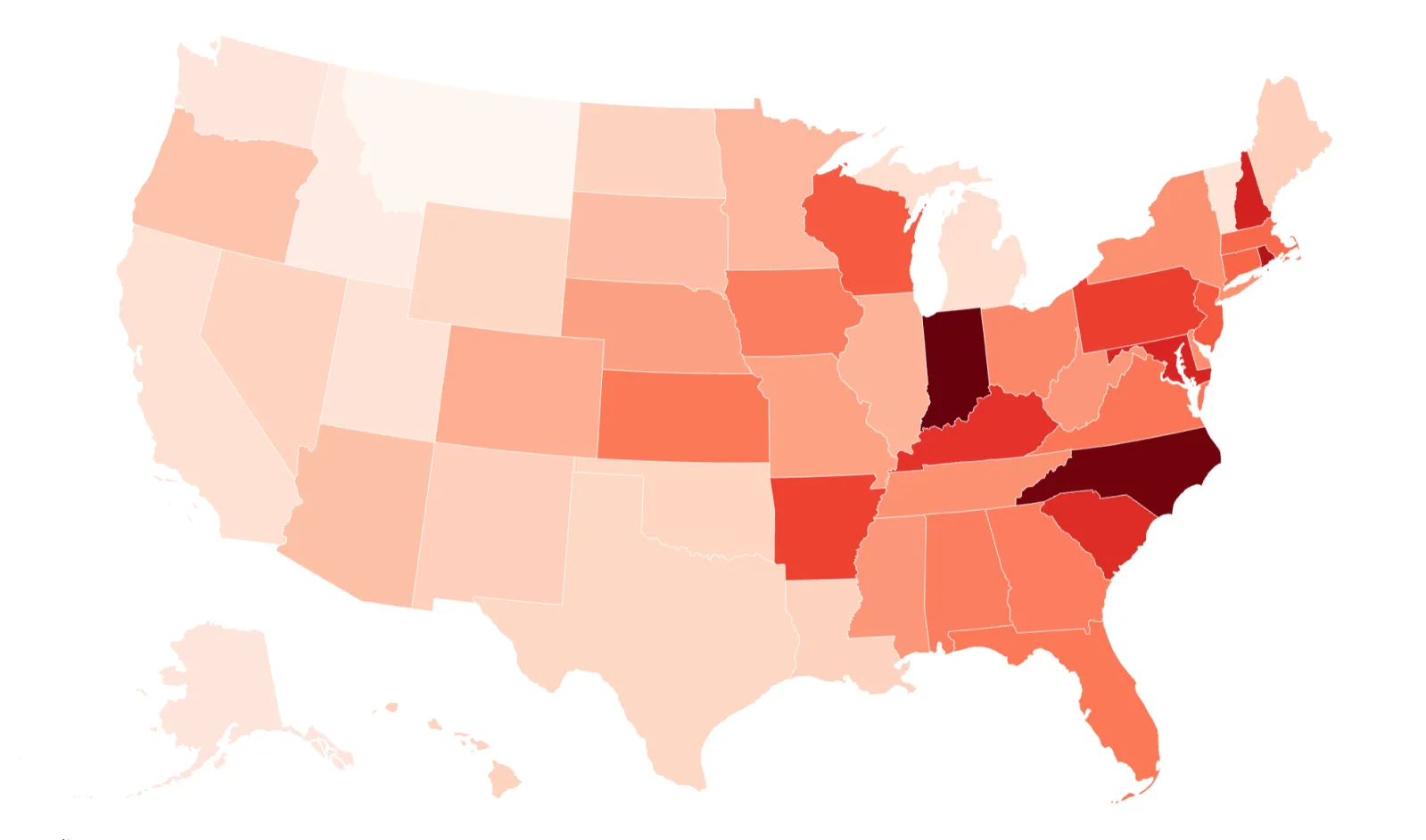
Indiana and North Carolina, according to LendingTree's analysis of U.S. Census Bureau data, get nearly half of their imports from EU nations, respectively at 46.2 percent and 45.2 percent.
New Hampshire, Rhode Island and Maryland send at least 30 percent of their exports to EU nations, respectively at 38.5 percent, 35.2 percent, and 33.2 percent, and are likely to be the most vulnerable to potential retaliatory tariffs from the EU.
In Indiana and Kentucky, trade with the EU makes up the highest percentage of the two states' gross domestic product (GDP), respectively at 13.3 percent and 14.6 percent, while in the rest of the country the percentage is in the single digit.
What People Are Saying
Donald Trump said earlier this month in response to retaliation from the EU and Canada: "Whatever they charge us with, we're charging them."
European Commission President Ursula von der Leyen said in a press release earlier this month: "Tariffs are taxes—bad for business, worse for consumers. Unjustified tariffs on the EU will not go unanswered—they will trigger firm and proportionate countermeasures. The EU will act to safeguard its economic interests. We will protect our workers, businesses and consumers."
What Happens Next
The two-stage retaliation announced by the EU in the aftermath of the U.S. steel and aluminum tariffs will come into effect on April 1 for $8.7 billion (€8 billion) worth of U.S. goods, while starting from mid-April, the bloc said it will set further retaliatory tariffs over $19.6 billion (€18 billion) worth of U.S. goods.
Washington-based think tank the Tax Foundation estimated that, even before accounting for any retaliation, the already-imposed tariffs on Canada, Mexico, China, and the expansion of the steel and aluminum tariffs "would reduce U.S. economic output by 0.4 percent."
Threatened tariffs against the EU and on all auto imports "would further shrink US GDP by an estimated 0.3 percent," the think tank said.
...
View 0 Comments
Submit Correction
View Editorial & AI Guidelines