...

By Joe Edwards
Reporter
0
Share
Newsweek is a Trust Project member
See more of our trusted coverage when you search.Prefer Newsweek on Googleto see more of our trusted coverage when you search.
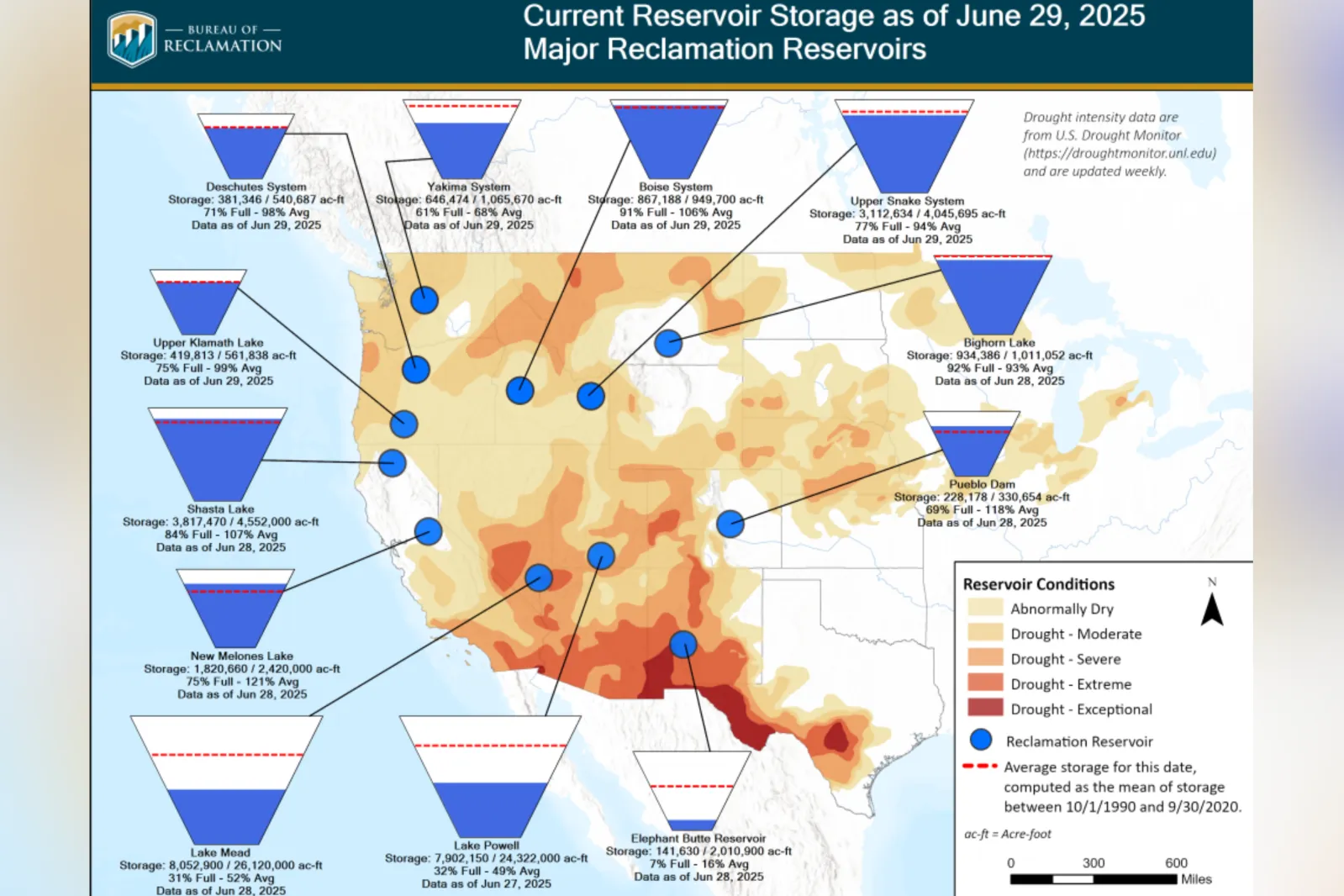
Water levels at some of the United States' largest reservoirs are well below average for this time of year, according to data from the U.S. Bureau of Reclamation (USBR).
Lake Mead was 31 percent full as of June 29, with just over eight million acre-feet of water in storage, according to the data.
This equated to 52 percent of the average storage level for this date between October 1, 1990 and August 30, 2020.
Read More
Warning Issued to Parents in Three States3 min read

US States Issued Drinking Water Warning4 min read

Lake Mead’s Water Projected to Hit Lowest Point on Record5 min read

...
Why It Matters
Lake Mead is the largest reservoir in the U.S. by capacity — capable of storing more than 26 million acre-feet of water, according the USBR. It is followed by Lake Powell, which is capable of storing 24 million acre-feet.
Declining water levels in these reservoirs could jeopardize city water systems, farm irrigation, and hydroelectric power output.
What To Know
The USBR's June 29 data revealed that Lake Powell, situated on the Colorado River in Utah and Arizona, fared only marginally better than Lake Mead, at 32 percent of full capacity. However, this was just 49 percent of the average storage level for this date.
In contrast, California's Shasta Lake contained more than 3.8 million acre-feet of water, reaching 84 percent of its total capacity of 4,552,000 acre-feet — about seven percent above its historical average for this time of year.

...
Water levels in Lakes Mead and Powell were notably lower on June 29 this year than in 2020. According to USBR data, Lake Mead was 41 percent full in 2020, at 68 percent of its average storage capacity, while Lake Powell was 53 percent full, 79 percent of its average storage capacity.
Meanwhile in 2000, Lake Mead and Lake Powell were 90 percent and 89 percent full respectively.

...
What People Are Saying
Sharon Megdal, director of the University of Arizona Water Resources Research Center, told Newsweek: "Lake Mead is one part of the highly managed Colorado River system and Lake Mead's elevation over the past 25 years reflects inflows and outflows over that period of time.
"[The last 25 years have] been dominated by lower annual natural river flows than those of the prior century. In addition, deliveries to water users in the Lower Basin, coupled with 1944 Treaty deliveries to Mexico, have exceeded inflows, causing significant decline in the amount of water in storage [in Lake Mead] since 2000."
What Happens Next
The states that depend on the Colorado River have been in talks to establish new water-sharing agreements by 2026.
View 0 Comments
Submit Correction
View Editorial & AI Guidelines