...

By Jenna Sundel
News Reporter
0
Share
Newsweek is a Trust Project member
See more of our trusted coverage when you search.Prefer Newsweek on Googleto see more of our trusted coverage when you search.
The national average gas price increased by nearly $0.06 over the past week and could increase further amid the U.S. conflict with Iran.
Why Did the U.S. and Israel Attack Iran?
President Donald Trump said the strikes, which were conducted alongside ally Israel, were intended to crush Iran’s nuclear and missile capabilities and urged Iranians to overthrow their leaders once the operation ends, telling them to “take over your government.”
Read More on News
In a speech announcing the attack on Saturday, Trump said, "Our objective is to defend the American people by eliminating imminent threats from the Iranian regime.... its menacing activities directly endanger the United States, our troops, our bases overseas, and our allies throughout the world.”
“It has always been the policy of the United States, in particular my administration, that this terrorist regime can never have a nuclear weapon. I'll say it again, they can never have a nuclear weapon. That is why, in Operation Midnight Hammer last June, we obliterated the regime's nuclear program at Fordow, Natanz, and Isfahan,” he said.
He warned Iranians that “it’s very dangerous outside. Bombs will be dropping everywhere,” but once the operation is finished, “take over your government. It will be yours to take.”
Why Are Gas Prices Increasing?
Oil prices rose on Monday amid disruptions to traffic through the Strait of Hormuz following the U.S.-Israeli strikes on Iran that saw the death of Iranian Supreme Leader Ayatollah Ali Khamenei.
The share of global maritime oil trade transported through the Strait of Hormuz in the first fiscal quarter of 2025 was 26.6 percent, according to the U.S. Energy Information Administration.

...
"Obviously, the Straits of Hormuz are incredibly important because so much oil comes out of that area right through that very vulnerable spot. And so that's a critical issue," Stephen Moore, a former adviser to Trump, told Newsweek. "I think also trying to encourage American companies to oil companies to produce as much as possible right now as a kind of patriotic duty. But also, the good news is the Saudis have so far said, we're going to continue to produce as much oil as we can to cushion the blow. I think we can get through this assuming it's just a short-term conflict and not a long-term quagmire that we could see a liberation of Iran and a regime change there without dramatic negative impact on the US economy."
The price of oil is a key factor in how much U.S. motorists pay for gas. Crude oil price increases are substantially reflected in gas prices in 20 days and a $10 per barrel increase typically results in around a 25-cent rise per gallon, according to 2019 research by the Federal Reserve Bank of Dallas.
Gas prices were already rising ahead of the summer driving season as people travel more, the Associated Press reported.
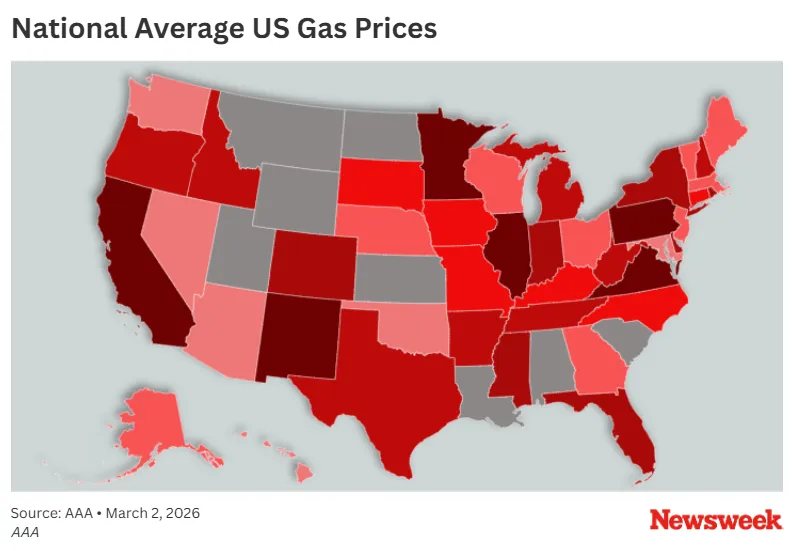
Average gas prices rose over the past week in nearly all 50 states, except for Delaware, Maryland, New Jersey, Ohio, Pennsylvania, Utah and Virginia, according to AAA.
Where Are U.S. Gas Prices the Highest?
The average gas price is highest in California, with a current average of around $4.66, according to AAA, with Hawaii having the second-highest average gas price at around $4.39.
Washington has a current average of around $4.37, and Oregon has a current average of around $3.92, according to AAA. Nevada has a current average of around $3.70.
The average gas price is lowest in Oklahoma, with a current average of around $2.48, AAA said.
Meanwhile, the national average for gas prices as of Monday afternoon is $2.997.
Do you have a story that Newsweek should be covering? Do you have any questions about this story? Contact LiveNews@newsweek.com.
In a polarized era, the center is dismissed as bland. At Newsweek, ours is different: The Courageous Center—it's not "both sides," it's sharp, challenging and alive with ideas. We follow facts, not factions. If that sounds like the kind of journalism you want to see thrive, we need you.
When you become a Newsweek Member, you support a mission to keep the center strong and vibrant. Members enjoy: Ad-free browsing, exclusive content and editor conversations. Help keep the center courageous. Join today.


View 0 Comments
Submit Correction
View Editorial & AI Guidelines