...

By Giulia Carbonaro
Senior Reporter
0
Share
Newsweek is a Trust Project member
See more of our trusted coverage when you search.Prefer Newsweek on Googleto see more of our trusted coverage when you search.
Gas prices have jumped more than 18 percent since the U.S. and Israel launched joint strikes on Iran on February 28, starting an ongoing conflict in the Middle East which has no clear end in sight.
As of Tuesday, March 10, the average price for a gallon of regular gas was $3.539 nationwide, according to data from the American Automobile Association (AAA), up from $3.109 a week earlier and $2.921 a month earlier. U.S. drivers have not faced prices this high at the pump since the summer of 2024., according to Patrick De Haan, head of petroleum analysis at GasBuddy.
Before the U.S. and Israel launched their attacks on Iran, on February 27, the average nationwide gas price was $2.982, trending down on a weekly, monthly, and yearly basis. In December, the White House was saying Americans were “spending less on gas than they have in years” and adding that it was “only the beginning.”
Read More on News
But energy prices have exploded since the U.S. and Israel bombed Iran, threatening to wipe out any financial gains obtained by Americans in recent months and raising real concerns among Republicans ahead of the upcoming midterm elections.
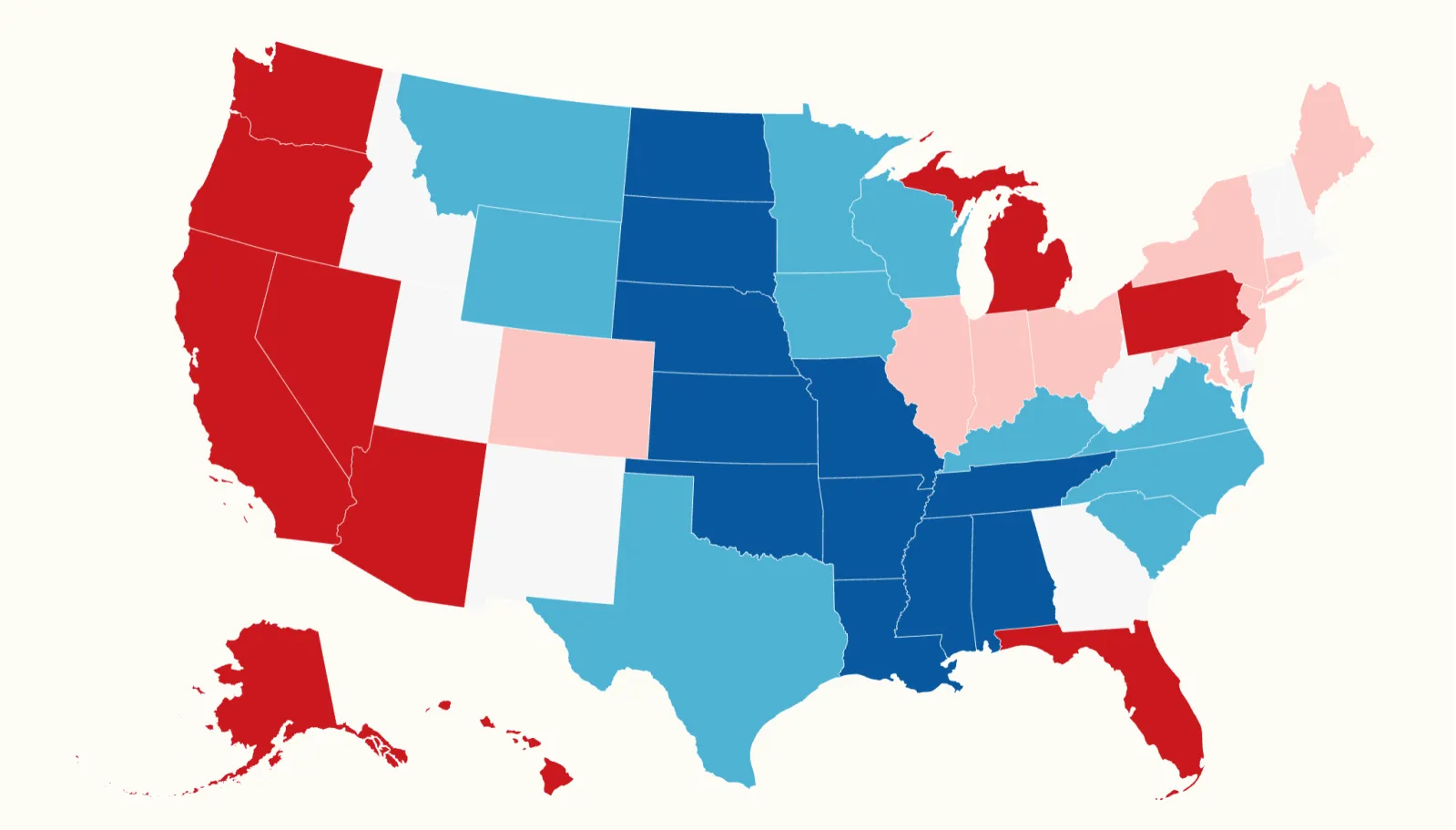
Where Are Gas Prices Rising the Most?
Gas prices are rising all across the U.S. as a result of the war in Iran. On Monday, Brent crude, the international standard, reached $114 per barrel for the first time since 2022, up 23 percent from its Friday closing price of $92.69.
This is happening mainly because of the chokehold the conflict in the Middle East has placed on the Strait of Hormuz, a narrow shipping route carrying one-fifth of the world’s oil.
In the U.S., these disruptions are bringing prices up at a time when they would normally rise anyway—though typically much less—as drivers’ demand for fuel goes up in the springtime and summer-blend gasoline production begins.
The surge in gas prices is hitting the West Coast and California, where drivers already paid the highest prices in the nation, especially hard. In the Golden State, the average price of regular gas, per gallon, was $5.290 on Tuesday, up from $4.642 on February 27.
California Governor Gavin Newsom, whom Trump has blamed in the past for the high cost of gas in the state, has pointed the finger at the president for the recent increases.
“Average gas prices in California have stayed below $5 for nearly two years—until now,” the governor’s office wrote in a recent statement on X. “This is because of Trump’s war with Iran.”
States like Indiana, Ohio, West Virginia, Florida, and Texas have also seen big increases.
In Indiana, the average price of a gallon of regular gas was $3.492 on Tuesday, up from $2.999 only a week ago and $2.769 a month earlier.
In Ohio, it was $3.422, up from $3.004 a week earlier and $2.857 a month earlier; in West Virginia, it was $3.410, up from $2.997 a week earlier and $2.832 a month earlier. In Florida, prices have jumped from $2.905 a month ago and $3.068 a week ago to $3.630.
In Texas, the average price of a gallon of regular gas was $3.206, up from $2.736 a week ago and $2.546 a month earlier.
Will Prices Continue Rising in the Coming Days and Weeks?
Experts believe that the only way gas prices will fall in the U.S. is if the war in the Middle East ends and passage through the Strait of Hormuz is reestablished.
On Monday, Trump suggested that the war was “very complete, pretty much”—a statement that saw oil prices fall sharply to below $90 a barrel, promising relief for gas prices.
But only a few hours later, he added: “We have won in many ways, but not enough. We will not relent until the enemy is totally and decisively defeated.”
...
View 0 Comments
Submit Correction
View Editorial & AI Guidelines