
By Alice Gibbs
Senior Reporter
0
Share
Newsweek is a Trust Project member
See more of our trusted coverage when you search.Prefer Newsweek on Googleto see more of our trusted coverage when you search.
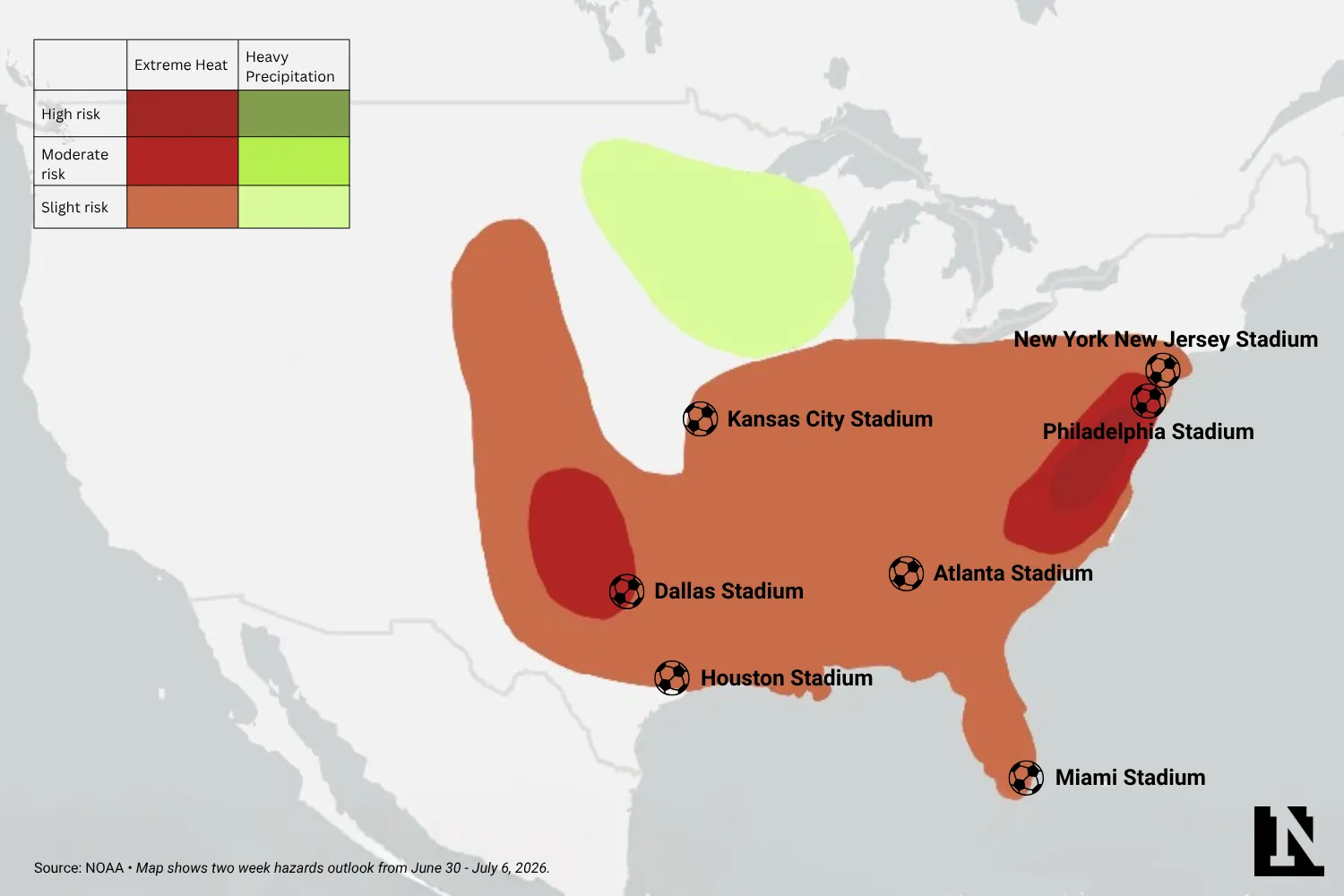
A National Oceanic and Atmospheric Administration (NOAA) hazards outlook is signaling potentially dangerous heat across swaths of the United States just as the 2026 FIFA World Cup moves into its knockout rounds, with teams including France, Brazil, Argentina and England set to play in host cities—New York/New Jersey, Philadelphia, Atlanta, Miami, Kansas City, Dallas and Houston—flagged for extreme heat risk between June 30 and July 6.
The pattern is being driven by a heat dome—an area of high pressure that traps hot air and humidity over a region—allowing temperatures to build over several days.
How Hot Could It Get?
NOAA’s week-two outlook does not offer exact game-time temperatures, but it points to a significant and widespread heat risk across key World Cup host cities.
Read More on U.S.
Parts of the Mid-Atlantic could see temperatures climb into the mid‑90s, including Philadelphia, while New York City may reach 90°F or higher. High humidity in the region could push the heat index toward 100–105°F, raising concerns for the open-air knockout matches scheduled at MetLife Stadium on June 30 and July 5, as well as Philadelphia’s Round of 16 game on July 4.
Further south and into the central United States, conditions could be even more intense. NOAA says parts of the Southern Plains may reach 100°F or higher, with heat index values exceeding 105°F and potentially climbing toward 110°F in some areas. That risk overlaps with fixtures in Dallas and Houston, where long-range forecasts already suggest outside highs in the upper 90s around June 30 and July 3, with similarly hot conditions persisting into July 6.
Elsewhere, the pattern is broadly consistent. Kansas City could see temperatures in the mid-to-upper 90s around its July 3 match, while Miami’s Round of 32 fixture is currently tracking near 91°F, with heavy humidity likely to make conditions feel significantly hotter. Atlanta, which hosts a match on July 1, is also expected to be in the low 90s, though its indoor-capable stadium may reduce on-field exposure compared to other venues.
Which World Cup Games Could Be Hit
The heat risk coincides directly with the World Cup’s knockout phase.
In New York/New Jersey, France beat Sweden 3–0 on June 30 in an open-air stadium, with further matches set to take place there, including Brazil vs. Norway on July 5. Philadelphia will also host Paraguay vs. France on July 4, another afternoon game in an open-air venue.
Dallas has also already staged Norway’s win over Ivory Coast and will host more knockout ties, including Australia vs. Egypt on July 3 and another Round of 16 game on July 6.
Elsewhere, England plays DR Congo in Atlanta on July 1, Argentina faces Cape Verde in Miami on July 3, and Colombia meets Ghana later that day in Kansas City—with Miami and Kansas City among the venues more directly exposed to heat due to open or partially covered designs.
The Round of 16 continues that pattern. Along with Philadelphia and New York/New Jersey, Houston will host Canada vs. Morocco on July 4, while Dallas again hosts a match on July 6.
Overall, the confirmed schedule places multiple knockout games in open-air or partially covered stadiums across the Mid-Atlantic and central U.S., where the most intense heat is forecast, while indoor-capable venues such as Dallas, Houston and Atlanta are expected to rely on cooling systems to reduce on-field exposure.
The United States men’s national team remains outside the hottest areas for now. Its Round of 32 match against Bosnia and Herzegovina is set for July 1 in Santa Clara, and a potential next game in Seattle would also avoid the core heat zone highlighted in the forecast.
Instructions for the Heatwave
During extreme heat public health guidance from the CDC advises people to stay hydrated, limit time outdoors during peak heat and seek cooler, shaded or air‑conditioned environments to reduce the risk of heat exhaustion or heatstroke.
Experts also warn that extreme heat can affect how some medications work. The CDC says certain drugs—including those for blood pressure, mental health and heart conditions—can increase heat sensitivity by impairing sweating, thirst or the body’s ability to regulate temperature, raising the risk of heat-related illness. High temperatures can also degrade some medicines or reduce their effectiveness if they are not stored properly.
Weather concerns extend to the matchday experience for fans. Before the tournament kick off FIFA tightened stadium entry rules, banning refillable water bottles and limiting supporters to small, sealed disposable bottles, meaning many will have to rely on vendors inside the grounds.
In response to heat, FIFA say additional “heat mitigation” measures—such as hydration points, misting stations and cooling areas—will be available around venues.
Hydration Breaks and Air Conditioning
FIFA has already moved to address heat concerns by mandating hydration breaks in every match, regardless of venue or temperature.
The stoppages will come around the 22nd minute of each half and are being applied across the tournament, even in games played in roofed or climate-controlled stadiums, as part of a player-welfare policy introduced ahead of the 2026 World Cup.
Among the stadiums in this forecast window, Dallas Stadium, Houston Stadium and Atlanta Stadium can all be operated as fully climate-controlled venues with retractable roofs and stadium cooling.
By contrast, New York/New Jersey Stadium, Philadelphia Stadium and Kansas City Stadium are open-air, while Miami Stadium has a canopy that shades much of the seating bowl but does not create a fully enclosed, air-conditioned environment over the field.
In practical terms, that means the weather may be a much bigger direct factor in New York/New Jersey, Philadelphia, Kansas City and Miami than in Dallas, Houston or Atlanta.
Contact Newsweek editors on this story: Tobias Meyjes and Emma Lee-Sang.
Update 06/24/26, 11:00 a.m. ET: This story was updated with additional information.
Update 07/01/26 07:45 a.m. ET: This story was updated with match information.
View 0 Comments
Submit Correction
View Editorial & AI Guidelines