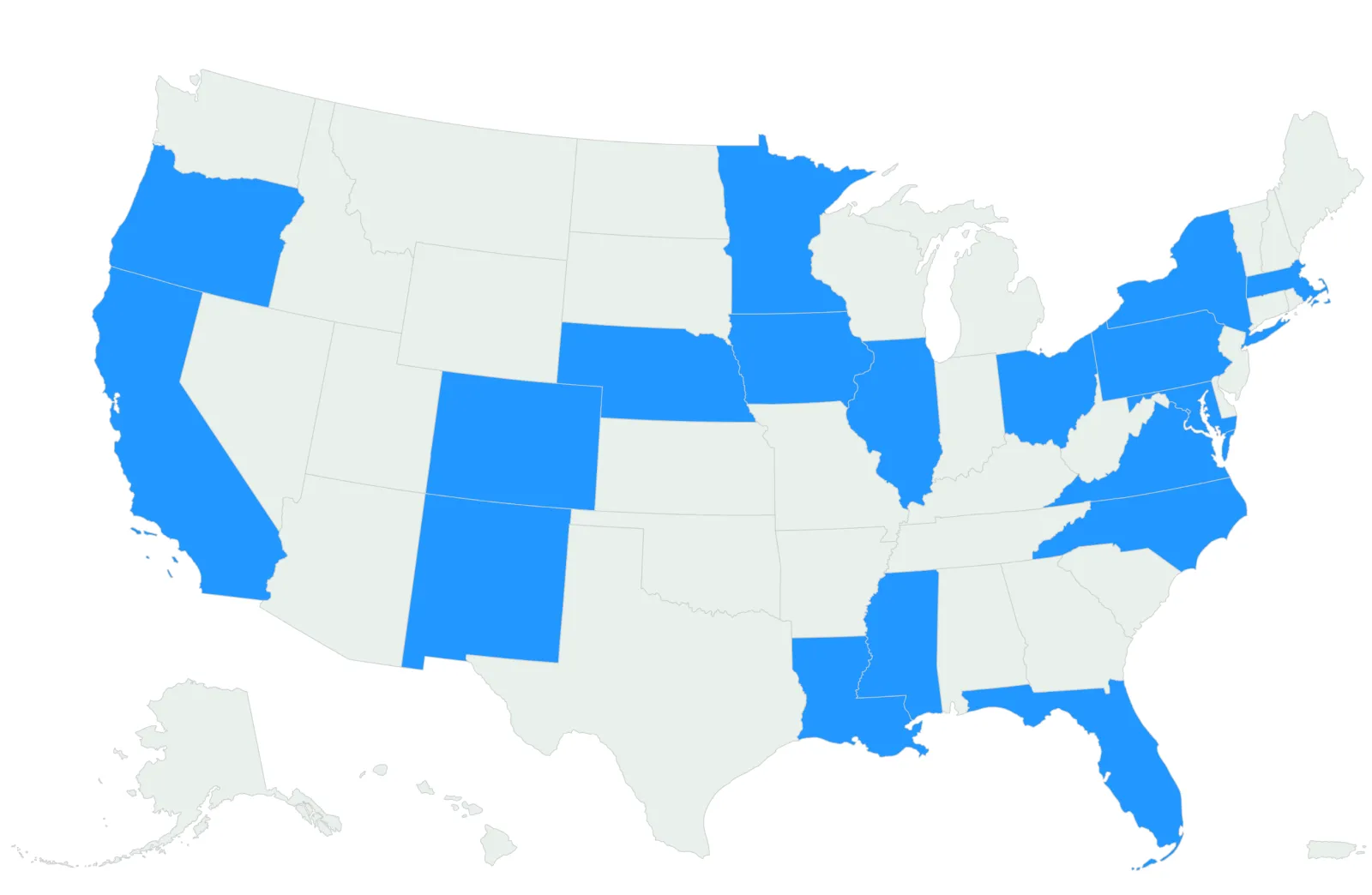
basic income map

By Hugh Cameron
Reporter
0
Share
Newsweek is a Trust Project member
See more of our trusted coverage when you search.Prefer Newsweek on Googleto see more of our trusted coverage when you search.
Universal or guaranteed basic income programs are gaining momentum across the country, as local governments and nonprofits experiment with the bold new alternative to traditional welfare models.
According to Stanford University's Basic Income Lab, which tracks ongoing UBI or GBI pilot programs across the U.S., citizens in 18 states, as well as the District of Columbia, have taken part in some form of basic income study this year.
"UBI differs quite radically from welfare as we know it because it goes to all without means tests or work requirements," said Juliana Bidadanure, founder of the Basic Income Lab. "It builds a robust floor that prevents all from falling too low, and it achieves that with a principle of radical inclusivity (everyone is opted in automatically)."
Read More on Politics
Why It Matters
Neither UBI nor GBI programs have yet become a nationwide practice in any country, and their implementation will continue to be hindered by political and fiscal concerns some governments may have over providing citizens with unconditional payments. However, the studies that have been conducted have provided important data on the benefits and drawbacks of income guarantees for citizens, and could lead to further adoption in the future.
Given that economies across the globe are faced with mounting inequality and the prospects of automation depriving millions of working opportunities, advocates believe that providing a basic income is an increasingly necessary means of ensuring financial security in the face of rapid economic shifts.
What To Know
According to the Stanford Basic Income Lab's tracker, 57 basic income experiments were ongoing as of late January, with over a dozen in California alone. While many have concluded, others remain ongoing, varying in payment amounts, recipients and intended purposes.
One such experiment is currently being conducted by the Southern California non-profit Inland SoCal United Way in conjunction with the California Department of Social Services. The pilot program will provide unconditional cash payments of $600 per month for 18 months to hundreds of pregnant women in their first or second trimesters, as well as $750 per month to 21-year-olds who have spent time in the foster care system.
Another is the Richmond Resilience Initiative, operated by the city's government and now in its fifth year, which focuses on providing support to those who serve as their household's primary caregiver. Participants receive $500 per month for a period of two years, and it is aimed at "reducing financial instability for working families."
Canadian health economist and basic income scholar Evelyn Forget told Newsweek that current welfare programs are plagued with bureaucratic obstacles and inefficiencies, issues she believes are made easier by an unconditional payment system like UBI.
"In North America, we have a range of social programs — most underfunded and virtually all 'conditional,'" she said. "These conditions, on their face, seem reasonable... In practice, many of these conditions are imposed in ways that make access to cash difficult: How do you 'prove' residency when you have no ID? How do you 'prove' an episodic mental illness? How do you access child support when you're the grandmother caring for the kids but their parents, who may be unreachable, have custody?"
Amy Castro, co-founder of the Center for Guaranteed Income Research at the University of Pennsylvania, said that the heightened interest in unconditional cash programs has been driven by "pervasive economic strain."
"Americans are working more and making less to the detriment of our health, well-being, and relationships," she said. "Living with chronic financial stress like not knowing if you will receive enough shifts at work to make rent drives poor public health outcomes, food insecurity and a range of mental health stressors."
Castro added that the benefit of such programs is that cash "is provided with no strings attached, no conditions on how the money can be spent," and that this can work alongside existing social safety nets.
Based on data from over 30 basic income pilots across the U.S., the Stanford Basic Income Lab tracked how Americans spent the money they received through these programs. The majority of expenditures went toward retail sales and services. Food and groceries were the second-highest at 32 percent, followed by transport and housing/utilities, both at 9 percent.
What People Are Saying
Juliana Bidadanure, founder of the Stanford Basic Income Lab, told Newsweek that a system of simple, unconditional payments "suppresses bureaucratically burdensome eligibility tests and protects individuals in poverty from being subject to the discretionary power of state agents. It implements a real right to live free from abject poverty, no questions asked, no paperwork filed."
"The universal feature of UBI also makes it harder to demonize or stigmatize those on benefits," she added. "This is important since a common feature of Western countries with targeted cash payment has been the stigmatization of benefits recipients as scroungers and welfare queens."
Danny Avula, Mayor of Richmond, Virginia, upon launching the fifth Resilience Initiative basic income pilot, said: "In Richmond, we believe everyone has a right to thrive, not just survive. The Richmond Resilience Initiative reflects our ongoing commitment to creating a city where families have the stability and support they need to build a better future."
Amy Castro, co-founder of the Center for Guaranteed Income Research, told Newsweek: "The advantage of cash is that it is flexible, fungible, and efficient—particularly when enduring an unexpected economic shock like a natural disaster or sudden drop in the market. Traditional safety net benefits like WIC, SNAP or housing supports require constant administrative recertification and are plagued by the benefits cliff where working families are penalized for every dollar they make above the income threshold."
"People spend tremendous amounts of time and cognitive bandwidth negotiating these cliffs to make sure they don't lose benefits crucial for surviving a risky economy," she added. "This traps people at the poverty line because they must choose between a raise at work or an extra shift and potentially losing their benefits."
View 0 Comments
Submit Correction
View Editorial & AI Guidelines