10
Loading video...

By Andrew Stanton
Reporter
0
Share
Newsweek is a Trust Project member
See more of our trusted coverage when you search.Prefer Newsweek on Googleto see more of our trusted coverage when you search.
President Donald Trump’s approval rating is underwater in the nation’s largest farm states as diesel prices have surged in recent days, a major warning sign for Republicans ahead of the 2026 midterm elections.
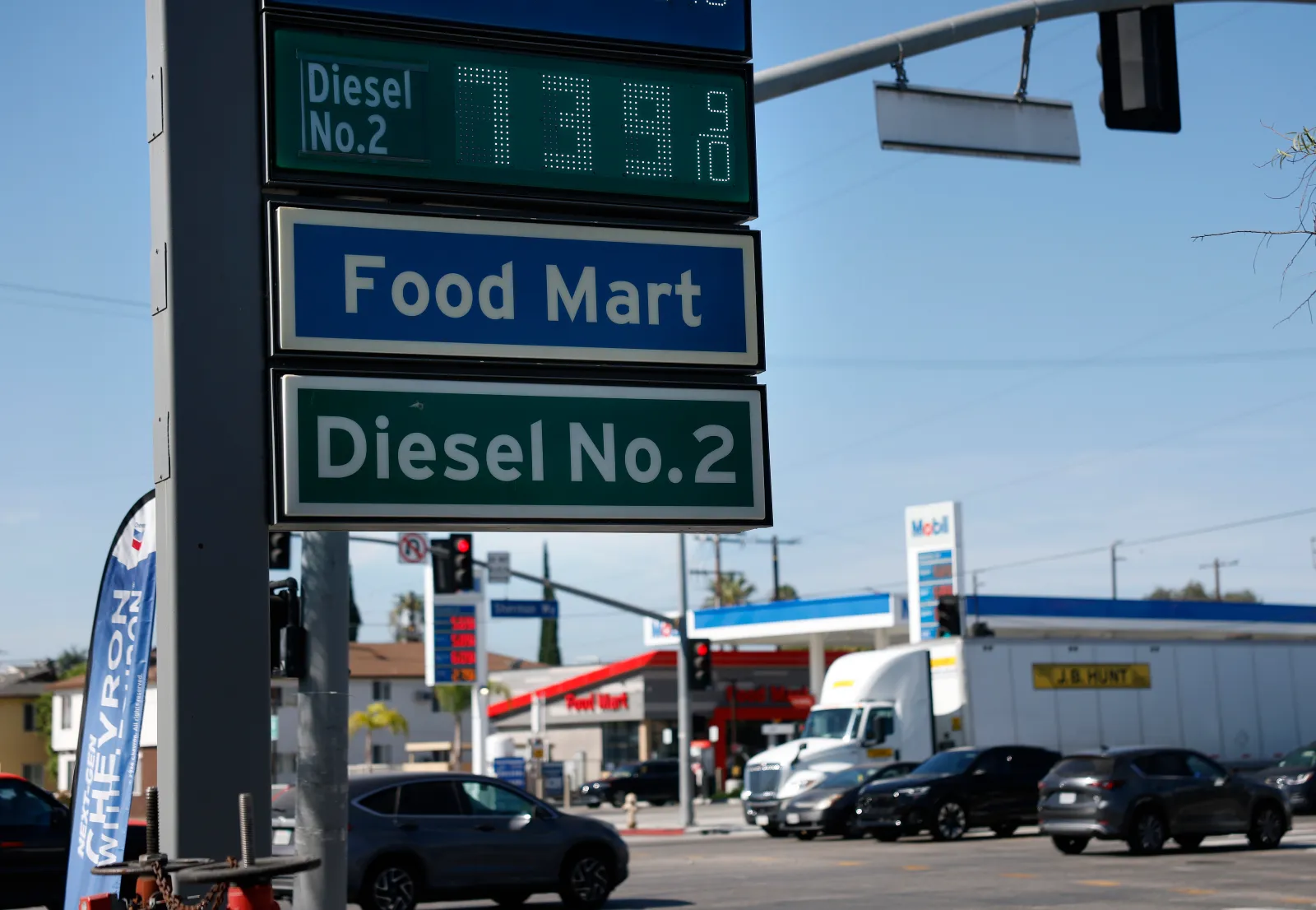
Rising diesel prices could have critical impacts for farmers, who rely on diesel to power agricultural equipment. Rising prices could also drive up transportation costs across the agricultural industry. Rising diesel prices stem from disruptions to oil and fuel shipments in the Middle East amid the United States' war in Iran, which began earlier this year.
Newsweek reached out to the White House for comment via email.
Read More on Politics
Why It Matters
For Republicans, there is a political risk if farmers, a core part of the Republican base that helped elect Trump in 2016 and 2024, abandon the party or sit out the midterms due to frustration over the impact. Rising prices come just weeks before the November midterms, and Democrats hope to expand the electoral battleground into more conservative states like Iowa and Kansas, where diesel's impact could be felt most acutely.
What Are the Biggest Farm States?
According to the 2022 Census of Agriculture, the following 10 states have the highest market value of agricultural products sold:
- California ($59.01 billion)
- Iowa ($43.94 billion)
- Texas ($32.17 billion)
- Nebraska ($29.41 billion)
- Minnesota ($28.48 billion)
- Illinois ($26.42 billion)
- Kansas ($23.99 billion)
- North Carolina ($18.69 billion)
- Indiana ($18.03 billion)
- Wisconsin ($16.7 billion)
Those states include a mix of solidly Democratic states like California, competitive swing states like North Carolina and Wisconsin, and conservative states like Nebraska and Texas.
Trump’s approval was in the negatives in all of those states except for Kansas, where he remained slightly above water in the latest data from Civiqs, which tracks the president’s approval rating in each state as part of a poll with more than 130,000 responses nationwide.
How Much Has Diesel Increased?
Diesel prices reached a record high point on Wednesday, increasing to $6.3103 per gallon, according to AAA.
On Tuesday, the national average was $6.2694 per gallon. Prices averaged $5.9424 one week earlier, $5.4460 one month earlier and $3.7008 one year earlier. Regular gas prices have also increased to $4.3672 per gallon, according to AAA.
Why Diesel Is So Important to Farmers
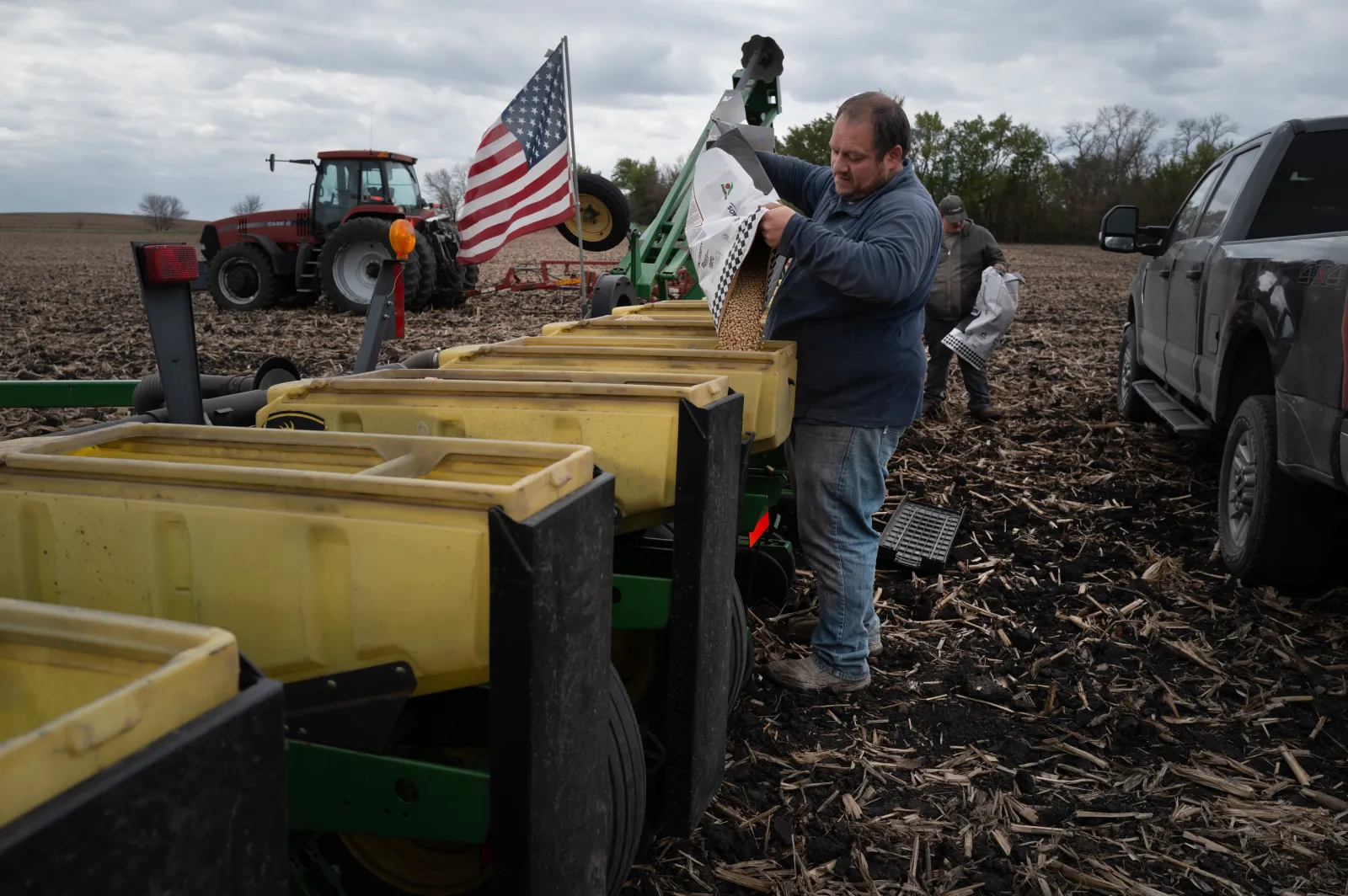
Diesel matters to farmers for several reasons. Heavy agricultural machinery, including tractors, harvesters, and irrigation pumps, uses diesel engines. Rising diesel prices translate to higher operating costs for farmers.
Diesel also powers trucks, trains and ships that move agricultural products across the supply chain, increasing transportation costs across the industry.
Diesel fuel is critical to the entire process, Andrew Muhammad, professor of agricultural and resource economics at the University of Tennessee, told Newsweek on Wednesday.
“We need diesel for farm machinery and equipment. Obviously we're approaching harvest time, and you need diesel to run harvesters and combines. We need diesel to run planters,” he said. “The entire farm machinery process, whether it's planting to harvest, requires diesel fuel directly.”
It’s also important because farming communities rely heavily on imported goods like fertilizer, and rising diesel fuel costs mean higher transport costs, he said.
Farmers Facing Tight Squeeze
Farmers have also been facing other challenges, including the rise of input costs, which relates to the broader geopolitical situation, including the Russian invasion of Ukraine in addition to the Iran war, he said.
“What people don't really realize is a big part of this is the disruptions as a result of the trade war,” he said.
Record-high diesel prices could make farming less profitable "to the point where it might not even be worth the next production cycle or to plant next season under these prices," in the context of low farm prices, he said.
Some farmers have criticized Trump amid rising diesel prices. Jason Kurtz, a farmer who voted for Trump in 2024, told Fortune that "cash-strapped" farms were struggling amid record-high diesel costs and had to make cuts just to make it through harvest.
"We have to harvest," he said. "We have to run the machines. We have to use the diesel, so it cuts into our bottom line."
Related Story
Inflation Remains Elevated as Diesel Prices Hit Record High
Can Democrats Win Votes From Farmers?
Farmers may not be happy with Trump's policy, but that does not necessarily mean they will vote for Democrats at the ballot box in November.
Muhammad said part of the answer is whether farmers view Democrats as part of the solutions to the problems they are facing.
“You've got so much going on globally. One would have to ask the question, could the Democratic Party make peace with Iran and open up the straits of Hormuz? Is the Democratic Party going to be effective at sort of peace in Gaza, say, for example, or peace between Ukraine and Russia?” he said.
Diesel is a global commodity, and a change in power in Washington “does not necessarily guarantee we're going to get sort of a change in economic outcomes,” he said.
Still, voters could also vote against Republicans to “punish the current administration and the current party for getting us into this mess in the first place,” he said.
What Is Donald Trump’s Current Approval Rating?
Overall, Trump’s approval rating stood at -26 points in the latest Civiqs poll, with 60 percent disapproving of him and 34 percent approving as of Wednesday.
Here's where Trump’s approval rating stands in the 10 states with the largest agricultural revenue:
California
Trump’s approval rating in California is one of his worst in the nation. The state had $59.01 billion in annual revenue, according to the 2022 Census. His approval stood at 24 percent, while 71 percent disapproved of him.
In 2024, former Vice President Kamala Harris defeated Trump by 20 points. This year, a gubernatorial race pits former Health and Human Services Secretary Xavier Becerra, a Democrat, against Republican Steve Hilton, though Becerra is favored.
Some House races are competitive, including the Central Valley seat held by Republican Representative David Valadao, where agricultural issues could be more salient in November.
Iowa
Iowa, once a battleground, has shifted rightward over the past decade. But Democrats believe backlash to Trump’s tariffs and rising diesel prices could improve their chances in the state, where several races could be competitive.
According to Civiqs, Trump’s approval was -20 points in Iowa, even though he carried it by 13 points over Harris in 2024. Only 35 percent of Iowans approved of him, compared to 55 percent who disapproved.
In the Senate race, Democratic state legislator Josh Turek and Republican U.S. Representative Ashley Hinson are facing off in an increasingly competitive race, while Democratic state Auditor Rob Sand has built out a slim polling lead over Republican businessman Zach Lahn in the governor’s race. There are also three competitive House races in Iowa.
...
Texas
Democrats have their sights set on Texas, as polls suggest Republicans’ grip on the Lone Star State is slipping in the midterms. Democrats are increasingly hopeful about their chances of flipping the state this year in both the Senate and gubernatorial races.
In the Senate race, polls show a toss-up between Democratic state Representative James Talarico and Republican Attorney General Ken Paxton, while Republican Governor Greg Abbott is viewed as the favorite against Democratic state Representative Gina Hinojosa in the gubernatorial race.
Trump was 18 points underwater, with 38 percent approving of his job performance and 56 percent disapproving, according to Civiqs. In 2024, the state backed Trump by nearly 14 points over Harris.
Nebraska
In Nebraska, Trump’s approval rating was 5 points in the negative, with 43 percent approving and 48 percent disapproving, according to Civiqs. Nebraska voted for Trump by nearly 20 points in 2024.
The Senate race is viewed as being potentially competitive. Republican Senator Pete Ricketts faces a challenge from independent Dan Osborn, and some polls suggest a competitive race.
Minnesota
Trump’s approval was -35 points in Minnesota, where 28 percent of respondents approved of him, and 63 percent disapproved, according to Civiqs. Harris won Minnesota by about 4 points in 2024.
Republicans hope to make the state competitive this year, but polling and forecasts show Democrats Amy Klobuchar and Peggy Flanagan leading Republicans Lisa Demuth and Michelle Tafoya in the gubernatorial and Senate races, respectively.
Illinois
In the reliably Democratic state of Illinois, only 29 percent of respondents approved of Trump, while 66 percent disapproved. While Chicago powers Democratic victories in the state, the large, rural downstate regions are more conservative and home to many farmers.
Harris won Illinois by about 11 points in 2024, and Democrats are favored in statewide races this year.
Kansas
Trump has a positive approval rating in Kansas, where 47 percent of respondents approved of his administration, and 44 percent disapproved, according to Civiqs.
Democrats are hoping to make the Sunflower State more competitive this year. In the gubernatorial race, Democrat Cindy Holscher and Republican Ty Masterson are running to succeed Democrat Laura Kelly. In the Senate race, Democrat Adam Hamilton is running against GOP Senator Roger Marshall.
Kansas voted for Trump by about 16 points in 2024.
North Carolina
In North Carolina, which gave Trump about a 3-point victory in 2024, Trump’s approval rating has fallen to a net -18 points. Thirty-eight percent of respondents approved of the president, while 56 percent disapproved, according to Civiqs.
The state is home to one of the most watched Senate races, where Democrat Roy Cooper, a former governor, has built a polling lead over Michael Whatley, former chair of the Republican National Committee, to flip the seat vacated by retiring Republican Senator Thom Tillis.
Indiana
Indiana backed Trump by 19 points in 2024, but Trump’s approval has declined to -6 points. Forty-nine percent of Indiana voters disapproved of Trump, compared to 43 percent who approved, according to Civiqs.
Indiana has no Senate or gubernatorial race this year.
Wisconsin
Trump is also unpopular in swing-state Wisconsin, according to Civiqs, with approval at 38 percent and disapproval at 57 percent. Wisconsin backed Trump by less than a percentage point in 2024.
The state's gubernatorial race is competitive, with GOP Representative Tom Tiffany and Democratic Milwaukee County Commissioner David Crowley facing off in what is viewed as a toss-up.
Contact Newsweek editors on this story: Jason Lemon, Sam Wilson, Gray R. Thomas.
View 0 Comments
Submit Correction
View Editorial & AI Guidelines