10
Loading video...

By Sam Stevenson
Associate News Editor
0
Share
Newsweek is a Trust Project member
See more of our trusted coverage when you search.Prefer Newsweek on Googleto see more of our trusted coverage when you search.
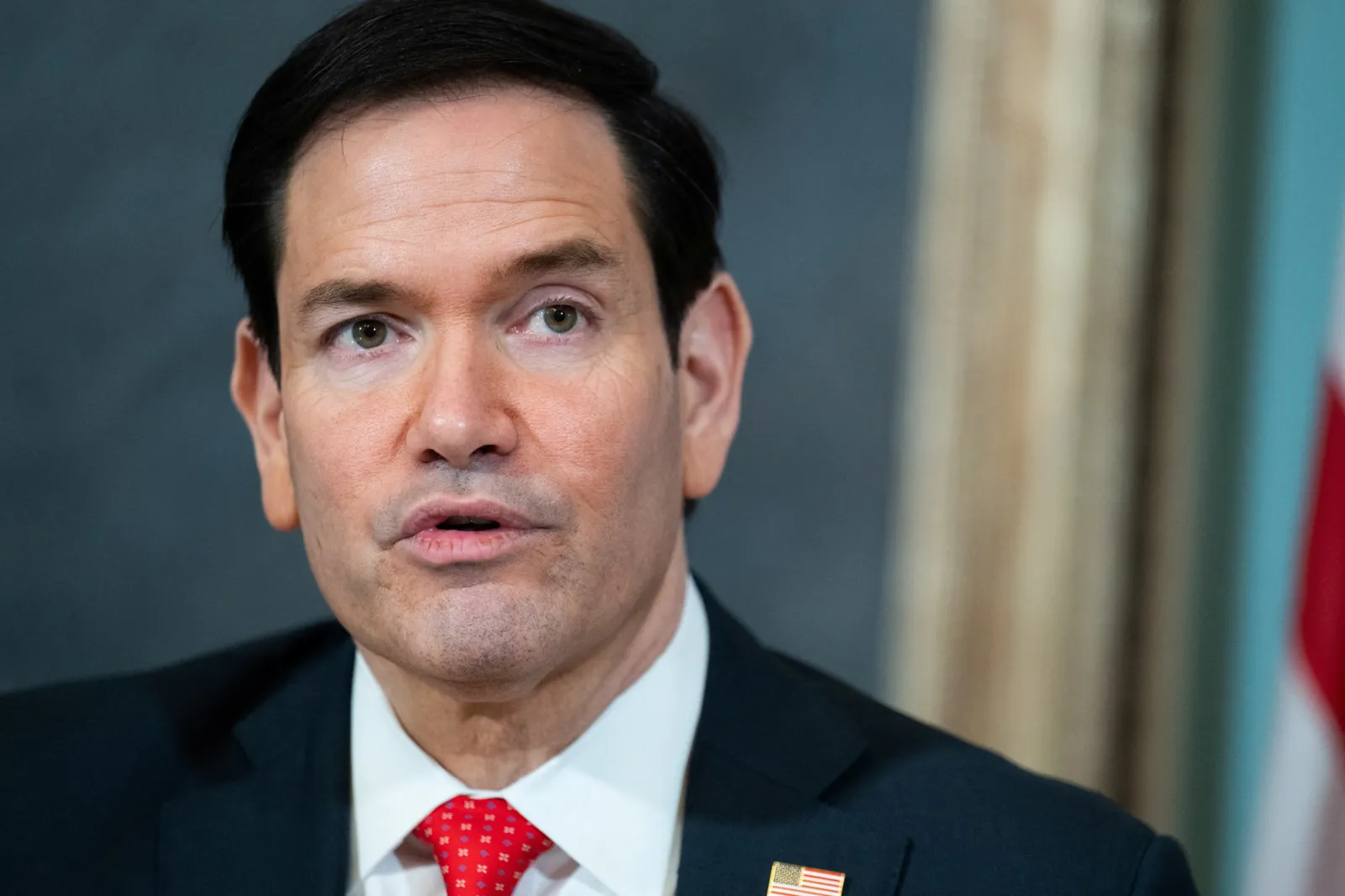
Secretary of State Marco Rubio is now the joint odds-on favorite to become the next President of the United States, according to a U.S.-regulated prediction market that briefly placed him narrowly ahead of early rivals and gave him a record-high chance.
On prediction markets, candidates are priced by traders, with those prices expressed as percentage chances of winning.
On Kalshi, Rubio’s implied probability of winning the 2028 presidential election rose to 19 percent on May 6, narrowly ahead of Vice President J.D. Vance at 18 percent and California Governor Gavin Newsom at 16 percent, before falling again to 18 percent on May 7, currently tying him with the former Ohio Senator at the time of writing.
Read More on Politics
That marks a sharp shift in trader sentiment over recent months, with Rubio gaining ground as early speculation about the next presidential race begins to take shape.
Prediction market movements offer an early snapshot of elite and investor expectations ahead of the 2026 midterms, when the contours of the 2028 race are likely to become clearer.
Potential candidates, donors and party strategists are watching shifting expectations closely, as early positioning and fundraising decisions begin to take shape.
No major candidates have entered the race yet, with most expected to wait until after the 2026 midterms before declaring.
Why It Matters
...
The 2028 race remains fluid, with several high-profile figures still weighing whether to run. In that context, prediction markets provide a real-time signal of how informed traders are reassessing the political landscape.
What To Know
Rubio’s rise on prediction markets has been both rapid and significant.
At the start of 2026, his implied probability of winning the presidency stood at just 6 percent. On May 6, that briefly climbed to 19 percent—an increase of 13 points in a little over four months—before falling to 18 percent on May 7.
At the same time, his closest Republican rival has moved in the opposite direction.
Vice President Vance, who began the year as the clear front-runner on roughly 29.7 percent, has fallen to 18 percent—a drop of 11.7 points over the same period.
A similar, though more modest, decline has been seen on the Democratic side. California Governor Newsom’s implied probability has slipped from 20.9 percent at the start of the year to 16 percent, representing a 4.9-point drop.
Taken together, those shifts suggest that traders are reassessing the Republican field more dramatically than the Democratic one, with Rubio emerging as a potential consensus alternative to Vance rather than benefiting from a broader Democratic decline.
Prediction markets such as Kalshi operate by allowing users to buy and sell contracts based on real-world outcomes, with prices reflecting what traders collectively believe the probability of an event to be. In this case, a “Yes” price of 20 cents on Rubio implies roughly a 20 percent chance of victory.
Supporters argue these markets can aggregate a wide range of information—including polling, fundraising data and political developments—more quickly than traditional forecasting methods.
Because traders have financial stakes in the outcome, or so the argument goes, prices may reflect more considered judgments than simple survey responses.
However, their limitations are well established. Prediction markets are sensitive to who is trading and how much money is involved, meaning they can be skewed by low liquidity or concentrated participation.
In early-cycle races like 2028, where uncertainty is high and the field is not yet defined, those issues are particularly pronounced.
Analyses of the 2024 election cycle—including research by Vanderbilt political science professor Joshua D. Clinton and TzuFeng Huang—suggest prediction markets can show mixed accuracy and signs of inefficiency, so their prices are best treated as an imperfect signal rather than a definitive forecast.
In Rubio’s case, the recent shift appears to reflect a recalibration among traders rather than a settled consensus.
An 18-19 percent probability still implies an 81-82 percent chance that someone else will win, underscoring how open the race remains.
What The Polls Say
Traditional polling paints a more complex and, in many ways, less favorable picture for Rubio at this stage.
A survey conducted by Echelon Insights in mid-April suggests Vance retains a commanding lead in the early Republican primary field, with 42 percent support. The poll surveyed 1,012 voters in the likely electorate from April 17 to April 20, 2026, and had a 3.5 percent margin of error.
Rubio trailed significantly at 14 percent, placing him well behind the current frontrunner.
In that poll, on the Democratic side, former Vice President Kamala Harris leads narrowly among potential candidates, polling at 22 percent compared to Newsom’s 21 percent, while Pete Buttigieg and Alexandria Ocasio-Cortez trail further back.
Around one in ten respondents said they were undecided, highlighting the early and unsettled nature of the race.
A separate Harvard/Harris survey conducted in late April shows Harris consolidating her position further, with support from 50 percent of Democratic voters—up from earlier in the year—while Newsom sits at 22 percent and other candidates remain in single digits.
Early polling often reflects name recognition as much as underlying electoral strength, according to D. Stephen Voss, political science professor at the University of Kentucky.
Candidates with high visibility, such as Harris or Vance, tend to perform strongly at this stage, while others may gain ground later as campaigns take shape, he explained.
Speaking about the poll, he previously told Newsweek via email: “Polls two years out from a presidential election do not tell us much about who will win the nomination battle.
“They reflect name recognition, mostly—but being well known doesn’t guarantee voter support. Frontrunners often collapse quickly, while newcomers can rise once the electorate gets to know them. Even a year from now, the polls may not be predictive.”
That disconnect between polling and prediction markets is not unusual.
Markets attempt to project who will ultimately win a nomination or election, factoring in party dynamics, fundraising and electability, while polls primarily capture current voter preferences.
What Happens Next
Attention is likely to shift after the 2026 midterm elections, when potential candidates typically begin formally entering the race and party dynamics become clearer.
For now, both polling and prediction markets suggest the 2028 contest remains wide open, with early frontrunners emerging but no candidate close to consolidating the field.
View 0 Comments
Submit Correction
View Editorial & AI Guidelines