10
Loading video...

By Anna Skinner
Associate News Editor
0
Share
Newsweek is a Trust Project member
See more of our trusted coverage when you search.Prefer Newsweek on Googleto see more of our trusted coverage when you search.
With measles cases at a 30-year high in the United States, attention has turned to what is often described as "one of the most contagious viruses" and how mortality and vaccination rates compare to the rising caseload.
Measles is a highly contagious virus that was declared eradicated in the U.S. in 2000, decades after the development of the measles vaccine. Since then, there have been occasional annual spikes in case numbers. However, vaccination rates have recently fallen below the 95 percent threshold needed to maintain herd immunity.
“The concerning thing is measles is one of the most contagious viruses we have, so it’s very difficult to contain,” Johns Hopkins School of Medicine faculty member Dr. Geetika Sood told Newsweek. “If you’re unvaccinated and exposed to someone who has measles, you have a 90 percent chance of developing measles. That’s very high.”
Read More on Health
Sood warned that measles “spreads like wildfire” among unvaccinated communities.
...
What to know about measles cases rising in the U.S.
At least three people have died from measles complications in the U.S. this year, and the Centers for Disease Control and Prevention (CDC) have confirmed more than 3,400 measles cases nationwide this year across 45 states and Washington, D.C. However, Sood anticipates the actual number of cases to be much higher, as many people, especially those who are unvaccinated, might not go to the doctor even after developing symptoms.
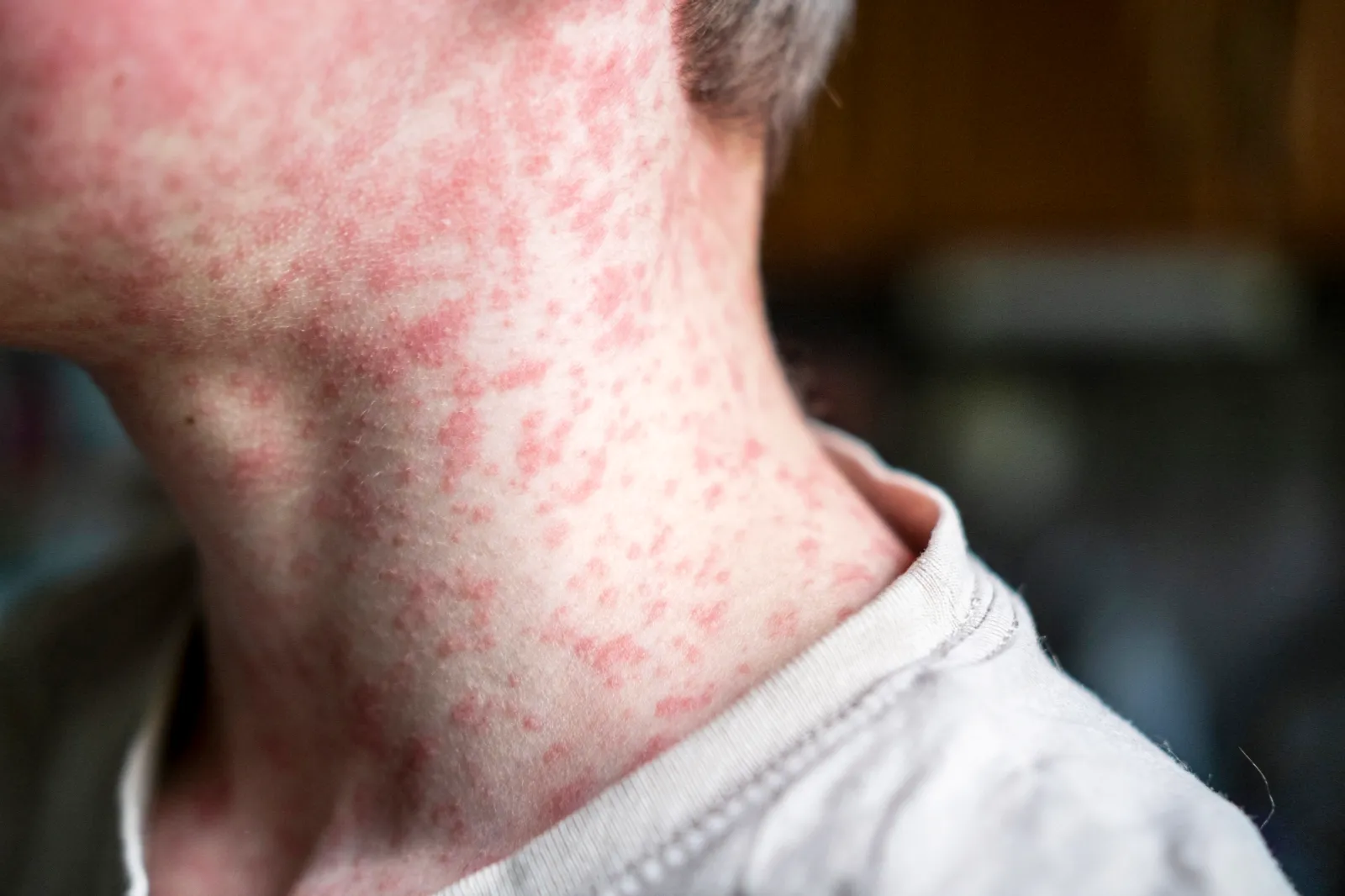
Measles symptoms include a high fever, cough, and runny nose, and the hallmark measles rash that can occur three to five days after symptoms begin. There are also severe complications from measles, such as pneumonia and encephalitis, or inflammation of the brain.
“Those are concerning complications, and they are so easily preventable,” Sood said.
Measles Virus Exposed at US Airport
Earlier this week, officials warned that people at the Philadelphia International Airport may have been exposed to the highly contagious virus after a traveler with measles passed through the airport between 7:25 p.m. on September 13 and 12:05 a.m. on September 14. The traveler was in terminals B and F, as well as areas connecting to terminals C, D and E, but did not leave the airport.
People who may have been in those areas during the exposure window were urged to check if they were protected against the virus.
How Do Measles Vaccination and Mortality Rates Compare?
Nationwide, vaccination rates are around 93 percent, but vaccination rates vary widely depending on location in the U.S., Sood said.
"There are some communities that generally tend to not vaccinate so much," Sood said. "Since 2020, there has been a lot more misinformation and distrust about vaccines. We’ve seen that with plummeting COVID vaccination rates for sure, and it has spilled over to a lot of the childhood vaccinations as well."
Despite the surge in cases and drop in vaccination rates, measles mortality rates remain low at about one to three deaths for every 1,000 reported cases, Dr. Steven Goldberg, chief medical officer at HealthTrack, told Newsweek. There is about one case of encephalitis per 1,000 cases.
"Infants, young children, adults, and people who are immunocompromised are more likely to develop severe complications or die," Goldberg said. "The worldwide toll is much higher. In 2023, measles caused an estimated 107,500 deaths, most of them in children younger than 5. In malnourished populations, as many as 25% of people with measles may die."
Goldberg said his greatest concern is that the measles resurgence in the U.S. is not because of vaccine failure, but because of not being vaccinated.
"Coverage has fallen below the level needed for community protection, with the sharpest declines concentrated in certain areas," he said. "That creates conditions for rapid, sustained spread. In the past, most U.S. outbreaks began with international travelers. The declining share of cases classified as strictly imported suggests that more transmission is now occurring within the United States. If that continues, the country’s measles elimination status, maintained since 2000, could be at risk."
Both Goldberg and Sood are concerned there will be more deaths from measles in the U.S. because of falling vaccination rates.
“Unfortunately, even with a low mortality rate, if you have enough spread of disease, you will see these very severe complications too,” Sood said.
Almost all cases of measles occur in unvaccinated people, she added.
Is the Measles Vaccine Safe? What To Know Under Robert F. Kennedy, Jr.'s Department of Health
The measles vaccine is safe, and the federal government continues to urge people to get vaccinated.
Health and Human Services (HHS) Secretary Robert F. Kennedy, Jr. has spent decades questioning vaccine safety and helping lead the modern anti-vaccine movement. But since becoming HHS secretary, he has publicly said the government "promotes" the measles vaccine, acknowledged that it is highly effective at preventing measles, and said children should receive it, marking a notable shift in tone from many of his past statements.
Kennedy's revised stance on the measles vaccine was reconfirmed in an August interview with CNN's Dana Bash, when, after arguing with Bash about the U.S. COVID-19 response and vaccines, Kennedy said: "Parents should get their children vaccinated for measles. A measles vaccine is effective. It stops measles in about 97 percent of the cases. People should get vaccinated."
Is It Too Late to Get a Vaccine as an Adult?
It is not too late for adults to receive the measles vaccine if they aren’t fully vaccinated, Sood said. Adults born before 1957 are considered immune to measles since the illness was so widespread at that time. For adults born between 1971 and 1984, they likely only have one dose of the vaccine, which is 93 percent effective. Two doses are 97 percent effective.
Sood added that anyone born recently who attended public school is likely fully vaccinated. If someone was born before 1957 or only ever received one dose of the vaccine, they may want to consider a second dose.
Even if someone is unvaccinated and exposed to measles, the vaccine could still help.
“If you are unvaccinated and you are exposed to measles, all is not lost,” Sood said. Even three days after exposure to measles, the vaccine can prevent disease. Up to six days after exposure, immunoglobulin can prevent disease.
If someone is exposed, they will be infectious four days before the rash appears and four days after it disappears.
View 0 Comments
Submit Correction
View Editorial & AI Guidelines