...

By Jenna Sundel
News Reporter
0
Share
Newsweek is a Trust Project member
See more of our trusted coverage when you search.Prefer Newsweek on Googleto see more of our trusted coverage when you search.
The CDC said it is aware of a meningococcal disease outbreak in Kent, England, and there is a possibility it could spread to the U.S., but the disease does not spread easily.
“If someone who is exposed to these bacteria travels to the United States, there’s the possibility of the outbreak strain of the bacteria spreading. However, meningococcal bacteria don’t spread easily. Transmission requires exchange of respiratory or throat secretions (saliva) during close or lengthy contact, especially if living in the same household,” a CDC spokesperson told Newsweek.
Dr. Matthew Binnicker, the director of clinical virology at Mayo Clinic, said he thinks the risk of the outbreak spreading to the U.S. is “extremely low.”
Read More on News
“This is not a new pathogen. This is something that’s been around for a very, very long time, and we’ve had outbreaks of Neisseria meningitis here in the U.S.,” Binnicker told Newsweek. “And there are even people here in the U.S. who carry this bacteria in the back of their nose and throat asymptomatically. They don’t even know that they're infected, and they don’t have symptoms from it. So this bacteria is already here in the U.S., it’s just not causing an outbreak.”
Alicia Stillman, co-executive director of the American Society for Meningitis Prevention, who lost her 19-year-old daughter to meningitis in 2013, said the Kent outbreak could spread to the U.S. if a carrier travels from England to the U.S.
“Every disease is a plane ride away. What we see in other countries, we can see here in the blink of an eye,” Stillman told Newsweek.
She also shared concerns about additional outbreaks developing if proper precautions are not taken.
“Can it cross the pond? Sure, if one of those kids comes over, but it isn’t just that specific outbreak. It can be, with the relaxed recommendations that we are seeing now with this administration, that’s all it takes, is one case to explode here. And yeah, we could see an outbreak on any college campus in our country,” Stillman said.
Why It Matters
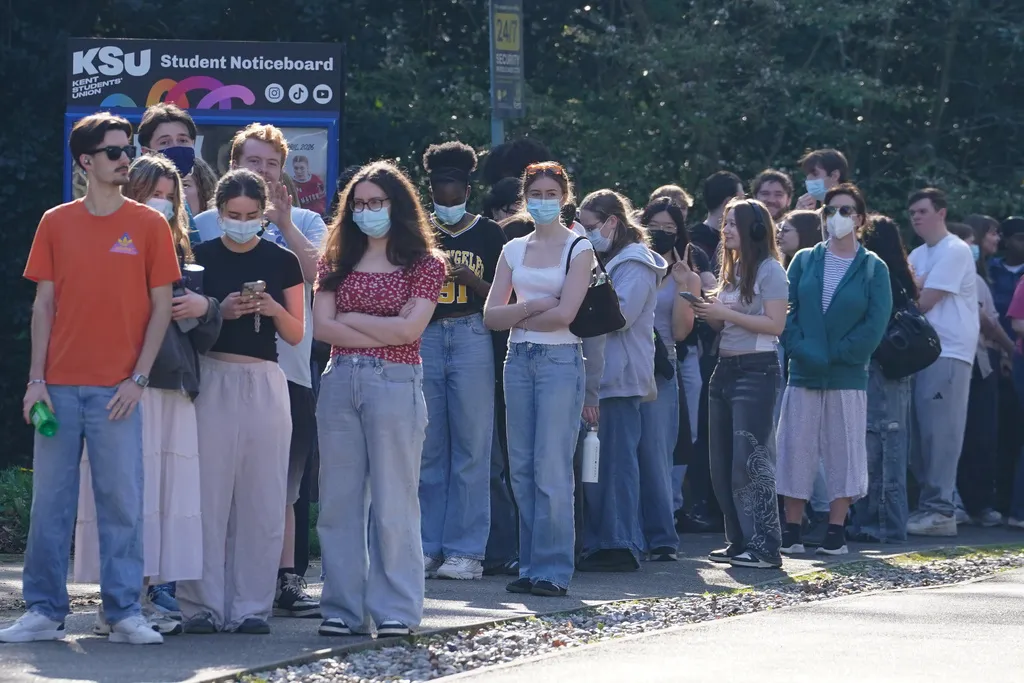
The outbreak of meningitis in England has resulted in the deaths of a University of Kent student and a student at a nearby school. U.K. Health Secretary Wes Streeting said the outbreak is unprecedented, with a high number of cases appearing in a short amount of time.
...
The first case was confirmed on Friday, and the number of cases in the area had risen to 20 by Wednesday. Most cases were linked to the University of Kent in Canterbury. The majority of the cases have been confirmed as stemming from a bacterial infection of meningitis B. A CDC spokesperson said serogroup B of meningococcal disease is “relatively rare” in the U.S.
What To Know
Meningitis is inflammation of the meninges, which is a part of the brain, that can be caused by a bacterial infection, viruses or other microbes, Binnicker said.
Meningitis typically starts with flu-like symptoms, such as body aches and fever, Binnicker said.
“The disease can progress rapidly over the course of hours, and that’s when they start to develop more of the signs and symptoms of meningitis, which can include neck stiffness, sensitivity to light, severe headaches, confusion, just lethargy, meaning that they don’t have energy, and if it progresses far enough, they can go into a coma,” Binnicker said.
He said that 10 percent of people with Neisseria meningitis, which is the cause of the outbreak in Kent, will die from the infection, even if they receive treatment.
Stillman also said the disease progresses quickly.
“When my daughter contracted it in 2013 in Michigan, one night she had a headache, and the next day she was brain-dead. That’s how fast it hits. And she was healthy,” Stillman said.
Binnicker said meningococcal meningitis spreads when an individual becomes exposed to an infected person’s saliva or respiratory secretions, typically through more prolonged contact.
He said examples include “kissing or sharing a contaminated drink or utensil, so that’s why we see these outbreaks of meningococcal meningitis in settings like university campuses, because we’ve got adolescents or young adults in close quarters, oftentimes participating in activities that would allow them to have kind of more prolonged direct contact, which the bacteria really needs to be transmitted.”
Stillman said there are vaccines for meningitis to help prevent the spread of the disease.
“There are vaccines available to protect against all five preventable serogroups, and a parent needs to be able to educate themselves, so that when they go into the healthcare provider’s office, they know specifically what to ask for to make sure their child is protected,” she said.
A vaccine preventing against meningitis A, C, Y and W was previously recommended for all adolescents, but under Health Secretary Robert F. Kennedy Jr.’s guidance, the CDC is now only recommending the vaccine for certain high-risk groups or populations, NBC News reported. A separate vaccine for meningitis B is also recommended for certain high-risk groups or populations.
A CDC spokesperson said the agency recommends that people 10 years and older who are at risk during an outbreak of serogroup B meningococcal disease get vaccinated with a MenB vaccine.
“While there are no travel-specific recommendations for MenB vaccine, U.S. travelers can discuss with their healthcare provider about getting vaccinated before traveling to Kent,” the spokesperson said. “The decision to vaccinate is a personal one. People should consult with their healthcare provider to understand their options to get a vaccine and should be informed about the potential risks and benefits associated with vaccines.”
Stillman said there is now a pentavalent, or a vaccine combining five vaccines into one dose, which covers five different types of meningitis.
“Before the change of administration, we were actively working to get a nice, strong recommendation for that so our adolescents and young adults would be protected against all five serogroups,” Stillman said.
Binnicker said that as vaccine rates decline, it opens up immunity gaps for various infections, including Neisseria meningitis.
“We still have relatively good vaccine coverage, but I think the outbreak in Kent just, I think, calls to attention the possibility of these outbreaks occurring, and we need to do everything we can to prevent and also keep our young adults and kids protected against these infections. And vaccinations are the best way to do that,” Binnicker said.
What People Are Saying
A CDC spokesperson, in comments to Newsweek: “For those who travel to an outbreak area, it’s important to seek treatment immediately if they develop symptoms of meningococcal disease. Their close contacts (e.g., family, roommates) should also be aware of when to seek treatment.”
Alicia Stillman, co-executive director of the American Society for Meningitis Prevention who lost her 19-year-old daughter to meningitis in 2013, in comments to Newsweek: “Meningitis is here, and if we relax our recommendations, we’re going to see more deaths.”
What Happens Next
The number of cases in England is expected to rise because the infection’s incubation period can last up to 14 days. The UK Health Security Agency issued an alert for the state-run National Health Service across England to look out for signs and symptoms of meningitis.
Do you have a story that Newsweek should be covering? Do you have any questions about this story? Contact LiveNews@newsweek.com.
View 0 Comments
Submit Correction
View Editorial & AI Guidelines