Japan Meteorological Agency

By Anna Skinner
Associate News Editor
0
Share
Newsweek is a Trust Project member
See more of our trusted coverage when you search.Prefer Newsweek on Googleto see more of our trusted coverage when you search.
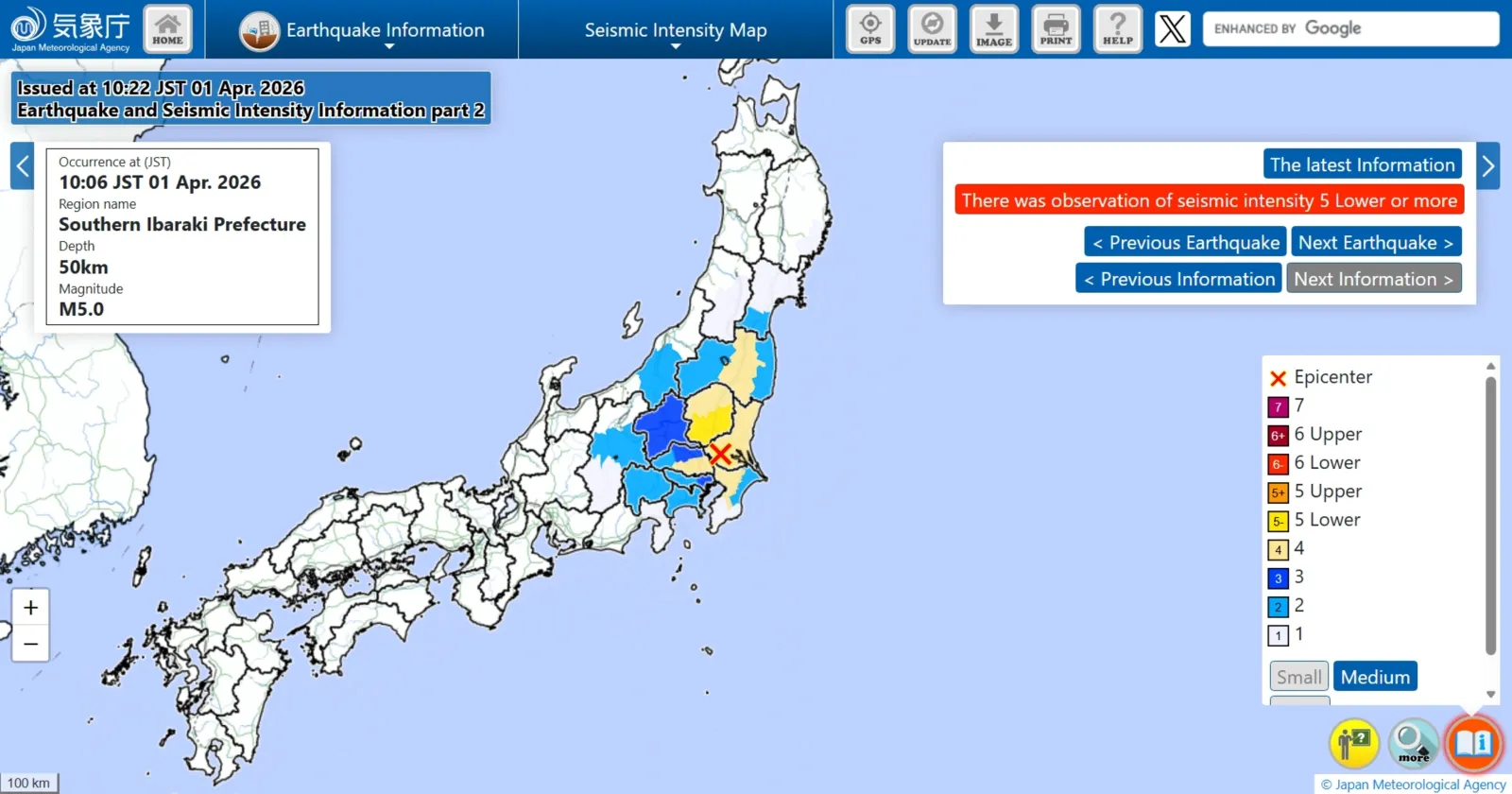
A magnitude‑5.0 earthquake shook eastern Japan on Wednesday morning, prompting authorities to warn millions that aftershocks of similar strength could strike over the course of the next week.
The quake was centered in southern Ibaraki Prefecture, striking at 10:06 a.m. local time at a depth of roughly 30 miles. Shaking was strongest in Ibaraki and Tochigi, where ground movement reached levels capable of unbalancing people. Surrounding prefectures—including Fukushima, Chiba, and Saitama—reported weaker tremors. The shaking did not generate a tsunami.
...
Read More on News
Rail operators temporarily halted high‑speed bullet train services between Sendai and Tokyo to conduct mandatory inspections, causing significant travel delays, the Independent reported. Nuclear facilities were checked and found operating normally.
Meteorologists said communities should be prepared for additional tremors that could be as forceful as the initial jolt, urging residents to stay alert as the region enters a period of elevated seismic instability.
"In areas with strong tremors, be careful of earthquakes with a maximum seismic intensity of about 5 or less about one week after the earthquake occurred," a press release from the Japan Meteorological Agency said.
Newsweek reached out to the Japan Meteorological Agency by email for comment.
What Is an Earthquake Aftershock?
Aftershocks are smaller quakes that follow a primary seismic event as underground stress redistributes along the fault line. They can occur minutes, hours, or even days after the initial rupture. In some cases, aftershocks approach the strength of the first quake, which is why officials warned that additional shaking—potentially intense enough to disrupt daily routines—remains possible for up to a week. Japan’s geological position along the Pacific Ring of Fire, where several tectonic plates interact, makes these sequences especially common.
What Kind of Damage Can a Magnitude 5.0 Earthquake Do?
A magnitude‑5.0 earthquake is considered moderate, but its real‑world impact depends on how strongly the shaking is felt at the surface. In Japan, this quake registered a “lower 5” on the country’s seismic intensity scale—enough to cause items to topple, create difficulty standing, and lightly strain older buildings. Thanks to Japan’s strict seismic engineering standards and widespread preparedness, early assessments found no major injuries or structural collapses, though transportation networks experienced disruptions as safety checks were performed.
What to Do During an Earthquake?
During an earthquake, safety depends on quick, steady action. Emergency officials recommend following the *“*Drop, Cover, and Hold On” method: drop to the ground to prevent being knocked over, take cover under sturdy furniture or against an interior wall, and hold on until the shaking stops.
People indoors should stay away from windows, shelves, and heavy objects that may fall, while those outside should move clear of buildings, power lines, and anything that might collapse. If you are in a moving vehicle, pull over safely and remain inside until the shaking ends. These steps help reduce injuries during sudden or intense ground movement and are widely promoted across Japan due to the country’s frequent seismic activity.
In a polarized era, the center is dismissed as bland. At Newsweek, ours is different: The Courageous Center—it's not "both sides," it's sharp, challenging and alive with ideas. We follow facts, not factions. If that sounds like the kind of journalism you want to see thrive, we need you.
When you become a Newsweek Member, you support a mission to keep the center strong and vibrant. Members enjoy: Ad-free browsing, exclusive content and editor conversations. Help keep the center courageous. Join today.


View 0 Comments
Submit Correction
View Editorial & AI Guidelines