...

By Gabe Whisnant
News Editor
0
Share
Newsweek is a Trust Project member
See more of our trusted coverage when you search.Prefer Newsweek on Googleto see more of our trusted coverage when you search.
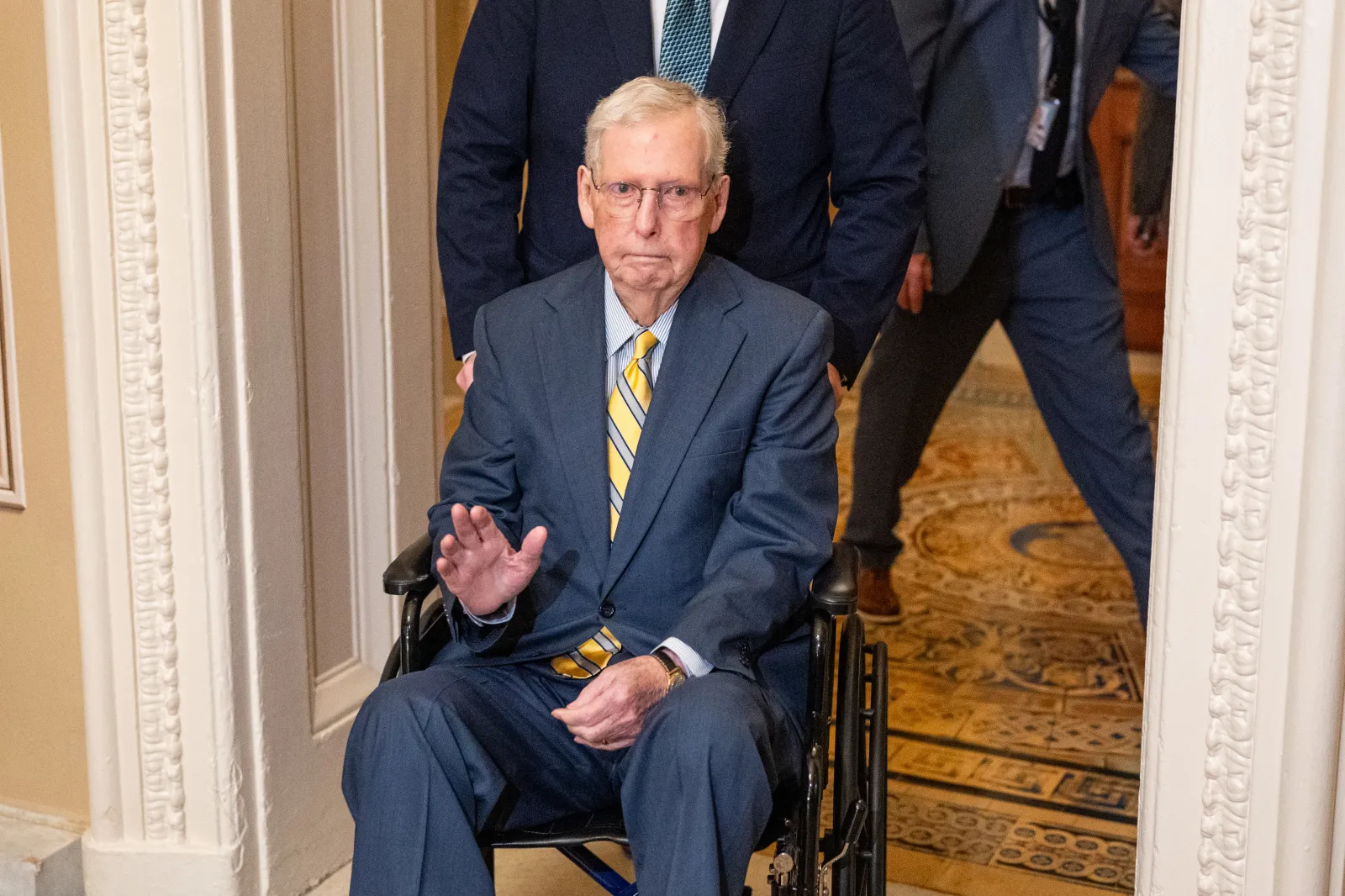
A Republican congressman publicly questioned Thursday whether former Senate Republican leader Mitch McConnell is still alive, underscoring growing concerns and calls for transparency as the Kentucky senator remains hospitalized nearly a month after being admitted for an undisclosed medical condition.
Representative Marlin Stutzman of neighboring Indiana made the remarks during an appearance on NewsNation's Morning in America, where he criticized the lack of information coming from McConnell's office and said both Republicans and the public deserve more clarity about the longtime lawmaker's condition.
McConnell, who was admitted to a hospital on June 14, has not appeared publicly since, and his office has disclosed few details about the nature of his illness.
Read More on Politics
"I have not heard from him, and I think it's a question that Republicans should be asking because he does represent the state of Kentucky," Stutzman said. He argued that McConnell's constituents deserve answers and voiced support for efforts to obtain additional information about the senator's health.

...
The comments come after Kentucky Democratic Governor Andy Beshear called on McConnell's office to provide a more substantive update on the senator's condition. Beshear sent a letter seeking additional information amid concerns about the prolonged hospitalization of one of Kentucky's most prominent political figures.
“Allowing speculation to continue in the media is not fair to the Senator or to Kentuckians,” Beshear said in a statement accompanying the letter, adding that the request gives McConnell the opportunity to share information “direct from the source.”
Stutzman said he agreed with the governor's request and suggested members of his own party should be willing to ask difficult questions.
"As a Republican, I think we need to hold our own party accountable, so the fact that we haven't heard anything really from Senator McConnell is very discouraging and concerning," he said.
He then went a step further, saying he had received no confirmation that McConnell, 84, was alive.
"Do you know that he's alive? I don't," Stutzman said. "The things that I've heard and seen from some friends are that he's obviously not doing well, but I don't know if he's alive or has passed away."
McConnell's office issued its last statement on Monday, telling Newsweek that the senator is recovering and continuing to work on Senate- and Kentucky-related matters while Congress is out of session. "The Senator continues to improve," the statement said, adding that McConnell appreciates the support he has received during his recovery.
Newsweek has reached out to McConnell's office via email on Thursday morning for comment.
Several Republicans said they spoke with Senator Mitch McConnell this week.
The comments from Senate Majority Leader John Thune, Senate Majority Whip John Barrasso, and Republican strategist Scott Jennings were the first to shed any light on McConnell's condition since his hospitalization last month.
Jennings described a 20-minute call with the 84-year-old Kentucky Republican in which he said they discussed several key political issues.
"I spoke to my old friend Mitch McConnell this morning, the senior Senator from Kentucky," Jennings said in a post on X. "He’s still recovering in the hospital. We talked for just shy of 20 minutes…about IRAN, UKRAINE, the unfolding situation in MAINE, my visit to the TR Presidential Library, and even a little bit of Senate history. I told him we want to see him back at work as soon as possible," the commentator added.
Thune also said he'd had a "lengthy and substantive conversation" with McConnell on Monday.
McConnell is serving his seventh term in the Senate, having first been elected in 1984. The Kentucky Republican, who became the longest-serving Senate party leader in U.S. history during his tenure atop the GOP conference, announced in 2025 that he would not seek reelection in 2026, making his current term his last. His term is scheduled to expire in January 2027, bringing to a close more than four decades in the Senate.
The uncertainty surrounding McConnell's health has intensified scrutiny of the limited information being released by his office, with questions now emerging from both sides of the political aisle about the condition of the longest-serving senator in Kentucky history.

...
Where Is Mitch McConnell? What We Know About Kentucky Senator's Absence From Congress
McConnell has not appeared publicly since he was hospitalized on June 14 for an undisclosed medical condition. His office has confirmed only that he remains hospitalized following his June 14 admission. It has not publicly disclosed the hospital's location or the nature of the senator's illness, citing privacy concerns.
Why Mitch McConnell's Absence From Congress Is a Disruption
McConnell's absence has drawn intense scrutiny, but its immediate impact has been somewhat muted by the fact that the Senate has been out of session and has not held a floor vote since June 27. Even so, there is little Kentucky lawmakers, Beshear or Senate leaders could do if McConnell remains in office but is unable to carry out his duties through the end of the current Congress in January, as Senate rules do not allow proxy voting and there is no mechanism to temporarily replace a sitting senator.
The larger question is what happens when lawmakers return to Washington. McConnell has not cast a Senate vote since June 11, several days before he was hospitalized on June 14, and has missed multiple votes since then, including a June 23 vote on a House-passed resolution directing President Trump to withdraw U.S. troops from the conflict with Iran.
Republicans currently hold a 53-47 Senate majority, meaning McConnell's continued absence reduces the maximum number of Republican votes available to 52. That could become significant on closely contested measures, particularly as Senate leaders prepare for a busy legislative stretch.
McConnell had been among Republicans opposing war powers resolutions aimed at limiting Trump's military options in Iran, meaning his absence leaves the administration with less room for defections from within its own party. On other issues, however, the impact is less clear: McConnell has also broken with Trump on some major priorities, including the president's sweeping elections overhaul.
McConnell's absence extends beyond floor votes. The former Republican leader remains one of the Senate's most influential members and serves on the powerful Appropriations Committee, where prolonged absences can affect committee business and, at times, leave Republicans and Democrats evenly divided on key matters.

...
The Closest Modern Parallel: Thad Cochran
One of the closest modern parallels is former Senator Thad Cochran of Mississippi. In 2017, the veteran Republican spent extended periods away from Washington as questions mounted about his health, while his office provided only limited public updates. The uncertainty fueled speculation about whether Cochran could continue serving and when he might return to the Senate.
Cochran's case drew particular attention because he chaired the powerful Senate Appropriations Committee during a critical period for government funding negotiations. As concerns about his health persisted, attention shifted from his personal condition to the potential impact on Senate business. He ultimately announced in March 2018 that he would retire because of ongoing health challenges and left office the following month.
Who Would Replace Mitch McConnell if He Is No Longer Able to Serve as Senator?
If McConnell were to leave office before his term expires, Beshear would have far less influence over choosing a replacement than governors in most states. While the 17th Amendment allows states to authorize governors to appoint interim senators, Kentucky lawmakers have repeatedly revised state law in recent years to limit that power. Until 2021, a governor could appoint a temporary replacement. But Republican lawmakers changed the law after McConnell and other GOP leaders argued that Beshear should not be able to alter the Senate's partisan balance by naming a Democrat to fill a Republican-held seat.
Under that 2021 law, if a Senate vacancy occurred, a committee from the departing senator's political party would submit three names and the governor would be required to choose from that list. In practice, that meant any McConnell replacement would have been a Republican. Beshear vetoed the measure, but the Republican-controlled Legislature overrode him.
Lawmakers changed the rules again in 2024, eliminating the interim appointment process altogether and requiring a special election to fill a Senate vacancy. Under the current law, Beshear's primary role would be to issue a proclamation calling that election rather than selecting a replacement himself. He also vetoed that measure, but lawmakers again overrode his objections.
Exactly how the process would unfold remains unclear because the law has never been tested. The statute requires the governor to call a special election but does not specify when that election must be held. If a vacancy occurred close to November's general election, one possibility would be to hold the special election on the same day voters are already choosing a senator for the full six-year term beginning in 2027. In that scenario, Kentucky voters could end up casting separate ballots to choose both McConnell's immediate successor and the senator who would serve the next full term.
Timeline of Mitch McConnell's Health Issues
Questions about McConnell's health have surfaced repeatedly in recent years. In 2023, he suffered a concussion and fractured rib after a fall at a Washington dinner event, sidelining him from the Senate for several weeks. Later that year, he experienced two widely publicized freezing episodes while addressing reporters, prompting renewed scrutiny of his health.
The latest concerns began on June 14, when McConnell, a childhood polio survivor, was hospitalized for an undisclosed medical condition.
Contact Newsweek editors on this story: Gray R. Thomas
View 0 Comments
Submit Correction
View Editorial & AI Guidelines