...

By Maria Morava
Relationships Reporter
0
Share
Newsweek is a Trust Project member
See more of our trusted coverage when you search.Prefer Newsweek on Googleto see more of our trusted coverage when you search.
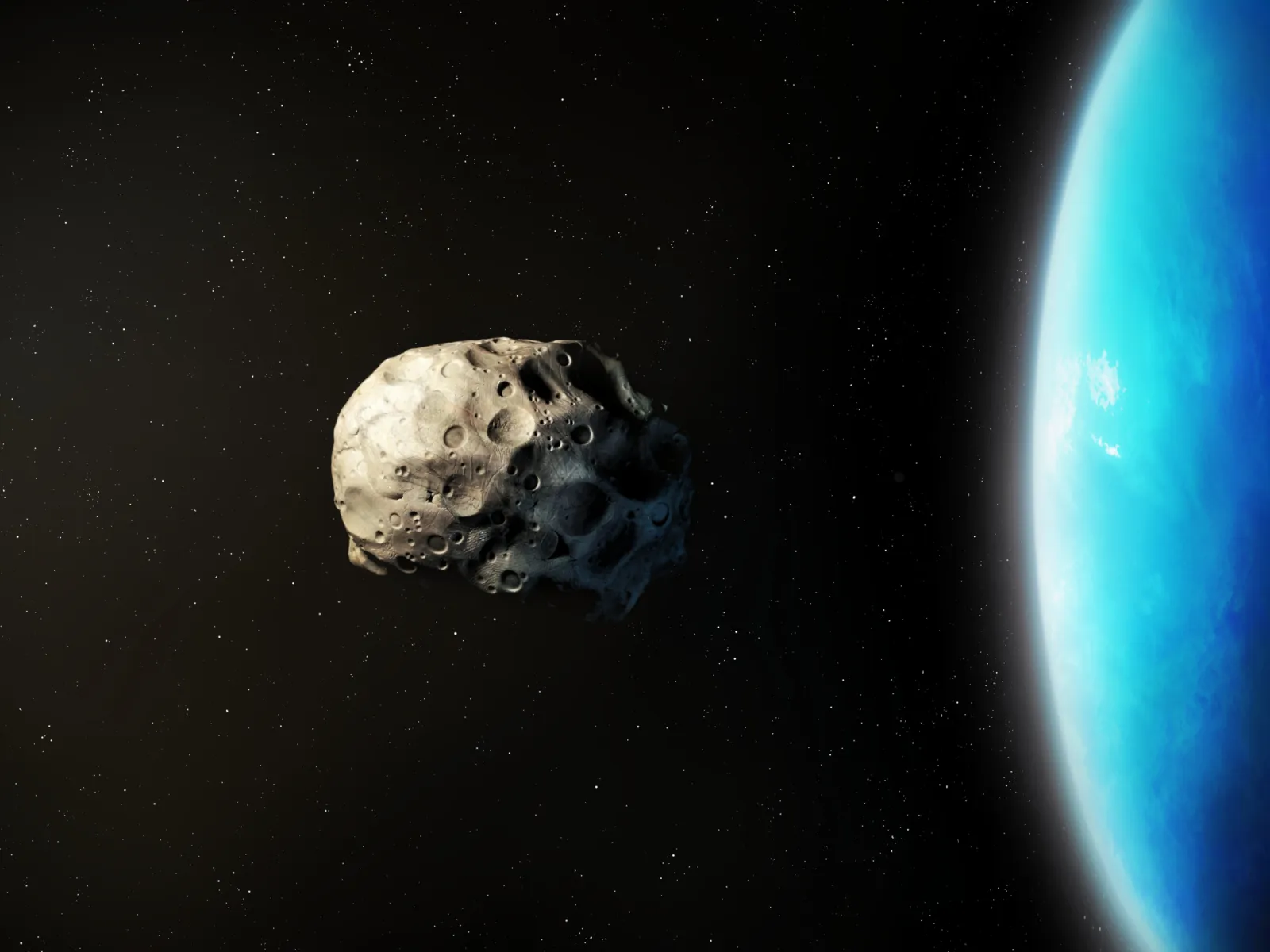
An extraordinary celestial event could unfold in the night sky in less than a decade if an asteroid passing Earth collides with the Moon.
The impact of asteroid 2024 YR4 into the lunar surface would likely send debris flying out towards us, resulting in a unique meteor shower composed entirely of moon dust.
This intriguing prospect is the subject of recent study by researchers from the University of Western Ontario, Athabasca University and the Institute for Earth and Space Exploration (IESX).
Read More on Science
The team estimate that 2024 YR4—which is some 200 feet in diameter—has around a four percent chance of impacting the moon on December 22, 2032.
Should the collision occur, the energy released would be substantial—equivalent to 6.5 megatons of TNT. Such an impact would to excavate a massive crater out of the lunar surface, one more than half a mile in diameter.
...
A Meteor Shower of Moondust
The most fascinating consequence of the 2024 YR4's collision with the Moon for Earth would be the creation of a moondust meteor storm.
The impact would release a significant amount of lunar material, a portion of portion of which might travel towards our planet. According to the researchers, "as much as 10 percent of this material may accrete to the Earth on timescales of a few days," depending on the exact location of the impact on the Moon's surface.
The moondust blasted at Earth's would differ significantly from typical meteors, the team explain.
Firstly, the dust would enter Earth's upper atmosphere at the relatively slow speed of approximately seven miles per second; this is considerably slower than well-known showers like the Perseids, which travel at around 37 miles per second.
As a result, these lunar meteors would likely appear dimmer and more prolonged than standard "shooting stars"—but they could still be visible to the naked eye, and in substantial numbers. Simulations by the researchers suggest that this unique storm could continue for several days.
What makes this event truly remarkable is the prospect that nearly every visible meteor during such a shower would be an actual fragment of the Moon.
Historical Significance and Concerns
If asteroid 2024 YR4 does strike in 2032, it would be a rare historical event, the researchers note.
"If 2024 YR4 strikes the Moon in 2032, it will (statistically speaking) be the largest impact in approximately 5,000 years," they wrote in their paper.
Beyond the spectacular sight, though, the potential impact also raises concerns for planetary defense and space operations.
The researchers noted that the "impacts on the Moon may generate particles which can interfere with Low Earth orbiting satellites," often used for communication, Earth observation and research.
Astronomers will have a clearer picture of asteroid 2024 YR4's trajectory in 2028 when it clears the sun and becomes observable again, allowing for updated calculations on its likelihood of impact.
Do you have a tip on a science story that Newsweek should be covering? Do you have a question about asteroids? Let us know via science@newsweek.com.
Reference
Wiegert, P., Brown, P., Lopes, J., & Connors, M. (2025). The potential danger to satellites due to ejecta from a 2032 lunar impact by asteroid 2024 YR4. arXiv. https://arxiv.org/abs/2506.11217
View 0 Comments
Submit Correction
View Editorial & AI Guidelines