Saudi Press Agency via AP

By David Averre
0
Share
Newsweek is a Trust Project member
See more of our trusted coverage when you search.Prefer Newsweek on Googleto see more of our trusted coverage when you search.
In April 1949, representatives of 12 countries met in Washington, D.C., to sign the treaty that birthed NATO.
It took more than 50 years and the turn of a new millennium for one of its founding members to sustain an attack deemed fit to trigger the all-important Article 5, forcing the alliance to deliver on its collective security promise.
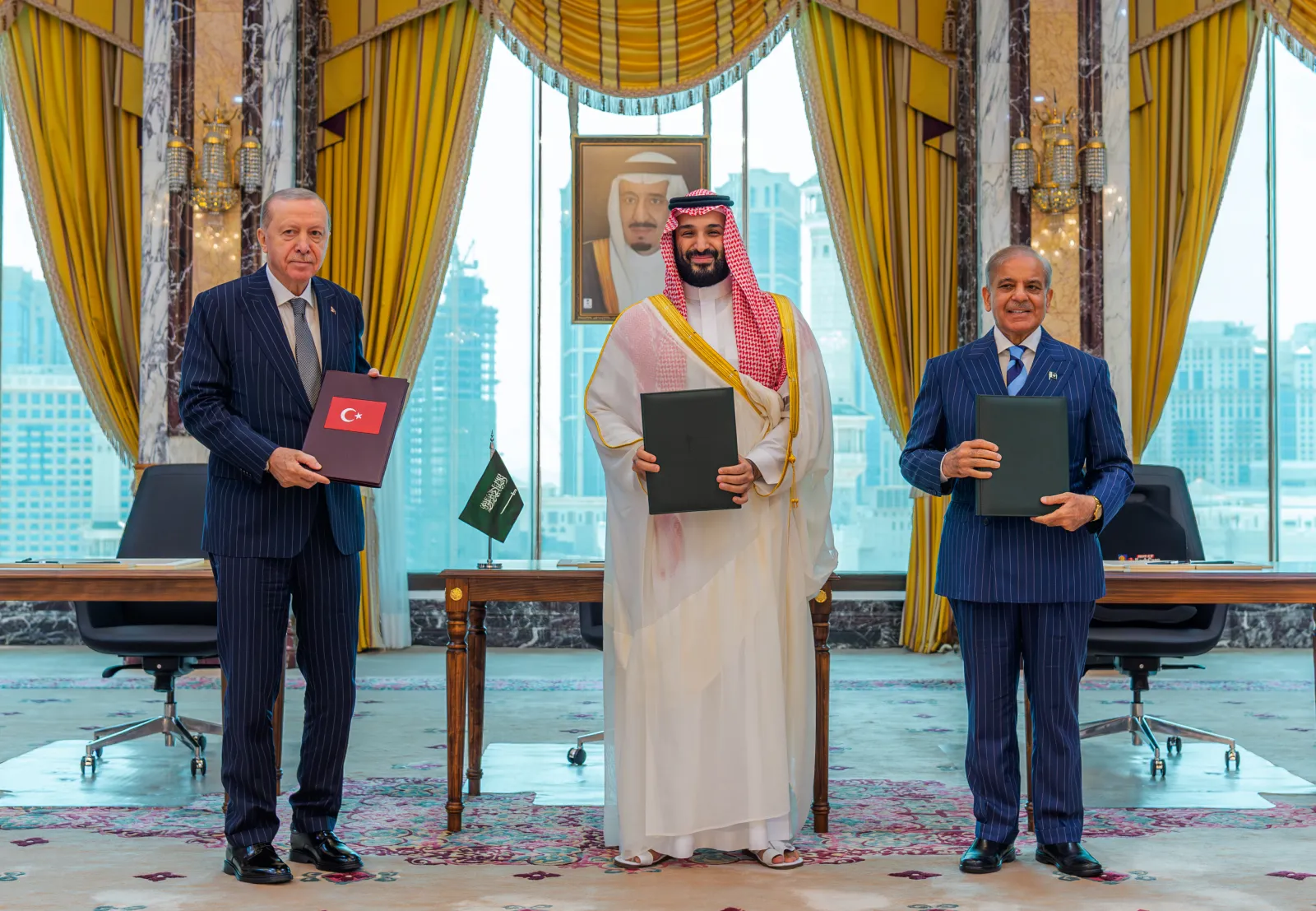
Saudi Arabia, Turkey and Pakistan signed the Mecca Joint Defense Agreement on August 7, 2026. Thirty-two days later, ballistic missiles and drones began raining down on one of its members.
Read More on Analysis
Yemen’s Houthi rebels this week struck civilian and economic targets in the Saudi cities of Abha, Khamis Mushait, Jazan and Najran, injuring more than 70 people, including women and children. The group declared its ballistic missiles were aimed at facilities of Saudi national oil company Aramco, a key industrial hub, and the Saudi Air Force’s King Khalid Air Base.
With the world watching, will the fledgling defense alliance rise to the challenge?
All for One, Allegedly
Calling the Mecca agreement a Muslim or Middle Eastern NATO isn’t a loose comparison drawn by ill-informed Westerners unable or unwilling to see the world from any perspective other than their own.
The official joint statement heralding the agreement said its signatories wanted to strengthen "collective deterrence against any act of aggression," stipulating that “an armed attack against any one of the three States shall be regarded as an attack against them all."
Pakistan stressed each signatory’s right to collective self-defense under Article 51 of the United Nations Charter. Turkish Foreign Minister Hakan Fidan said the core provision of the defense agreement was “technically the same” as NATO’s Article 5.
Less than a month after the agreement was signed in Islam’s holiest city, the foreign ministers, defense ministers and military chiefs of all three parties met in Istanbul for the first Strategic Political and Defence Committee. There, they agreed to create a permanent secretariat in Saudi Arabia, initially headed by a Pakistani secretary-general - steps intended to ensure the "credibility and effectiveness" of their collective deterrence and defense.
Eight days later, Houthi missiles and drones slammed into Saudi territory.

...
This prompted a flurry of strongly worded statements. Ankara condemned the Houthi attacks "in the strongest terms," backed Saudi sovereignty and territorial integrity and called on the Yemeni rebel group to cease its attacks immediately.
Pakistani Prime Minister Shehbaz Sharif called the strikes "cowardly" and promised "unwavering solidarity," while his defense minister, Khawaja Asif, reiterated that “any aggression against any of the three is regarded as an aggression against all.”
But hot air is all Saudi Arabia’s new partners have offered so far.
We’re more than a day removed from the attacks, and at the time of writing, not a single Pakistani fighter jet or Turkish drone has threatened to breach Houthi skies.
We can’t dismiss the Mecca agreement as a paper tiger just yet, though. Partly because, if we’re sticking with the NATO comparison, Article 5 doesn’t necessarily mean all alliance members must launch retaliatory strikes on an aggressor.
Break Glass in Case of Actual War
The Washington Treaty triggers a mutual-assistance obligation for the entire alliance but, crucially, leaves each government to decide what that assistance should look like. NATO’s guidance explicitly says assistance "may or may not involve the use of armed force" and requires each member to take whatever action it "deems necessary."
The alliance’s response to 9/11 illustrates this perfectly. Once NATO determined that the attacks had been directed from abroad by a non-state actor, its members agreed on eight initial measures. These included increased intelligence sharing, granting U.S. aircraft overflight rights and access to allied ports and airfields, and sending naval forces into the eastern Mediterranean. There were no immediate airstrikes.
The Mecca agreement appears to operate an even more flexible mechanism.
We don’t yet know the finer operational details because the full text has not been publicly released, but according to the terms of the agreement outlined by Turkey's Fidan in August, the attacked country must first ask for help and specify what it needs. His examples of what form that help could take ranged from intelligence sharing and logistical support to the provision of ammunition and an armed response.
Saudi Arabia has not yet publicly requested Turkish or Pakistani assistance in resisting or retaliating against the Houthis. Ankara and Islamabad can’t therefore be accused of failing to live up to their collective-defense obligations by refusing a request that, as far as we know, has not been made.
Related Story
Trump’s Iran War at Six Months: 5 Scenarios for What Comes Next
Pakistan’s Asif today openly stated that the military was not obliged to immediately strike back at the Houthis, telling the media: "We don't need to respond to a brick with a stone."
Dr. Burcu Ozcelik, a senior research fellow for Middle East Security at the RUSI think tank, told Newsweek: “It would be premature now to call (the Mecca agreement) a paper tiger. Just as NATO members apply discretion in triggering Article 5, Turkey, Pakistan and Saudi Arabia will decide on a case-by-case basis what the most appropriate level of response is when confronted with an attack."
For now, at least, Saudi Arabia seems content to respond alone. The Houthis said the Kingdom’s forces carried out 32 airstrikes across four Yemeni provinces overnight into this morning. This should hardly come as a surprise, given that a Saudi-led coalition intervened in Yemen in March 2015 and carried out more than 25,000 airstrikes before the UN-brokered truce of 2022.
Perhaps, then, the Mecca agreement - without sounding too dismissive of the Houthis - was designed with bigger threats in mind than a confrontation Riyadh has been managing for more than a decade.
The signing of NATO’s underlying treaty in April 1949 formalized a set of allies, but didn’t immediately create a military structure capable of coordinating them effectively. Supreme Headquarters Allied Powers Europe—the central military headquarters for NATO's Allied Command Operations—was not activated until two years later.
Expecting Saudi Arabia, Turkey and Pakistan to display NATO-level integration after 32 days as formal allies is absurd.

...
The Mecca Trio’s Real Test
It is unfair, then, to suggest the Mecca Defense Agreement isn’t worth the paper it’s written on just because Ankara and Islamabad haven’t yet delivered a punishing strike on Sanaa. A much better way to measure the agreement’s weight is to watch, in the coming days and weeks, whether the procedures and mechanisms enshrined within are properly activated.
First comes consultation. Saudi Arabia now has a Strategic Political and Defence Committee linking the foreign ministers, defense ministers and military chiefs of all three countries. Does Riyadh use it to request assistance, or at least coordinate with its partners on what happens next?
Next comes material support. Turkey and Pakistan do not have to bomb Yemen, but the agreement should eventually produce something Saudi Arabia would not otherwise have received: some kind of actionable intelligence on Houthi launch sites, air-defense or surveillance support, or even some kind of joint military exercise. Qatar and Bahrain have already offered Riyadh diplomatic solidarity without signing a collective-defense pact; Ankara and Islamabad should offer something more tangible.
Finally comes deterrence. Before August 7, a Houthi commander preparing a missile strike on Jazan expected to sustain a response from Saudi Arabia. Now, Houthi forces must be forced to at least factor in the prospect of Pakistani and Turkish responses when planning their attacks.
That determination can’t be made yet, because there simply hasn’t been enough time to gauge whether the nature of the Houthi-Saudi conflict has been meaningfully influenced by the Mecca agreement.
"The Houthi strikes do not automatically trigger a certain category of military action," Ozcelik said. "Pakistan and Turkey may respond ultimately, but they are unlikely to telegraph what that action will look like in advance."
For now, the bar is low; we just need to see something other than a strongly worded press release from Ankara and Islamabad.
View 0 Comments
Submit Correction
View Editorial & AI Guidelines