10
Loading video...


By Alyce Collins and Kristina Phillips
0
Share
Newsweek is a Trust Project member
See more of our trusted coverage when you search.Prefer Newsweek on Googleto see more of our trusted coverage when you search.
Family life used to feel so vibrant and joyful, but at the same time, it was quite normal. We were a typical family with three young children—Parker, Mason and Mia. My husband, Ryan, and I were in the newborn trenches while also juggling school and our sons’ extra-curricular activities.
Mason was the typical second child. He was extremely smart, funny, and he loved to test the boundaries. Mason absolutely adored his older brother, and he was adapting so well to being a big brother to Mia.
In March 2024, Mason got sick and tested positive for influenza B, and it wasn’t even the first time he caught it that season. We kept him at home, gave him plenty of fluids and made sure he got lots of rest. He wasn't the type to get sick often, but when he did, he usually still wanted to play and do his normal routine.
Read More on My Turn

...
Only this time, he seemed to be getting worse.
We noticed some petechiae on his abdomen, which we initially thought might be a reaction to the dose of Tamiflu we had given him. We stopped using it immediately, but then we spotted some random bruises developing, and he woke up one morning with a bad nosebleed.
From the bruising to the nosebleed, we became increasingly concerned. They were the most telling signs that there was something serious going on. At that point, we thought it could be a blood disorder, which seemed terrifying.
On March 21, 2024, Ryan took Mason to our pediatrician who ordered a complete blood count immediately. We had no idea, but that turned out to be crucial. Alarmingly, the results show that Mason’s white blood cell count was 969,000 (a normal range for his age is approximately 6,000 to 17,000). Action needed to be taken fast, so Mason was airlifted from our local hospital to the Children’s Hospital of Philadelphia (CHOP) for fear that he could experience a cardiac event en route to the hospital.

...
‘Those Words Felt Like We Failed Him’
Once he got to the PICU, everything happened so quickly.
Mason was intubated so they could perform a procedure called therapeutic leukapheresis, where he was hooked up to a machine that removes excess white blood cells to prevent leukostasis, which can be life-threatening. They also ran more tests (including a bone marrow biopsy) and got him into surgery for his port and PICC lines.
It all changed so fast; one minute we were giving Mason medicine at home, then next he was being airlifted to hospital.
The following morning, doctors told us the news that no parent should ever have to hear—Mason was diagnosed with T-Cell acute lymphoblastic leukemia (ALL).
Hearing those words felt like we failed him. We had more questions than answers at that point and the fear of the unknown road ahead was very scary.
As he was only 2 years old, Mason, thankfully, did not understand. He was aware when things hurt and was able to let us and his doctors know, but the word “cancer” was meaningless to him.

...
Due to how high his white blood cell count was, Mason was considered high-risk. He received the standard treatment protocol, consisting of multiple chemotherapy drugs and a steroid to reduce inflammation.
Mason handled the diagnosis with such bravery. In fact, for the first five months of treatment, the only way you would have known that he had cancer was by the port scar on his chest or his lack of hair. Other than that, he was back to his normal self (just with more medical appointments).
‘Mason Was Part of a Very Rare Statistic’
In August of that year, we received the incredible news that Mason was in remission. He was still in the consolidation phase of treatment, but we were so relieved to know there was an end in sight. We could finally look ahead and dream of what life would look like once he was done with treatment.
Any optimism or hope was short-lived however, as the situation took a turn on Labor Day weekend 2024.
Just two weeks after reaching remission, Mason started screaming of leg pain and he could not get comfortable enough to sleep. We tried to give him his at-home pain medication, but it did not seem to help. There was no choice but to rush him back to the hospital where they did another bone marrow biopsy.
The result was not what any of us wanted.
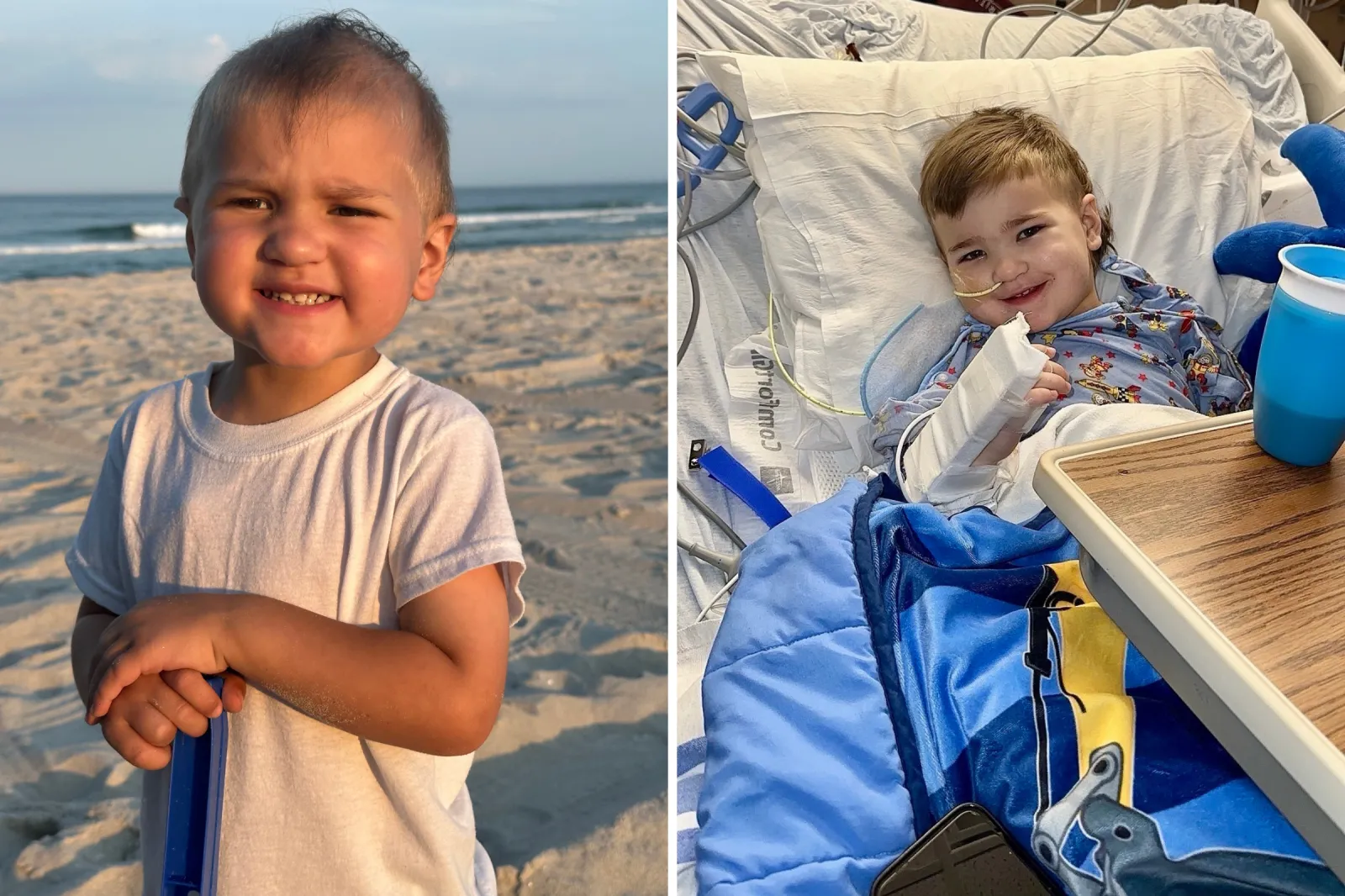
It showed that 80 percent of his marrow was cancer, but this time, it was not T-Cell ALL, it had become acute myeloid leukemia (AML). In the coming days we learned that Mason was part of a very rare statistic whereby his relapse ended up being a lineage switch from ALL to AML. It is a very uncommon phenomenon, with less than 100 documented cases in the U.S.
Sadly, the prognosis for a lineage switch is extremely poor.
...
We thought we might be able to put Mason’s cancer behind us, but suddenly everything became more complicated. The new diagnosis meant there was no standard treatment protocol anymore.
Mason endured five additional and aggressive treatment regimens, all of which ended with a bone marrow biopsy that showed his marrow still consisted of 80 percent cancer cells. That was, except for one drug, Topotecan.
Mason was on a five-day continuous infusion of Topotecan after trying every other harsh chemotherapy drug. The bone marrow biopsy after completing this regimen showed that there was nothing in his marrow—nothing healthy, nothing cancerous, just “scorched earth” as his oncologists put it. This gave us a glimmer of hope, but it also brought additional fears as we waited. Our goal was to keep his cancer at bay long enough to get him into a CAR-T trial.
Due to his treatments, we lived exclusively at the hospital from November 17, 2024, until February 14, 2025. The nurses and doctors made our stay so much more tolerable, and Mason bonded with them wonderfully. He loved the hospital, his nurses, doctors, and never complained about not being at home. Mason handled his battles with more strength and grace than most adults could.
Unfortunately, his body could only take so much.
Following months of treatment, he began to deteriorate. Mason sadly passed away on February 14, 2025, surrounded by his parents and listening to his favorite singer, Zach Bryan. Mason got to listen to his favorite song, “Motorcycle Drive-by” one last time, and took his last breath during “The Good I'll Do.”
We took that as a sign that our mission is to do good for other families in his honor.

...
‘The Worst Out-of-Body Experience’
Saying goodbye to Mason was the worst out-of-body experience we have ever had. To this day, it doesn't feel real and I don't know if it ever will. Losing a child isn't something your brain ever comes to terms with.
We carry our grief with us every day. It is present in every ordinary Tuesday morning, every new life event, every family picture. It never goes away. The more time goes by, you just get used to carrying it.
After Mason passed, we knew one of the best ways to deal with our grief was to help other families who are still fighting. We help raise money for local foundations in New Jersey, specifically The Ashley Lauren Foundation and Ocean of Love, since they were a big help for us. As a family, we also make sure to honor his life at special childhood cancer events.
We also want to make sure Parker and Mia grow up feeling connected to their brother and inspired to continue making a difference in the world of childhood cancer.
I want everyone to understand that childhood cancer is not as rare as you think. Relapse rates are through the roof, and current treatment protocols were designed for adults. We need far more research, funding, and people to stand up and help our children.
Kristina Phillips, 37, resides in Barnegat, New Jersey, with her husband Ryan and their children. Following Mason’s passing, the family continues to raise awareness and honor his legacy through fundraising, and through their advocacy on social media (@masons.tribe on Instagram and @masonstribe on TikTok).
Contact Newsweek editors on this story: Charlotte Nisbet and Emma Lee-Sang
View 0 Comments
Submit Correction
View Editorial & AI Guidelines