
By Amanda Castro
Associate News Editor
0
Share
Newsweek is a Trust Project member
See more of our trusted coverage when you search.Prefer Newsweek on Googleto see more of our trusted coverage when you search.
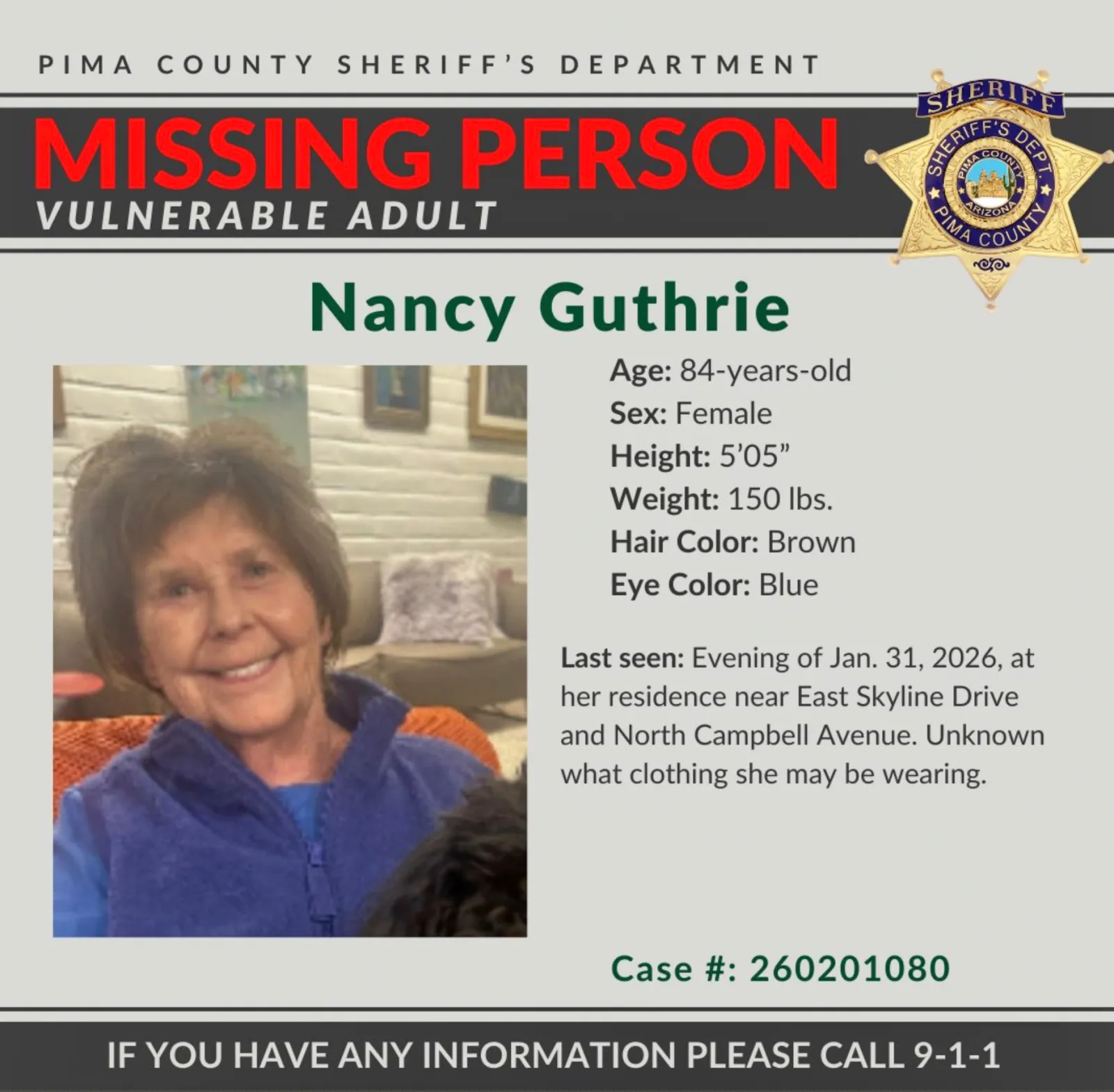
Authorities in Arizona say the reward for information in the abduction of 84‑year‑old Nancy Guthrie has now climbed to more than $200,000, after an anonymous donor contributed $100,000 to the county tip line. Guthrie, the mother of Today co‑anchor Savannah Guthrie, vanished from her Tucson home in early February, and investigators continue to treat the case as a kidnapping.

...
What to Know:
- The 88‑CRIME program received a $100,000 anonymous donation, raising its reward to $102,500.
- The FBI is offering a separate $100,000 reward, bringing the total available to over $200,000.
- Investigators say Guthrie was taken from her home overnight between Jan. 31 and Feb. 1.
- The Pima County Sheriff’s Department says biological evidence recovered from the residence is undergoing DNA analysis.
- Authorities have released surveillance footage showing a masked, armed individual tampering with a Nest camera at the home.
- Gloves found two miles away produced a DNA profile, but no match was returned in the national database.
- No suspects or persons of interest have been identified as of Feb. 18.
- Savannah Guthrie has remained in Arizona with her family and has publicly pleaded for her mother’s safe return.
- Neighbors have tied yellow ribbons and placed flowers around the community in support of the family.
Newsweek's live blog is closed.
In a polarized era, the center is dismissed as bland. At Newsweek, ours is different: The Courageous Center—it's not "both sides," it's sharp, challenging and alive with ideas. We follow facts, not factions. If that sounds like the kind of journalism you want to see thrive, we need you.
When you become a Newsweek Member, you support a mission to keep the center strong and vibrant. Members enjoy: Ad-free browsing, exclusive content and editor conversations. Help keep the center courageous. Join today.


Feb 19, 2026 at 12:05 PM EST
Neighbor says investigators asked twice whether he owned a truck
A neighbor living near the home of missing Arizona woman Nancy Guthrie says detectives have visited his house twice, each time asking whether he owns a truck. David Romano, who lives around the corner from Guthrie, told Newsweek that he does not drive a truck but got the impression investigators are searching for someone who does.
Romano said officials did not specify what type of truck they were looking for or why his household was questioned more than once. The repeated inquiries suggest investigators may be working to identify or eliminate vehicles seen in surveillance footage or reported by witnesses as the search for Guthrie continues into its second week.
Feb 19, 2026 at 11:50 AM EST
Crypto forensics expert says Monero likely used in ransom demand — but still traceable
As the search for 84‑year‑old Nancy Guthrie enters its third week, investigators have received a second ransom note — this time demanding payment in a different cryptocurrency than the original $6 million Bitcoin request. The shift has drawn immediate attention from crypto‑forensics specialists, who say the new demand likely points to Monero, a currency long favored by criminal groups for its privacy features.
Bezalel Eithan Raviv, CEO of Lionsgate Network and a leading blockchain‑forensics expert, told Newsweek that Monero’s design makes it attractive to kidnappers and extortionists. “If I had to guess, Monero is the token referenced in the new ransom note,” he said, noting that the coin uses ring signatures and stealth addresses to conceal the sender, recipient and transaction amount.
Raviv emphasized, however, that Monero’s reputation for perfect anonymity is overstated. “Every token, including Monero, is traceable. No cryptocurrency is truly untouchable,” he said. While Monero obscures activity on its own blockchain, investigators can still track funds at the points where criminals enter or exit the system — such as exchanges, cash‑out services or other identifiable choke points.
He compared Bitcoin to “a transparent bank where every transaction is recorded publicly,” while describing Monero as “a sealed, anonymous envelope.” That opacity, he said, is precisely why criminals choose it — but it does not make them invisible. Behavioral patterns, timing analysis and specialized forensic tools can still reveal who is behind a wallet once investigators obtain an address.
“Monero presents a harder path, not an impossible one,” Raviv said. “With the right intelligence, we can follow the money and expose the entity behind the scenes.”
The Guthrie investigation remains active, and authorities have not disclosed whether the family has received instructions for providing a Monero wallet address or whether the new demand is considered credible. stop them.”
Feb 19, 2026 at 11:36 AM EST
Expert says investigators must treat every tip as potential break in Guthrie case
As the disappearance of Nancy Guthrie continues to draw national attention, a former U.S. Secret Service official says the overwhelming volume of tips pouring into law enforcement must be handled with patience and precision. Robert E. McDonald, now an assistant professor of criminal justice at the University of New Haven, told Newsweek that investigators cannot afford to dismiss any lead at first glance.
“All of the many tips that are received must be triaged and run out to see if there is investigative value,” McDonald said, noting that even seemingly minor details can become pivotal once cross‑checked against other evidence. He emphasized that large‑scale cases often hinge on “good old‑fashioned police work” — knocking on doors, interviewing neighbors and witnesses, and methodically eliminating dead ends.
McDonald said the painstaking process is essential when tens of thousands of calls come in, as investigators work to isolate the one piece of information that could move the case forward. “Hopefully,” he added, “that one lead will allow us to resolve this case and bring Mrs. Guthrie home to her family.”
Feb 19, 2026 at 11:23 AM EST
FBI reportedly seeks control of Nancy Guthrie search amid criticism of local sheriff
The search for 84‑year‑old Nancy Guthrie has entered a tense new phase as multiple law enforcement sources told the New York Post that the FBI is eager to take over the investigation — but cannot do so unless Guthrie’s family formally requests it. The TODAY Show anchor Savannah Guthrie’s mother has been missing since February 1, and frustration over the pace and direction of the case is mounting.
Pima County Sheriff Chris Nanos is facing growing criticism from within his own ranks and from outside agencies. Sgt. Aaron Cross, who heads the Pima County Deputies Organization, said many believe the investigation has become “an ego case for Sheriff Nanos.” Critics point to early missteps, including leaving Guthrie’s home unguarded shortly after she vanished and the lack of clear suspects more than two weeks into the search.
The latest setback came when a latex glove found near the property produced no DNA match. A law‑enforcement source told the Post that investigators “were never confident in the glove,” adding that recent press briefings have offered little new information.
Savannah Guthrie, in an emotional video posted Sunday, pleaded directly to whoever may have taken her mother. “We still have hope and we still believe,” she said. “It’s never too late to do the right thing.”
The FBI continues to assist but remains unable to assume full control unless the family requests federal leadership — a procedural barrier that has become a flashpoint as the search stretches into its third week.
Feb 19, 2026 at 11:09 AM EST
WATCH: Is it incompetence in Tucson?
Feb 19, 2026 at 10:56 AM EST
Nancy Guthrie case draws parallels to historic U.S. abductions
As the search for Nancy Guthrie enters its fifth day, investigators say they have no suspects but remain hopeful the 84‑year‑old mother of Today host Savannah Guthrie is alive. Her disappearance has captured national attention, echoing some of America’s most infamous abduction cases.
- Charles Lindbergh Jr. (1932): The 20‑month‑old son of aviator Charles Lindbergh was kidnapped from his New Jersey home. After multiple ransom notes, the child was found dead nearby. A German‑American carpenter was convicted and executed.
- Frank Sinatra Jr. (1963): The 19‑year‑old son of singer Frank Sinatra was abducted from a Lake Tahoe lodge. His father paid a $240,000 ransom before Sinatra Jr. was released. The kidnappers were later convicted.
- Patty Hearst (1974): The 19‑year‑old granddaughter of publishing magnate William Randolph Hearst was taken by the Symbionese Liberation Army. She later appeared to align with her captors, participating in crimes before serving prison time. Her sentence was commuted, and she was later pardoned.
- Jaycee Dugard (1991): Abducted at age 11 in California, Dugard was held captive for 18 years. She resurfaced in 2009, and her abductors were convicted of kidnapping and rape.
- Elizabeth Smart (2002): Taken at knifepoint from her Salt Lake City home at age 14, Smart was held for nine months before being rescued. She has since become an advocate for survivors.
- Amber Hagerman (1996): The unsolved abduction and murder of the 9‑year‑old in Texas led to the creation of the AMBER Alert system, now used nationwide.
- Michelle Knight, Amanda Berry, Gina DeJesus (2002–2013): The three women were held captive in Cleveland for more than a decade before Berry’s escape led to their rescue.
Feb 19, 2026 at 10:43 AM EST
Nancy Guthrie case highlights rarity of elder abductions
The disappearance of Nancy Guthrie, 84, has drawn national attention to the kidnapping of older Americans, a crime federal data shows is uncommon.
According to FBI statistics, more than 49,000 abductions and kidnappings were reported in 2025, but only 10 percent involved victims over 50. Just 145 cases were recorded in Guthrie’s age group, 80 to 89. Officials have stressed that her age and medical needs make locating her quickly especially urgent.
Investigators yesterday released video of a masked person tampering with Guthrie’s doorbell camera before she was reported missing. Her family told NBC they did not recognize the individual.
Most abductions do not involve strangers. FBI data shows only about 9 percent of kidnappings last year were committed by someone unknown to the victim. Separately, NCIC figures for 2024 found that of nearly 259,000 missing persons cases, only 4 percent involved adults. The vast majority were runaways, while stranger abductions accounted for just 0.1 percent.
Feb 19, 2026 at 10:30 AM EST
Expert says lack of ransom contact leaves key questions in Guthrie case
A former U.S. Secret Service official says the absence of early, direct communication from a potential abductor in the disappearance of Nancy Guthrie makes it difficult to determine whether the crime was financially motivated, targeted, or opportunistic.
Robert E. McDonald, now an assistant professor of criminal justice at the University of New Haven, told Newsweek that classic ransom‑driven kidnappings typically involve immediate outreach from the perpetrator. “Direct lines of communication are usually set up quickly,” he said, noting that ransom demands often clarify motive early in an investigation. That pattern has not emerged in Guthrie’s case.
McDonald said investigators on the ground appear to be conducting strong, methodical work, though he believes early public messaging could have been more tightly managed. Recent briefings, he added, suggest that the issue has improved.
As for what the lack of ransom contact reveals about the suspect, McDonald cautioned against drawing conclusions too soon. “We’re going to have to wait for an apprehension of the offender to work the investigation back,” he said. Only then, he added, will investigators be able to determine what the perpetrator intended — and why.
Feb 19, 2026 at 10:16 AM EST
True-crime influencers descend on Tucson, shaping public perception of Guthrie case
As national attention intensifies around the disappearance of 84‑year‑old Nancy Guthrie, a wave of true‑crime influencers has arrived in Tucson, creating a parallel ecosystem of commentary that is increasingly influencing how the public views the case. Podcasters, TikTok creators and YouTubers are producing a steady stream of videos, theories and on‑the‑ground updates — content that is far more speculative and emotionally charged than traditional reporting.
Their presence reflects a growing trend in high‑profile investigations: audiences want to participate, not just observe. That participatory energy can be powerful, but it also carries risks. Much of the influencer‑driven content blurs the lines that journalists are trained to respect, including by making unverified claims and compromising the integrity of an active investigation.
People involved in the case acknowledge that a breakthrough tip could come from anywhere. But they also say that, at times, the flood of amateur analysis has been “unhelpful,” fueling rumors and distracting from actionable leads. The Pima County Sheriff’s Department has repeatedly urged the public not to spread unsubstantiated information, with Sheriff Chris Nanos noting that “social media’s kind of an ugly world sometimes.”
The dynamic played out visibly this week when a pizza delivery driver arrived at the crime scene — an order placed for a controversial YouTuber broadcasting live from the neighborhood. It was a reminder of how the chase for clicks and real‑time engagement can collide with the needs of investigators working a delicate, time‑sensitive case.
Feb 19, 2026 at 10:03 AM EST
Law enforcement warns of surge in phone scams amid Guthrie case
Phone scams—long a persistent problem for law enforcement—are surging nationwide in the wake of the high‑profile abduction of Nancy Guthrie, according to multiple agencies. Officials say scammers are exploiting public fear and targeting vulnerable groups, including older adults and people with limited English proficiency.
Tony Botti of the Fresno County Sheriff’s Office said scammers often impersonate real deputies by pulling names from the department’s website. “They’ll pluck one of those real names and plug it in, saying they are, in fact, one of our employees,” he said.
Other schemes follow familiar patterns: fake jury‑duty fines, fraudulent bail‑out offers for jailed relatives, and urgent demands for payment to avoid arrest. Botti stressed that the sheriff’s office never solicits money over the phone. “If you ever get a call stating that it’s the Fresno County Sheriff’s Office and we’re trying to shake you down for money, know that it’s a complete scam,” he said.
Agencies across California, including the Mariposa County Sheriff’s Office, have also reported an uptick in kidnapping and ransom scams. In Southern California, federal prosecutors say Derrick Callella used a spoofed phone number to text the Guthrie family and demand Bitcoin in the days after Nancy Guthrie disappeared.
Scammers, Botti noted, are motivated by quick payouts. “If you can bulk somebody out of hundreds or thousands of dollars, then it’s mission accomplished for that scam artist,” he said.
Officials are also urging residents to check their home security systems regularly to ensure cameras are functioning and that passwords are accessible should law enforcement need them during an emergency.
Feb 19, 2026 at 09:50 AM EST
Investigators hope DNA breakthrough will solve Nancy Guthrie disappearance
A former FBI agent says investigators are hoping for what she called a “small miracle” as authorities turn to advanced DNA techniques in the search for Nancy Guthrie, the 84‑year‑old Arizona woman missing for nearly three weeks. The Pima County Sheriff’s Department confirmed Tuesday that detectives are preparing to upload DNA from the case into genetic‑genealogy databases after finding no matches in CODIS, the FBI’s national DNA index.
Retired FBI agent Jennifer Coffindaffer told Newsweek that investigators are now relying on investigative genetic genealogy — the same method that helped identify Bryan Kohberger in the 2022 University of Idaho killings. “Hopefully this will end up being a situation just like the miracle that happened with the knife sheath and that DNA of Bryan Kohberger being on that thumb snap,” she said. “That’s what we're looking for here. A small miracle to solve this case.”
Guthrie, mother of Today show host Savannah Guthrie, was reported missing on February 1 after blood was found on her porch and surveillance footage captured a man outside her home. Gloves discovered two miles away appear similar to those worn by the suspect, though Coffindaffer cautioned that investigators cannot yet confirm they belong to the same person.
Authorities believe Guthrie was taken against her will. The FBI has released a description of the suspect, and Sheriff Chris Nanos said all family members have been cleared.
Feb 19, 2026 at 09:37 AM EST
Google Trends activity raises questions in Guthrie case, but experts urge caution
Newly observed Google Trends data has drawn attention to possible online searches for Nancy Guthrie’s home address in the months before her disappearance, though experts warn the information is far from definitive. Guthrie, the 84‑year‑old mother of Today co‑host Savannah Guthrie, has been missing for 18 days after she was taken from her Tucson home in what investigators describe as a targeted abduction.
According to Google Trends snapshots reviewed by Fox News Digital, search activity related to Guthrie’s address may have occurred in Arizona as early as June 2025, with additional spikes appearing in January 2026 — weeks before she vanished. Trends data also showed searches for “Savannah Guthrie salary” originating in Tucson in December.
Investigators have not confirmed whether any of the activity is connected to the case. A Google spokesperson emphasized that Trends is designed to show broad patterns, not individual behavior, and that “spikes for uncommon topics are not definitive evidence that a search actually happened.”
The timing overlaps with a message posted on the Ring Neighbors app on Feb. 12, in which a user — not law enforcement — asked neighbors to share video from Jan. 11 and Jan. 31. The Pima County Sheriff’s Department later clarified that its official request sought footage recorded within two miles of Guthrie’s home between Jan. 1 and Feb. 2.
No suspects have been publicly identified, though several individuals have been detained and released, including a delivery driver from Rio Rico who said he was questioned after an anonymous tip. Investigators continue to canvass the area, review surveillance footage, and analyze DNA evidence collected from the home and from a glove found two miles away.
Feb 19, 2026 at 09:23 AM EST
Former FBI agent floats burglary-gone-wrong theory in Guthrie disappearance
A former FBI special agent is offering a grim possibility in the disappearance of 84‑year‑old Nancy Guthrie, suggesting the masked man seen on her doorbell camera may have been a burglar who panicked after encountering her inside the home. Jonathan Gilliam, who also served as a Navy SEAL and federal air marshal, outlined the theory during an appearance on Katie Pavlich Tonight, emphasizing that he does not have access to the investigators’ full case file.
Gilliam believes the suspect may have entered Guthrie’s Tucson residence around 3 a.m. and unexpectedly come face‑to‑face with her. “She woke up, and the suspect reacted,” he said, adding that the intruder may have injured or even killed her before spending nearly an hour inside the home deciding what to do next. He argued that the length of time the figure appeared to remain on the property suggests panic rather than a planned kidnapping.
The suspect in the widely circulated surveillance footage is seen wearing a holster and a full backpack — items Gilliam says are not inconsistent with a burglary. “He could have had 20 bags inside that backpack to fill with stolen items,” he noted.
Gilliam stressed that his assessment is only one of several possible explanations. Investigators have not endorsed the burglary theory, and the Pima County Sheriff’s Department continues to treat the case as an abduction. Guthrie was last seen on Jan. 31, and the search for her has now stretched into its third week.
Feb 19, 2026 at 09:10 AM EST
New A&E series puts spotlight on Pima County Sheriff’s Office as Guthrie search intensifies
As the search for 84‑year‑old Nancy Guthrie stretches into another week, the Pima County Sheriff’s Office is drawing added national attention — not only because of the high‑profile investigation, but also due to the recent debut of a television series featuring the department.
A&E’s new 10‑episode limited series Desert Law, which premiered in early January, offers viewers a behind‑the‑scenes look at one of the country’s largest sheriff’s departments. Filmed throughout the spring and summer of 2025, the show follows patrol deputies, night‑shift detectives, and DUI units as they respond to calls across the county. Sheriff Chris Nanos does not appear on camera but worked closely with producers to coordinate access.
The timing of the series rollout coincides with the department’s most urgent case: the disappearance of Nancy Guthrie, mother of Today co‑host Savannah Guthrie, who was taken from her Tucson home in the early hours of Feb. 1. Deputies featured in the show are now among those canvassing neighborhoods, processing evidence, and working alongside the FBI in the sprawling investigation.
The latest episode, “Weapons Found,” aired Wednesday and includes footage of deputies responding to incidents involving firearms — a reminder of the daily realities of policing in a state with some of the nation’s loosest gun laws.
Savannah Guthrie and her siblings have continued to plead publicly for their mother’s safe return, releasing emotional messages urging whoever is responsible to come forward. “We still have hope, and we still believe,” she said in a recent video.
Feb 19, 2026 at 08:56 AM EST
Investigators consider whether suspect had help in Guthrie abduction
Investigators searching for 84‑year‑old Nancy Guthrie are examining the possibility that the masked man seen on her doorbell camera the night she vanished did not act alone. Pima County Sheriff Chris Nanos said in an interview this week that detectives have not ruled out the involvement of an accomplice, underscoring how many unanswered questions remain nearly three weeks into the case.
Authorities believe Guthrie was forcibly taken from her Tucson home in the early hours of Feb. 1. The only recovered footage so far comes from her Google Nest doorbell camera, which captured an armed individual tampering with the device. Engineers are still working to retrieve video from additional cameras on the property, and investigators say they are hopeful that tech teams may uncover more usable images.
Rewards for information have climbed sharply. The 88‑CRIME tip line increased its reward to $102,500 after a major anonymous donation, while the FBI continues to offer up to $100,000. Despite the growing pressure, investigators have not named a suspect, and the bureau’s description of the masked figure remains limited: a man roughly 5'9" to 5'10" with an average build.
Sheriff Nanos also reiterated that Guthrie’s children and their spouses — including Today co‑host Savannah Guthrie — have been fully cleared. “They have been 100% cooperative with us through everything we’ve asked,” he said, noting that the family voluntarily turned over phones, vehicles, and access to their homes.
Detectives continue to pursue multiple forensic avenues. DNA from a glove found two miles from Guthrie’s home did not match CODIS or DNA collected inside the house, prompting investigators to explore genetic‑genealogy tools. Meanwhile, law enforcement sources say teams have deployed a “signal sniffer” device in an effort to detect emissions from Guthrie’s pacemaker, which disconnected from her phone around the time she disappeared.
The FBI is also reviewing recent gun purchases in the Tucson area, with at least one store owner confirming agents showed him images of individuals as part of their inquiries.
Feb 19, 2026 at 08:42 AM EST
Timeline: Three weeks into the search for Nancy Guthrie
The search for 84‑year‑old Nancy Guthrie has entered its third harrowing week, a stretch marked by frantic leads, emotional pleas, and a widening investigation that has yet to reveal where she was taken or why. Guthrie — the mother of Today show anchor Savannah Guthrie — vanished overnight from her Tucson‑area home, leaving behind her phone, her medications, and a community desperate for answers.
Below is a detailed timeline of key developments, drawn from law‑enforcement updates and the family’s public appeals.
...
January 31 — Last Known Sighting
Nancy Guthrie spends the evening with family, arriving at her daughter Annie’s home around 5:32 p.m. and returning to her own house shortly before 10 p.m. “It is that time we assume that Nancy’s home and probably going to bed,” Sheriff Chris Nanos later said.
February 1 — Disappearance Detected
Just before 2 a.m., Guthrie’s doorbell camera is disconnected, and minutes later, motion is detected outside her home. At 2:28 a.m., her pacemaker app disconnects from her phone — a sign she was no longer near it. Blood found on the front porch is later confirmed to be hers.
By late morning, friends realize she has not arrived for her usual virtual church gathering. Family members call 911 at 12:03 p.m., and deputies arrive within minutes.
February 3–5 — Ransom Notes and Intensifying Activity
Media outlets receive the first purported ransom letters demanding millions in bitcoin. Investigators return repeatedly to Guthrie’s home, collecting evidence and re‑examining the property. On February 5, the FBI announces a $50,000 reward for information.
February 7–9 — Family Pleas and New Deadlines
Guthrie’s children release emotional videos saying, “We will pay,” after receiving messages from someone claiming to be the abductor. A second ransom deadline passes without contact. Investigators search a septic tank on the property and continue canvassing the neighborhood.
February 10–11 — Suspect Images Released
The FBI releases surveillance footage showing a masked, armed individual tampering with Guthrie’s doorbell camera. Hours later, a man in Rio Rico is detained during a traffic stop but released after questioning. Thousands of tips pour in following the release of the images.
February 12–13 — Expanding the Search Radius
Investigators ask neighbors for any video showing cars or pedestrians. The FBI raises its reward to $100,000. That night, law enforcement conducts a major operation at a home two miles from Guthrie’s residence and examines a Range Rover in a nearby parking lot. No arrests are made.
February 15–17 — DNA Testing and Dead Ends
A glove found two miles from Guthrie’s home appears similar to the one worn by the suspect, but DNA on it does not match CODIS — nor does it match DNA found at Guthrie’s home. Investigators begin exploring additional genetic‑genealogy tools. “Nothing in the investigation has any matches in CODIS,” Sheriff Nanos says.
February 18 — Thousands of Hours of Video Reviewed
Investigators continue combing through “thousands of hours” of surveillance footage from across Tucson. Border authorities in both the U.S. and Mexico are briefed as a precaution due to the region’s proximity to the border. A Mexican volunteer search group, Madres Buscadoras de Sonora, is contacted by a member of the Guthrie family and plans to assist.
Where the Case Stands Now
Authorities say they still have no leading theory about motive, but they believe Guthrie was taken against her will. Her family has been formally cleared as suspects, with Nanos calling any suggestion otherwise “cruel.” Tip lines remain open, and investigators continue to pursue every lead.
Feb 19, 2026 at 08:28 AM EST
DNA technology offers promise and challenges
The DNA evidence in the Nancy Guthrie investigation underscores both the power and the complexity of modern forensic science. Today’s technology can extract usable profiles from tiny samples that would have been useless decades ago. But that sensitivity also introduces new challenges: DNA can transfer easily, and not every trace found at a scene belongs to a perpetrator.
Experts say the next steps — combining genealogy, public records, and traditional detective work — require time and precision. Investigators must rule out innocent relatives, reconstruct family histories, and cross‑reference timelines. While breakthroughs like the Golden State Killer case show what’s possible, they also illustrate that DNA alone rarely solves a crime. It’s one tool among many, and in Guthrie’s case, it may take all of them to find answers.
Feb 19, 2026 at 08:15 AM EST
What to know about CODIS
CODIS has long been the backbone of DNA‑based investigations, containing nearly 27 million profiles and assisting in hundreds of thousands of cases. But its limitations are clear in the search for Nancy Guthrie. If a suspect has never been arrested for a qualifying offense, their DNA simply won’t appear in the system.
Arizona is among the states that allow familial DNA searches within CODIS, enabling investigators to look for close relatives of an unknown DNA source. That approach has helped solve cases such as the Grim Sleeper murders. Still, experts caution that even with expanded searches, large portions of the population remain unrepresented in the database. For Guthrie’s case, CODIS has provided no direct leads — prompting investigators to widen their forensic toolkit.
Feb 19, 2026 at 08:01 AM EST
How genetic genealogy could help crack the case
As the search for Nancy Guthrie enters another week, investigators are preparing to use forensic investigative genetic genealogy, a tool that has reshaped modern crime-solving. Unlike CODIS, which relies on DNA from people arrested or convicted of crimes, genetic genealogy compares crime‑scene DNA to profiles voluntarily uploaded to public databases like GEDmatch.
Experts say even a distant match — a third cousin or beyond — can help genealogists build family trees and narrow down potential suspects. The process can be fast or painstakingly slow, depending on how many relatives appear in the system. While the technique has delivered breakthroughs in cold cases, it also raises privacy concerns, as most commercial DNA companies restrict law‑enforcement access without a warrant. For now, investigators are working within the smaller pool of public profiles, hoping it will be enough to generate a lead.
Feb 19, 2026 at 07:55 AM EST
DNA leads expand beyond CODIS in Nancy Guthrie investigation
Investigators searching for 84‑year‑old Nancy Guthrie are turning to advanced DNA tools after samples collected in and around her Tucson home failed to produce a match in CODIS, the federal database used to identify offenders. The Pima County Sheriff’s Department confirmed that neither the DNA found on Guthrie’s property nor the sample recovered from a glove discovered two miles away matched anyone in the national system.
With CODIS exhausted, detectives are now exploring forensic investigative genetic genealogy — a technique that uses publicly accessible genealogy databases to identify distant relatives of an unknown DNA source. The method has helped solve major cases in recent years, including the Golden State Killer and the Idaho student murders. Authorities hope the same approach could help pinpoint a suspect in Guthrie’s disappearance, which remains one of the most closely watched investigations in the country.
Feb 19, 2026 at 07:48 AM EST
Sheriff says Walmart-exclusive backpack could be breakthrough in Guthrie investigation
Pima County Sheriff Chris Nanos says one of the most promising leads in the search for 84‑year‑old Nancy Guthrie is the identification of the backpack worn by the masked suspect captured on surveillance video. Investigators have confirmed the bag is an Ozark Trail “Hiker” model sold exclusively at Walmart, giving detectives a concrete retail trail to follow.
“We are really concentrating a lot of energy and effort there,” Nanos told The New York Times. He said authorities are now pulling statewide sales data for the backpack and cross‑checking purchases with transactions involving latex gloves or masks — items similar to those seen in the footage from Guthrie’s front porch.
“It’s going to take a while,” Nanos said. “But it’s a lead and you gotta chase it down.”
Feb 19, 2026 at 07:44 AM EST
Sheriff pushes back as online sleuths target Guthrie family with baseless claims
As investigators continue searching for 84‑year‑old Nancy Guthrie, Pima County Sheriff Chris Nanos is confronting a different kind of challenge: a wave of unfounded accusations from online commentators who have turned the case into a true‑crime spectacle. Three weeks into the investigation, Nanos said he had grown frustrated with the barrage of amateur theories circulating on social media, many of which targeted Guthrie’s children and their spouses.
The speculation — ranging from inheritance conspiracies to armchair behavioral analysis — spread rapidly across YouTube, Reddit, X, and livestream platforms. Some content creators confidently named family members as “prime suspects,” despite having no access to evidence. Nanos said the claims were not only wrong but cruel, prompting him to publicly clear Guthrie’s children and their partners, a step he had hoped to avoid until an arrest was made.
“I need to step in when my victims are being revictimized by some knuckleheads out there,” he said.
The disappearance of Guthrie, the mother of Today co‑host Savannah Guthrie, has drawn intense national attention — and with it, a booming ecosystem of true‑crime influencers, livestreamers, and speculators. Crowds of content creators have gathered on Guthrie’s street alongside traditional media outlets, while others broadcast theories from afar. The attention has generated tens of thousands of tips, but many are baseless, diverting investigators from credible leads.
Experts say the frenzy reflects a broader trend: the rise of real‑time, crowdsourced crime‑solving fueled by social media engagement. But the consequences can be damaging. Innocent people have been wrongly accused in past high‑profile cases, including the 2022 murders of four University of Idaho students.
Local leaders say the behavior has crossed a line. Arizona state representative Alma Hernandez called the online speculation “creepy” and dangerous, noting that some influencers have followed police vehicles or misidentified bystanders. Friends of Guthrie say the accusations have deeply hurt the family, who are already living through a nightmare.
“It hurts the family,” said longtime friend Kris Federhar. “Why are we putting salt on the open wound?”
Feb 19, 2026 at 07:39 AM EST
Mexican official says FBI inquiry into possible cross-border lead has been ruled out
A Mexican security official says the FBI reached out to authorities in the state of Sonora as part of the investigation into the disappearance of 84‑year‑old Nancy Guthrie, but the line of inquiry has already been dismissed. The official, who was not authorized to speak publicly, told The New York Times that U.S. investigators had asked about an alleged “purchase” potentially tied to the case.
According to the official, Mexican authorities looked into the claim, but the FBI later determined the lead was not viable. No further details were provided about the nature of the alleged transaction or why it was ruled out.
Feb 19, 2026 at 07:35 AM EST
Genetic genealogy becomes next focus after DNA from glove yields no match in Guthrie case
A DNA dead end that once would have stalled an investigation is now only the starting point in the search for 84‑year‑old Nancy Guthrie. After a glove found two miles from her Tucson home failed to produce a match in CODIS, investigators confirmed they are turning to advanced genetic‑genealogy tools to widen the search.
The Pima County Sheriff’s Department said Tuesday that detectives are exploring additional genealogy databases to identify distant relatives of the unknown individual whose DNA was found on the glove and separately at Guthrie’s property. That second sample also does not match Guthrie or anyone known to have been in close contact with her.
The approach — comparing crime‑scene DNA to millions of voluntarily uploaded genetic profiles — has helped crack several high‑profile cases, including the Golden State Killer investigation and the Idaho student murders. But experts caution that results can vary widely. Genetic genealogist CeCe Moore told CNN the process can take minutes or stretch out over years, depending on how closely the unknown DNA matches existing profiles.
The method has delivered major breakthroughs in recent years, from identifying long‑sought suspects to naming victims in century‑old cases. But it also raises ongoing privacy debates, as most major commercial DNA companies restrict law‑enforcement access without a warrant. Investigators are largely limited to open‑source databases such as GEDmatch and FamilyTreeDNA, which contain far fewer profiles.
Moore noted that the technique's success depends heavily on who chooses to upload their DNA. Most available records come from Americans with deep European ancestry, leaving gaps for other populations.
Feb 19, 2026 at 07:29 AM EST
Former FBI agent says ruling out DNA from glove still moves Guthrie case forward
A former FBI special agent says investigators are making progress in the search for 84‑year‑old Nancy Guthrie despite a glove found near her Tucson home failing to produce a DNA match. Jonathan Gilliam told Fox 10 that eliminating possibilities is a critical part of any major investigation and should not be viewed as a setback.
“Eliminating leads is as important as affirming leads or evidence,” Gilliam said, noting that detectives must continue to work every angle with equal diligence. He emphasized that modern forensic tools and experienced investigators give authorities a strong chance of uncovering the truth. “If the clues are there and they’re able to locate those clues, then we will see a solution to this.”
The Pima County Sheriff’s Department confirmed that DNA recovered at Guthrie’s home does not match her or anyone close to her. The glove — discovered about two miles away and similar to the one worn by the masked suspect in surveillance footage — also failed to produce a match in CODIS, the FBI’s national DNA index. Investigators say the DNA on the glove does not match the sample found at the property either.
Gilliam said the process of ruling out evidence is part of the methodical work required in a case with few clear leads. As the search enters its third week, investigators continue to analyze DNA, review surveillance footage, and pursue tips from the public.
View 0 Comments
Submit Correction
View Editorial & AI Guidelines